
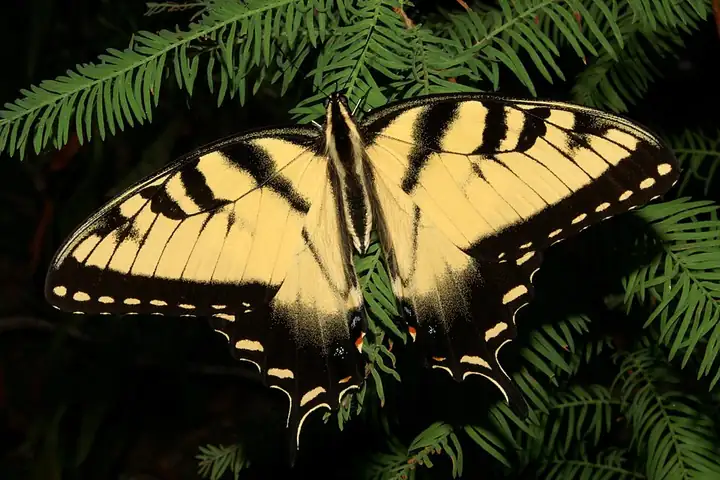
Garden butterflies
Many species (order Lepidoptera), such as tiger swallowtails, painted ladies, red admirals, buckeyes, sulphurs, fritillaries, mourning cloaks, hairstreaks, blues and skippers
| Type | Insect |
|---|---|
| What it does | Pollinator |
| When | Spring through fall; most species peak in mid to late summer. |
| How common it is by region | Very common here: Northeast, Southeast, South Central, Midwest, Great Plains, Mountain West, Southwest, Pacific Northwest, California |
About
Butterflies bring color to the garden and move some pollen from flower to flower as they drink nectar. Each kind needs specific host plants for its caterpillars, so a butterfly garden has both nectar flowers and leaves to eat.
This one is already on your side. Broad sprays kill it along with the pest, which is why the guide puts sprays last.
What it eats
Adults drink nectar, and some also take rotting fruit, sap or minerals from damp soil. Caterpillars eat the leaves of particular host plants, such as violets for fritillaries, thistles and hollyhock for painted ladies, nettles for red admirals and passion vine for the gulf fritillary.
Spotting it
How to find it early
Look on sunny, sheltered flower beds, especially on flat-topped clusters of small flowers. Males often gather on damp sand or mud.
Its young
Eggs are tiny and laid on the host plant. Caterpillars vary a lot; most do light, scattered chewing that plants outgrow.
When
Spring through fall; most species peak in mid to late summer.
Easy to mistake for
- Imported cabbageworm — The cabbage white is a small white butterfly that lays eggs on cabbage, broccoli, kale and other cabbage-family crops; its caterpillar is the imported cabbageworm, a pest.
- Monarch butterfly — The viceroy mimics the monarch but has a black line crossing the hind wing; the queen lacks the monarch's dark wing veins.
Bringing more of them in
Plant groups of the same flower in full sun, with bloom from spring through fall, plus host plants for caterpillars and a damp sandy spot for puddling. Avoid broad-spectrum sprays; Bt kills any caterpillar that eats a sprayed leaf, and soaps and oils kill the ones they touch, so spot-treat only true pests.
Plants that bring it in
Aster, Bee balm, Black-eyed Susan, Blanket flower (gaillardia), Blazing star (liatris), Buttonbush, Coreopsis (tickseed), Cosmos, Garden phlox (tall phlox), Goldenrod, Hollyhock, Lantana (garden), Lilac, Pentas (Egyptian star flower), Purple coneflower (echinacea), Scabiosa (pincushion flower), Sedum (stonecrop), Sunflower, Verbena (garden verbena), Yarrow, Zinnia
Worth knowing
Butterflies are weaker pollinators than bees because they carry little pollen. A few caterpillars nibble garden plants: painted ladies on hollyhock and sunflower, giant swallowtail 'orange dogs' on citrus, and gulf fritillaries on passion vine. The small white cabbage butterfly is a true pest whose caterpillar is the imported cabbageworm.
How common it is by region
| Northeast | Very common here |
|---|---|
| Southeast | Very common here |
| South Central | Very common here |
| Midwest | Very common here |
| Great Plains | Very common here |
| Mountain West | Very common here |
| Southwest | Very common here |
| Pacific Northwest | Very common here |
| California | Very common here |
| Alaska | Common here |
| Hawaii | Common here |
Sources
- fs.usda.gov
- extension.umn.edu
- extension.colostate.edu
- ucanr.edu
- texasinsects.tamu.edu
- hort.extension.wisc.edu
Photo: Photo: Kenneth Dwain Harrelson (HaarFager) / Wikimedia Commons, CC BY-SA 3.0 (CC BY-SA 3.0). Photo resized for the web.

Planting dates and advice are general guidance; check with your local Cooperative Extension office for your area.