
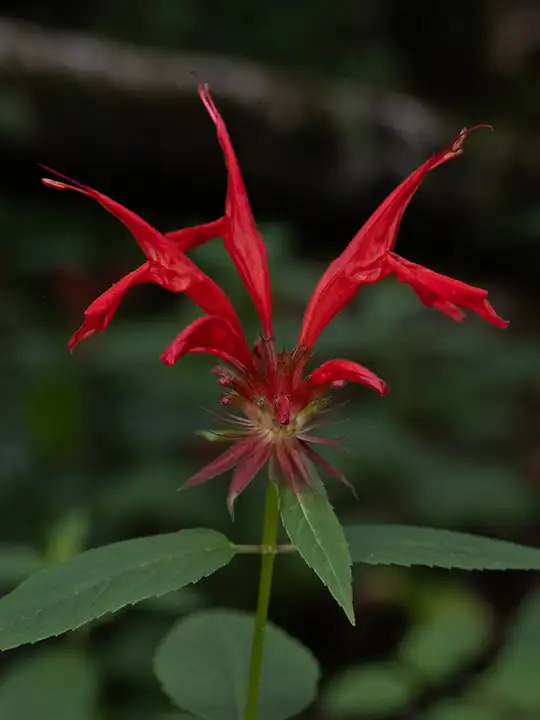
Bee balm
Monarda didyma (scarlet bee balm) and Monarda fistulosa (wild bergamot) · Mint family (Lamiaceae)
| Hardiness zones | 3 to 9 |
|---|---|
| Sun | full sun to part shade |
| Water | moderate |
| Life cycle | perennial |
| Frost | Hardy: takes frost |
| Spacing | 12 to 36 inches |
About Bee balm
Bee balm is a native perennial with shaggy flower heads that bumblebees, butterflies and hummingbirds love. Its minty leaves can be used in tea, and it spreads to form clumps.
Scarlet bee balm is hardy in zones 4-9 and wild bergamot in zones 3-9 (NC State).
Planting
Grow from divisions, cuttings or seed (NC State). Scarlet bee balm spreads by underground stems, so give it room; avoid overhead watering to limit powdery mildew, and choose resistant cultivars (NC State).
Soil
Rich, moist but well-drained soil; wild bergamot also handles clay and drier, rocky soils.
Plant in full sun in rich, moist, well-drained soil that is slightly acidic (pH below 6.8). Follow a soil test; without one, work about 1 lb of a complete fertilizer such as 10-10-10 per 100 sq ft into the bed, plus 2-3 inches of compost or other organic matter. A pH of 6.0 to 6.5 suits most perennials.
Feeding
- early spring, just before new shoots come up (only if growth is weak or a soil test calls for it): complete fertilizer such as 10-10-10 or 5-10-5. Most perennials need little fertilizer; about 1 lb of 10-10-10 per 100 sq ft is plenty. Scatter it around the plants, keep it off the leaves, and water it in.
Look for: a balanced or all-purpose fertilizer at the label rate. Skip high-phosphorus "bloom boosters" unless a soil test shows low phosphorus: most garden soils already have enough, and the extra can wash into streams.
Overfed perennials make soft, floppy growth and very few flowers. Do not let the soil dry out, since drought-stressed plants get more powdery mildew.
Harvest
Pick leaves for tea and flowers for garnish as needed. Leave cut stems standing so native bees can nest in them (NC State).
Varieties (26)
| Variety | Type | Zones | Notes |
|---|---|---|---|
| Blaukranz (Blue Wreath) | Bee balm hybrid | 3–9typical for bee balm | Strong purplish-red flowers. 4 stars with fair to good mildew resistance at Chicago Botanic Garden. Sources: [11] |
| Cambridge Scarlet | Bee balm hybrid | 3–9typical for bee balm | Vivid red flowers. Poor mildew resistance at Chicago Botanic Garden; 2 stars. Sources: [11] |
| Colrain Red | Bee balm hybrid | 3–9typical for bee balm | Deep purplish-red flowers; 3-5 ft tall. A 4-star plant with good mildew resistance at Chicago Botanic Garden, and a Mt. Cuba top performer. Sources: [11][12] |
| Croftway Pink | Bee balm hybrid | 3–9typical for bee balm | Rose-pink flowers. Very poor mildew resistance at Chicago Botanic Garden; 2 stars. Sources: [11] |
| Dark Ponticum | Bee balm hybrid | 3–9typical for bee balm | About 40 inches tall with blue-green leaves and a heavy bloom; slow to establish. Rated 4.5 of 5 at Mt. Cuba; fair mildew resistance, but leaves stayed healthy. Sources: [12][13] |
| Falls of Hill's Creek | Bee balm hybrid | 3–9typical for bee balm | Red flowers. 4 stars at Chicago Botanic Garden, with fair mildew resistance. Sources: [11] |
| Gardenview Scarlet | Bee balm hybrid | 3–9typical for bee balm | True red flowers loved by hummingbirds; about 3-4 ft. Fair mildew resistance at Mt. Cuba (4.0 of 5); fair to good and 4 stars at Chicago Botanic Garden. Sources: [11][14] |
| Grand Marshall | Bee balm hybrid | 3–8 | Deep reddish-purple flowers on a compact plant about 28 inches tall that spreads slowly. Excellent mildew resistance at Mt. Cuba (4.2 of 5). Registered name 'AChall'. Patented as Monarda didyma 'AChall', sold as Grand Marshall. Sources: [15][16] |
| Judith's Fancy Fuchsia | Bee balm hybrid | 3–9typical for bee balm | Vivid purplish-red flowers on tall plants that spread wide. Excellent mildew resistance at Mt. Cuba (4.1 of 5); it edged out look-alikes Raspberry Wine and Colrain Red on disease. Sources: [17] |
| Marshall's Delight | Bee balm hybrid | 4–9typical for Scarlet bee balm (Monarda didyma) | Purplish-pink flowers, about 2.5-4 ft tall. Chicago Botanic Garden's mildew benchmark: no more than 5% infection was ever seen. 4 stars. NC State lists this cultivar under M. didyma, though it is often described as a hybrid. Sources: [1][11] |
| Ohio Glow | Bee balm hybrid | 3–9typical for bee balm | Strong purplish-red flowers. 4 stars with fair to good mildew resistance at Chicago Botanic Garden. Sources: [11] |
| On Parade | Bee balm hybrid | 3–9typical for bee balm | Bright orchid-purple flowers on 4 ft plants; about 4 weeks of bloom. Fair mildew resistance at Mt. Cuba (4.1 of 5); mildew peaked during bloom, then eased. Sources: [18] |
| Petite Delight | Bee balm hybrid | 4–9typical for Scarlet bee balm (Monarda didyma) | Dwarf plant, about 17 inches, with lavender-rose flowers. 3 stars with fair mildew resistance at Chicago Botanic Garden. NC State lists this cultivar under M. didyma, though it is often described as a hybrid. Sources: [1][11] |
| Prairie Night | Bee balm hybrid | 3–9typical for bee balm | Deep purple flowers. Poor mildew resistance at Chicago Botanic Garden; 3 stars. Sources: [11] |
| Purple Mildew Resistant | Bee balm hybrid | 3–9typical for bee balm | Strong purple flowers. Excellent mildew resistance at Chicago Botanic Garden, though only 3 stars overall. Sources: [11] |
| Purple Rooster | Bee balm hybrid | 3–9typical for bee balm | The darkest, truest purple in the Mt. Cuba trial; stiff, upright stems about 44 inches. No powdery mildew was ever seen on it at Mt. Cuba (4.1 of 5). Sources: [19] |
| Raspberry Wine | Bee balm hybrid | 3–9typical for bee balm | Vivid purplish-red flowers on plants about 44 inches tall; mid-July peak. Fair mildew resistance at Mt. Cuba (4.0 of 5); good resistance and 4 stars at Chicago Botanic Garden. Sources: [11][20] |
| Rose Queen | Bee balm hybrid | 3–9typical for bee balm | Purplish-red flowers, about 3.5-4 ft. 4 stars with good mildew resistance at Chicago Botanic Garden. Sources: [11] |
| Rosy-Purple | Bee balm hybrid | 3–9typical for bee balm | Deep purplish-red flowers on tall plants, up to about 5 ft. 4 stars with good mildew resistance at Chicago Botanic Garden. Sources: [11] |
| Violet Queen | Bee balm hybrid | 3–9typical for bee balm | Violet flowers on 4 ft plants; blooms about 4 weeks and is very popular with bees. Excellent mildew resistance at Mt. Cuba (4.4 of 5); good resistance and 4 stars at Chicago Botanic Garden. Sources: [11][21] |
| Scarlet bee balm (species) | M. didyma | 4–9typical for Scarlet bee balm (Monarda didyma) | Red flowers. Poor mildew resistance in both trials; at Mt. Cuba it rated only 1.7 of 5, with weak growth and few flowers. Sources: [1][11][22] |
| Wild bergamot (species) | M. fistulosa | 3–9typical for Wild bergamot (Monarda fistulosa) | Light purple flowers. Very poor mildew resistance in both trials; floppy at Mt. Cuba. Mt. Cuba suggests Claire Grace instead. Sources: [2][11][23] |
| White bergamot | M. fistulosa f. albescens | 3–9typical for Wild bergamot (Monarda fistulosa) | White flowers. Good mildew resistance at Chicago Botanic Garden; 3 stars. Sources: [2][11] |
| Jacob Cline | Scarlet bee balm (M. didyma) | 4–9typical for Scarlet bee balm (Monarda didyma) | Huge 4.5-inch red flowers on vigorous 4 ft plants; by far the hummingbird favorite at Mt. Cuba. Fair mildew resistance at Mt. Cuba (4.0 of 5). Sources: [1][24] |
| Dotted bee balm | Spotted bee balm (M. punctata) | 3–8typical for Spotted bee balm (Monarda punctata) | Yellow flowers with brown spots, stacked in tiers with pink-to-white bracts; about 3 ft. Blooms about 6 weeks. Excellent mildew resistance at Mt. Cuba (4.0 of 5); reliably came back each year there. Sources: [25][26] |
| Claire Grace | Wild bergamot (M. fistulosa) | 3–9typical for Wild bergamot (Monarda fistulosa) | Lavender-purple flowers on a sturdy, upright plant about 4 ft tall with glossy leaves. Heavy pollinator traffic. Top-rated at Mt. Cuba (4.5 of 5) with good mildew resistance, but rated poor for mildew (2 stars) at Chicago Botanic Garden. Sources: [2][11][12][27] |
Diseases and problems
In the kitchen
Leaves are used in tea and to flavor jellies, soups and fruit salads; the flowers are edible (NC State).
Keeping it: Pick edible flowers the day you use them; if you must hold them, keep them in a plastic bag in the fridge for a day or so.
Pets: Not listed as toxic by the ASPCA
Sources
- plants.ces.ncsu.edu
- plants.ces.ncsu.edu
- aspca.org
- aspca.org
- extension.psu.edu
- extension.illinois.edu
- extension.illinois.edu
- extension.psu.edu
- extension.illinois.edu
- hgic.clemson.edu
- chicagobotanic.org
- mtcubacenter.org
- mtcubacenter.org
- mtcubacenter.org
- mtcubacenter.org
- patents.google.com
- mtcubacenter.org
- mtcubacenter.org
- mtcubacenter.org
- mtcubacenter.org
- mtcubacenter.org
- mtcubacenter.org
- mtcubacenter.org
- mtcubacenter.org
- mtcubacenter.org
- plants.ces.ncsu.edu
- mtcubacenter.org
Photo: Photo: Alex Abair, CC BY 4.0, via Wikimedia Commons (CC BY 4.0). Photo resized for the web.

Planting dates and advice are general guidance; check with your local Cooperative Extension office for your area.