
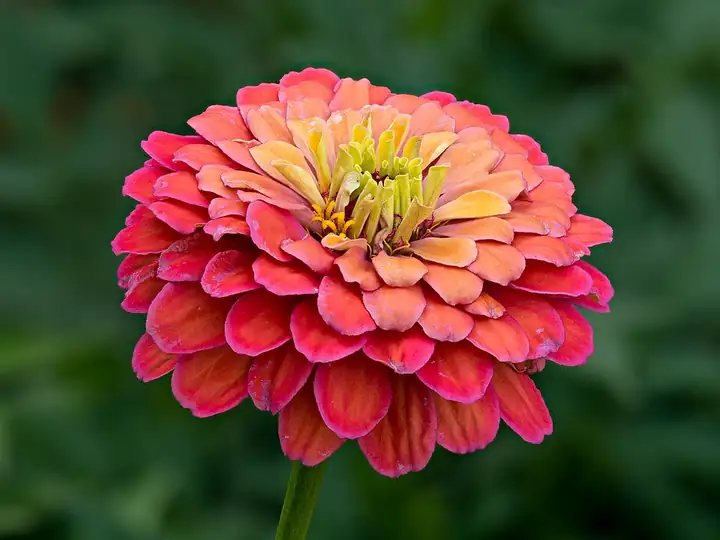
Zinnia
Zinnia elegans; some listed varieties are narrowleaf zinnia (Z. angustifolia), Z. haageana or the Profusion/Zahara hybrids · Daisy family (Asteraceae)
When to plant: Start seeds indoors 4 to 6 weeks before the last frost, set out plants up to 2 weeks after the last frost and sow seeds outdoors up to 2 weeks after the last frost.
| Hardiness zones | 2 to 11 |
|---|---|
| Sun | full sun |
| Water | moderate |
| Life cycle | annual |
| Frost | Tender: killed by frost |
| Spacing | 12 to 36 inches |
| Soil temperature to plant | at least 65°F |
About Zinnia
Zinnias are summer annuals with bright flowers in many colors, easy to sow right in the garden once frost is past. They draw butterflies, hummingbirds and bees, including some specialist native bees.
Grown as a summer annual in every zone; frost kills it.
When to plant
Timing is counted from your average last spring frost (and first fall frost). Sow & Tell works out the actual dates for your ZIP code.
- Start seeds indoors: 4 to 6 weeks before the last frost
- Set out plants: up to 2 weeks after the last frost
- Sow seeds outdoors: up to 2 weeks after the last frost
Sow directly after the danger of frost has passed, or start indoors 4-6 weeks earlier; seed germinates at 65-70 F. Give plants room for air to move to limit powdery mildew.
Soil
Well-drained loam or soil high in organic matter; tolerates a wide pH range.
Follow a soil test; zinnias like fertile, well-drained soil rich in organic matter with a pH of 5.5 to 7.5. Work compost into heavy soil.
Feeding
- monthly after planting: fertilizer with more phosphorus than nitrogen, such as 5-10-5. Feed about once a month at the label rate to keep new blooms coming, and water it in.
Look for: a balanced or all-purpose fertilizer at the label rate. Skip high-phosphorus "bloom boosters" unless a soil test shows low phosphorus: most garden soils already have enough, and the extra can wash into streams.
Harvest
Cut or deadhead spent blooms to keep more coming; 'Profusion' types need no deadheading.
Varieties (24)
| Variety | Type | Notes |
|---|---|---|
| Benary's Giant series | Common zinnia (Zinnia elegans) | Tall cut-flower zinnia, 36-42 in (NC State says up to 4 ft), with 5 in double flowers in many colors including lime. Bred for cutting, with improved vase life. Sources: [1][2] |
| California Giant Mix | Common zinnia (Zinnia elegans) | 3-4 ft tall with large double flowers in orange, pink, purple, red, white and yellow. Sources: [2] |
| Crestar Mix | Common zinnia (Zinnia elegans) | 18-24 in plants with semi-double, crested (scabiosa-type) flowers in warm and pastel colors. 2025 All-America Selections winner; good for cutting. Sources: [2] |
| Envy | Common zinnia (Zinnia elegans) | About 2 ft tall with large, semi-double pale green flowers. Sources: [2] |
| Holi series | Common zinnia (Zinnia elegans) | F1 hybrids 12-14 in tall with 3-3.5 in flowers. Described as very heat and disease tolerant. 'Holi Scarlet' was a 2019 AAS winner and 'Holi Pink' a 2020 AAS Southeast regional winner. Sources: [2] |
| Lilliput | Common zinnia (Zinnia elegans) | 18-24 in plants with small pompom-like flowers. Sources: [1] |
| Magellan series | Common zinnia (Zinnia elegans) | Early-blooming F1 hybrids 12-14 in tall with large flowers in many colors. 'Magellan Coral' was a 2005 AAS winner; NC State notes good leaf spot resistance in 'Magellan Orange'. Sources: [1][2] |
| Oklahoma series | Common zinnia (Zinnia elegans) | About 3 ft tall with 2 in semi-double to double flowers; bred for cutting. Good vase life; Illinois Extension says it is less prone to powdery mildew than other large cut-flower zinnias. Sources: [2][6] |
| Purple Prince | Common zinnia (Zinnia elegans) | Tall, 36-48 in, with lavender-purple flowers that keep coming. Sources: [1] |
| Queeny Lime Orange | Common zinnia (Zinnia elegans) | 1.5-2 ft plants with 2-4 in dahlia-like double flowers that open coral-orange and fade to peach with lime tones. 2018 All-America Selections winner. Wisconsin Extension lists the Queeny series at 30-40 in; 'Queeny Lemon Peach' was a 2022 AAS Northeast regional winner. Sources: [2][7] |
| State Fair Mix | Common zinnia (Zinnia elegans) | Tetraploid zinnia 3-4 ft tall with large flowers (NC State says 5 in) for cutting. Wisconsin Extension notes good tolerance of powdery mildew and alternaria leaf spot. Sources: [1][2] |
| Thumbelina | Common zinnia (Zinnia elegans) | Tiny plants 4-6 in tall with pastel flowers; good for edging and containers. 1963 All-America Selections Gold Medal. Sources: [1][2] |
| Zowie! Yellow Flame | Common zinnia (Zinnia elegans) | 24-28 in F1 hybrid with bright bicolor semi-double flowers. 2006 All-America Selections winner; makes an excellent cut flower. Sources: [2] |
| Old Mexico | Mexican zinnia (Z. haageana) | 12-18 in plants with 2.5 in red-orange flowers tipped golden yellow. 1962 All-America Selections winner. Sources: [2] |
| Persian Carpet | Mexican zinnia (Z. haageana) | 12-16 in plants with small single and bicolor flowers in yellow, orange and red. 1952 All-America Selections winner. Sources: [2] |
| Crystal White | Narrowleaf zinnia (Z. angustifolia) | Low, spreading narrowleaf zinnia 6-8 in tall and 10-12 in wide with small white daisy flowers. 1997 All-America Selections winner; the Crystal series has good tolerance of powdery mildew. Sources: [1][2] |
| Star series | Narrowleaf zinnia (Z. angustifolia) | Narrowleaf zinnia about 14 in tall with star-shaped single flowers in gold, orange or white. Sources: [1][2] |
| Double Zahara series | Zinnia hybrid (Z. marylandica) | 16-20 in tall and wide with large double flowers in orange, cherry, fire, salmon, white, yellow and a pink-striped form. 'Double Zahara Cherry' and 'Double Zahara Fire' were both 2010 AAS winners. Sources: [2][8] |
| Profusion Double series | Zinnia hybrid (Z. marylandica) | Same compact habit as Profusion but with semi-double flowers in salmon, cherry, gold, red, white and yellow. 'Deep Salmon' and 'Hot Cherry' were 2013 AAS winners; 'White Improved' won a 2026 AAS Gold Medal. Sources: [2][8] |
| Profusion Orange | Zinnia hybrid (Z. marylandica) | 11-12 in tall, spreading about 20 in, with single orange flowers 2-3 in across. 1999 All-America Selections Gold Medal. Takes heat and drought and needs no deadheading. Sources: [2][9] |
| Profusion series | Zinnia hybrid (Z. marylandica) | Compact, well-branched plants about 12 in tall and 20-24 in wide; single flowers in many colors from white to cherry, orange and red. A cross of common and narrowleaf zinnia bred for clean leaves; resists powdery mildew plus alternaria, cercospora and bacterial leaf spots. AAS winners include 'Cherry' and 'Orange' (1999 Gold Medals), 'White' (2001 Gold Medal), 'Red' (2017) and 'Red Yellow Bicolor' (2021). Sources: [2][8] |
| Zahara series | Zinnia hybrid (Z. marylandica) | 12-18 in tall and wide with large single flowers in cherry, fire, raspberry, red, white, yellow and bicolors. Bred for strong disease resistance; Illinois Extension notes resistance to leaf spot and mildew, so plants last longer into fall. Sources: [2][6][8] |
| Zahara Starlight Rose | Zinnia hybrid (Z. marylandica) | 12-14 in plants with 2.5 in white flowers striped rose. 2010 All-America Selections winner, noted for resisting leaf spot and mildew, plus heat and drought. Sources: [2][10] |
| Zydeco series | Zinnia hybrid (Z. marylandica) | Compact, well-branched plants 14-20 in tall and wide with large double flowers. 'Zydeco Fire', a burnt-orange double, was a 2025 AAS winner. Sources: [2] |
Pests to watch for
Tarnished plant bug, Four-lined plant bug, Tobacco budworm (geranium or petunia budworm)
Diseases and problems
Powdery mildew, Alternaria leaf spot of zinnia, White mold, Bacterial leaf spot, Tobacco mosaic and tomato mosaic, Cucumber mosaic, Lettuce mosaic, Turnip mosaic
In the kitchen
Keeping it: Put cut stems right into water with flower food; zinnias last about 7-10 days and don't mind sitting near fruit.
Pets: Not toxic to dogs, cats or horses (ASPCA)
Sources
- plants.ces.ncsu.edu
- hort.extension.wisc.edu
- aspca.org
- extension.umn.edu
- hgic.clemson.edu
- extension.illinois.edu
- all-americaselections.org
- utgardens.tennessee.edu
- all-americaselections.org
- all-americaselections.org
Photo: Photo: Reinhold Möller, CC BY-SA 4.0, via Wikimedia Commons (CC BY-SA 4.0). Photo resized for the web.

Planting dates and advice are general guidance; check with your local Cooperative Extension office for your area.