
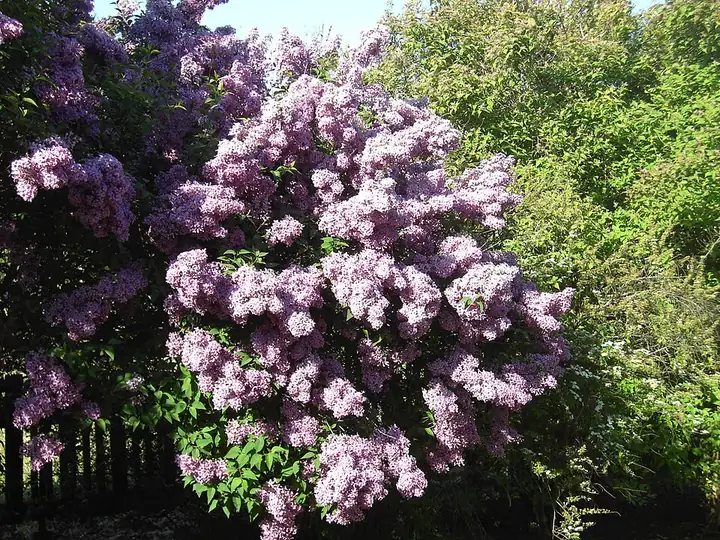
Lilac
Syringa vulgaris (common lilac) and other Syringa species and hybrids · Olive family (Oleaceae)
| Hardiness zones | 3 to 7 |
|---|---|
| Sun | full sun |
| Water | moderate |
| Life cycle | perennial |
| Frost | Hardy: takes frost |
| Soil pH | 7.0–7.5 |
About Lilac
Lilacs are cold-hardy deciduous shrubs famous for sweet-smelling spring flower clusters. Common lilac comes from the Balkans; smaller Korean and Meyer lilacs, early-blooming hybrids, and the tree-sized Japanese tree lilac give more choices. Butterflies, hummingbirds and bees visit the flowers.
Most lilacs grow in zones 3-7 and need cold winters; the early hybrid 'Excel' is rated to zone 9 and 'Angel White' is a low-chill choice (NC State).
Planting
Space plants by their mature size so air moves through and mildew stays down, and water well after planting (UMN). Young plants often don't flower their first year or two (UMN). Grafted plants can send up rootstock suckers; remove them (NC State).
Soil
Moist, well-drained soil that is neutral to slightly alkaline; lilacs will not tolerate soggy ground (UMN, NC State).
Choose a sunny spot with moist, well-drained, neutral to slightly alkaline soil (about pH 7.0); lilacs will not grow in soggy ground (UMN).
Feeding
- Every few years, once plants are 2-3 years old, in spring: all-purpose shrub fertilizer. Light feeding only, following the label and a soil test (UMN).
Look for: a balanced or all-purpose fertilizer at the label rate. Skip high-phosphorus "bloom boosters" unless a soil test shows low phosphorus: most garden soils already have enough, and the extra can wash into streams. - Right after flowering each year: deadheading and renewal pruning. Cut spent clusters back to a pair of leaves and remove about one-third of the oldest, thickest stems at the base (UMN).
Look for: a balanced or all-purpose fertilizer at the label rate. Skip high-phosphorus "bloom boosters" unless a soil test shows low phosphorus: most garden soils already have enough, and the extra can wash into streams.
Don't let high-nitrogen lawn fertilizer reach lilacs; too much nitrogen and too little sun are common reasons they don't bloom, along with pruning at the wrong time (UMN).
Harvest
Most lilacs bloom mid to late spring; early hybrids flower up to 10 days sooner and Japanese tree lilac waits until June. Deadhead right after bloom by cutting spent clusters back to a pair of leaves, and do any pruning then, because next year's buds form over summer (UMN).
Varieties (20)
| Variety | Type | Season and days | Zones | Notes |
|---|---|---|---|---|
| Agincourt Beauty | Common lilac (S. vulgaris) | Mid to late spring | 3–7 | Large purple flowers. Sources: [2] |
| Angel White | Common lilac (S. vulgaris) | Mid-spring | 3–7typical for lilac | White; needs less winter chill, so it suits warmer areas. Sources: [2] |
| Betsy Ross | Common lilac (S. vulgaris) | Mid-spring | 3–7typical for lilac | Sources: [1] |
| Ludwig Spaeth | Common lilac (S. vulgaris) | Mid-spring | 3–7 | Dark purple single flowers. Sources: [1][2] |
| Madame Lemoine | Common lilac (S. vulgaris) | Mid-spring | 3–7typical for lilac | Sources: [1] |
| Sensation | Common lilac (S. vulgaris) | Mid-spring | 3–7 | Purple flowers edged in white. Sources: [1][2] |
| Wonderblue | Common lilac (S. vulgaris) | Mid-spring | 3–7typical for lilac | Sources: [1] |
| Excel | Early hybrid lilac (S. x hyacinthiflora) | Early spring, up to 10 days before common lilac | 3–9 | Heat tolerant; the hyacinthiflora group resists powdery mildew. Sources: [4] |
| Maiden's Blush | Early hybrid lilac (S. x hyacinthiflora) | Early spring | 3–7 | Light pink. Sources: [4] |
| Mount Baker | Early hybrid lilac (S. x hyacinthiflora) | Early spring | 3–7 | White. Sources: [4] |
| Ivory Silk | Japanese tree lilac (S. reticulata) | June | 3–7 | Small tree with upright oval shape and creamy white flowers; resists powdery mildew, borers, scale and bacterial blight. This is Japanese tree lilac (Syringa reticulata), which Maine lists as invasive in some habitats; it is legal to sell, but keep it away from woods and wild areas there. [8][9] Sources: [3] |
| Summer Snow | Japanese tree lilac (S. reticulata) | June | 3–7 | Rounded, compact tree with large flower clusters. This is Japanese tree lilac (Syringa reticulata), which Maine lists as invasive in some habitats; it is legal to sell, but keep it away from woods and wild areas there. [8][9] Sources: [3] |
| Josee | Lilac hybrid | Spring, with fall rebloom | 3–7typical for lilac | Pale purple-pink; reblooms in fall. Sources: [2] |
| Tinkerbelle | Lilac hybrid | Mid-spring | 3–7 | Compact, disease resistant; wine-red buds open pink with a spicy scent. Sources: [1][5] |
| Miss Kim | Manchurian lilac (S. pubescens subsp. patula) | Mid to late spring | 3–7typical for lilac | Sources: [1] |
| Palibin | Meyer lilac (S. meyeri / S. pubescens) | Mid-May | 3–7 | Dwarf, dense shrub; reddish buds open to whitish pink; strong powdery mildew resistance. Sources: [1][5] |
| Sugar Plum Fairy | Meyer lilac (S. pubescens) | Mid-May, sporadic summer rebloom | 3–7 | Compact with rosy lilac flowers. Sources: [5] |
| Minuet | Preston lilac (S. x prestoniae) | Late spring (after common lilac) | 3–7typical for lilac | Sources: [1] |
| Miss Canada | Preston lilac (S. x prestoniae) | Late spring (after common lilac) | 3–7typical for lilac | Sources: [1] |
| Bloomerang | Reblooming lilac hybrid | Spring and again in late summer | 3–7typical for lilac | Reblooms. Sources: [1] |
Pests to watch for
Diseases and problems
Powdery mildew, Bacterial blight, Leaf spot, Black walnut toxicity
In the kitchen
NC State notes the flowers are edible raw or fried as fritters; eat only blooms grown without pesticides.
Pets: Not listed by the ASPCA. Don't confuse it with "Persian lilac" (chinaberry, Melia azedarach), a different tree the ASPCA lists as toxic to dogs, cats and horses.
Sources
- extension.umn.edu
- plants.ces.ncsu.edu
- plants.ces.ncsu.edu
- plants.ces.ncsu.edu
- plants.ces.ncsu.edu
- aspca.org
- aspca.org
- maine.gov
- maine.gov
Photo: Photo: Plrk, Public domain, via Wikimedia Commons. Photo resized for the web.

Planting dates and advice are general guidance; check with your local Cooperative Extension office for your area.