
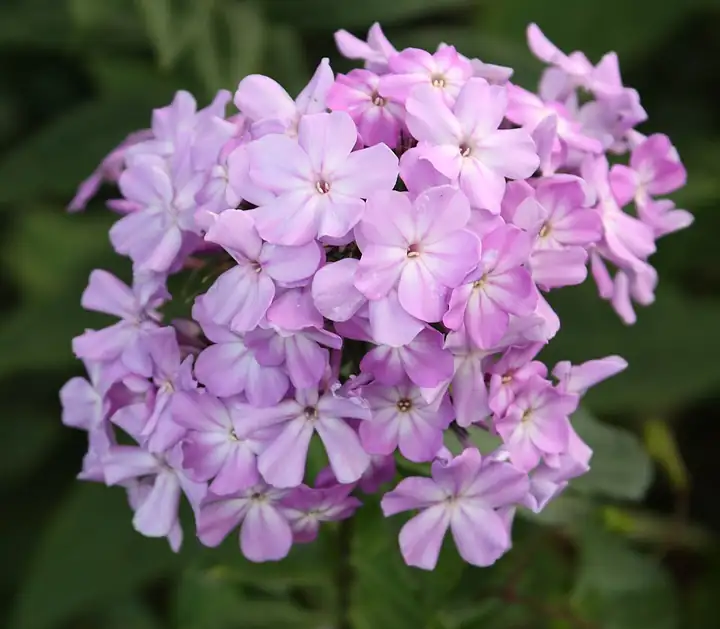
Garden phlox (tall phlox)
Phlox paniculata · Phlox family (Polemoniaceae)
| Hardiness zones | 4 to 8 |
|---|---|
| Sun | full sun to part shade |
| Water | moderate |
| Life cycle | perennial |
| Frost | Hardy: takes frost |
| Spacing | 12 to 36 inches |
About Garden phlox (tall phlox)
Garden phlox is an eastern US native with big, fragrant clusters of flowers from midsummer into fall. Hummingbirds, butterflies, moths and bees all visit. Older kinds are known for powdery mildew, so choose one of the many mildew-resistant cultivars that trials have found, like 'Jeana', 'David' or 'Shortwood'.
Native from New York to Iowa and south to Georgia and Arkansas; hardy in zones 4-8.
Planting
Grow from divisions or cuttings; named cultivars do not come true from seed. Give plants space and sun so air moves through them, which helps keep powdery mildew down (Penn State; UVM). Divide crowded clumps to open them up (Iowa State).
Soil
Moist, well-drained soil rich in organic matter; it grows in clay or loam (NC State).
Follow a soil test; work 2-3 inches of compost into the top 4-6 inches of soil and aim for pH 6.0-6.5 (Clemson).
Feeding
- early spring, before new growth starts: slow-release complete fertilizer such as 12-6-6. Scatter 1-2 lb per 100 sq ft and water it in (Clemson).
Look for: a balanced or all-purpose fertilizer at the label rate. Skip high-phosphorus "bloom boosters" unless a soil test shows low phosphorus: most garden soils already have enough, and the extra can wash into streams. - about 6 weeks after the spring feeding: slow-release complete fertilizer such as 12-6-6. Repeat the spring rate if you want more growth (Clemson).
Look for: a balanced or all-purpose fertilizer at the label rate. Skip high-phosphorus "bloom boosters" unless a soil test shows low phosphorus: most garden soils already have enough, and the extra can wash into streams.
Crowded, shaded plants get powdery mildew; give them sun and air (UVM; Penn State).
Harvest
Blooms from July into September. Cut off faded flower clusters to keep blooms coming and to stop self-sown seedlings, which revert to dull pastel colors over time (Penn State).
Varieties (19)
| Variety | Type | Season and days | Zones | Notes |
|---|---|---|---|---|
| Babyface | Mildew-resistant | 4–8typical for garden phlox | Pink flowers with a dark eye. Sources: [4] | |
| Blue Flame | Mildew-resistant | 4–8typical for garden phlox | Light blue flowers on short 12-20 in plants. Sources: [3] | |
| Coral Creme Drop ('Ditomdre') | Mildew-resistant | Mid-July to late August | 4–8typical for garden phlox | Salmon-pink flowers; about 3 ft tall. Sources: [4][5] |
| David | Mildew-resistant | Early July to early August | 4–8typical for garden phlox | White flowers; about 34 in tall. 2002 Perennial Plant of the Year and a garden standard for over 20 years. Sources: [2][3][4][5] |
| Delta Snow | Mildew-resistant | Early July to late August | 4–8typical for garden phlox | White flowers with a purple to soft pink eye; about 4 ft tall. Sources: [1][4][5] |
| Dick Weaver | Mildew-resistant | Early July to late August | 4–8typical for garden phlox | Magenta flowers; about 4 ft tall. Sources: [4][5] |
| Frosted Elegance | Mildew-resistant | 4–8typical for garden phlox | White flowers with pink centers over white-edged (variegated) leaves. Sources: [4][6] | |
| Glamour Girl | Mildew-resistant | Early July to late August | 4–8typical for garden phlox | Coral-pink flowers; about 3 ft tall. Sources: [4][5] |
| Goliath | Mildew-resistant | 4–8typical for garden phlox | Purple flowers; 26-30 in tall. Sources: [3] | |
| Jeana | Mildew-resistant | Mid-July to early September | 4–8typical for garden phlox | Fragrant lavender-pink flowers over a long season; about 5 ft tall and 4 ft wide. Top-rated phlox in Mt. Cuba's trial; 2024 Perennial Plant of the Year. Sources: [1][2][4][5] |
| John Fanick | Mildew-resistant | 4–8typical for garden phlox | Light pink flowers with a darker eye. Sources: [4][6] | |
| Katherine | Mildew-resistant | 4–8typical for garden phlox | Lilac-blue flowers with white centers. Sources: [4] | |
| Lavelle | Mildew-resistant | Early July to early September | 4–8typical for garden phlox | White flowers with a pale pink center; about 4 ft tall. Sources: [4][5] |
| Orange Perfection | Mildew-resistant | 4–8typical for garden phlox | Salmon-orange flowers; about 3 ft tall. Sources: [3][4] | |
| Peppermint Twist | Mildew-resistant | 4–8typical for garden phlox | Pink and white striped flowers. Sources: [4][6] | |
| Robert Poore | Mildew-resistant | Early July to mid-August | 4–8typical for garden phlox | Violet-pink flowers on 5 ft plants. Sources: [4][5] |
| Shortwood | Mildew-resistant | Mid-July to early October | 4–8typical for garden phlox | Rosy pink flowers on 50-54 in stems. The only 5-star phlox in the Chicago Botanic Garden trial, and among its most mildew-resistant every year. Sources: [4][5][6] |
| David's Lavender | 4–8typical for garden phlox | Lavender flowers. Sources: [1] | ||
| Lord Clayton | 4–8typical for garden phlox | Bright magenta-red flowers. Sources: [1] |
Pests to watch for
Diseases and problems
Powdery mildew, Phytophthora root rot, Black root rot, Cucumber mosaic
In the kitchen
Pets: We found no ASPCA entry for garden phlox, so we can't say it is pet-safe; discourage pets from chewing it.
Sources
- plants.ces.ncsu.edu
- extension.psu.edu
- uvm.edu
- yardandgarden.extension.iastate.edu
- mtcubacenter.org
- chicagobotanic.org
- aspca.org
- aspca.org
- aspca.org
- hgic.clemson.edu
- extension.psu.edu
Photo: Photo: Frank K., CC BY 2.0, via Wikimedia Commons (CC BY 2.0). Photo resized for the web.

Planting dates and advice are general guidance; check with your local Cooperative Extension office for your area.