
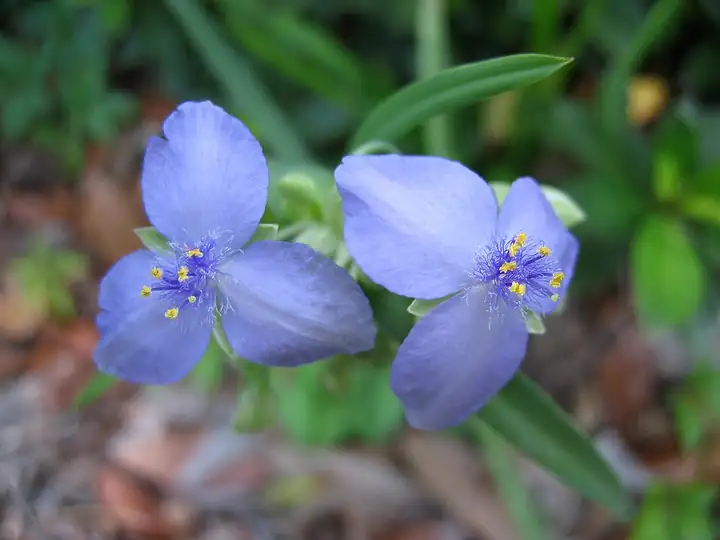
Spiderwort
Tradescantia ohiensis (Ohio spiderwort, bluejacket), T. virginiana (Virginia spiderwort) and the Andersoniana hybrids (T. x andersoniana) · Spiderwort family (Commelinaceae)
When to plant: Easiest from divisions or cuttings: divide clumps in early fall or very early spring into pieces with 4-6 shoots and roots, and replant right away (USDA NRCS, Wildflower Center).
| Hardiness zones | 4 to 9 |
|---|---|
| Sun | full sun to part shade |
| Water | moderate |
| Life cycle | perennial |
| Frost | Hardy: takes frost |
| Spacing | 12 to 36 inches |
About Spiderwort
Spiderworts are easygoing native perennials with grassy, arching leaves and clusters of three-petaled blue, purple, pink or white flowers that each open for just one morning, with new ones every day from late spring into summer (Penn State, NC State). Ohio spiderwort grows wild from Massachusetts to southeast Minnesota and south to Florida and east Texas, and Virginia spiderwort across the east-central and eastern U.S.; the garden Andersoniana hybrids are more compact (Wildflower Center, NC State, Penn State). They spread by creeping stems and seed and can take over a bed, so give them room or divide them often.
Hardy in zones 4-9 (NC State, Penn State). Not listed as invasive in the U.S., but garden spiderworts can spread aggressively by runners and seed (Penn State), and Virginia spiderwort has escaped in parts of California and Europe (NC State). Wild Virginia spiderwort is getting scarcer in the Carolinas, so buy nursery-propagated plants (NC State).
When to plant
Easiest from divisions or cuttings: divide clumps in early fall or very early spring into pieces with 4-6 shoots and roots, and replant right away (USDA NRCS, Wildflower Center).
Seed needs about 120 days of cold, moist treatment, or sow it unstratified outdoors in fall (Wildflower Center). No sourced day count to first bloom.
Soil
Moist, fertile soil is best, but it adapts to average, sandy, clay or occasionally wet soil and short dry spells; good in rain gardens. Give it shelter from hot afternoon sun (Penn State, NC State).
Work some compost into the bed; spiderworts like moist, fertile soil but adapt to average garden soil (NC State, USDA NRCS).
Feeding
- Early spring, just before new shoots come up (only if a soil test or weak growth calls for it): complete slow-release fertilizer such as 12-6-6. Without a soil test, Clemson suggests 1-2 lb per 100 sq ft of bed for perennials; keep it off the leaves and water it in.
Look for: a balanced or all-purpose fertilizer at the label rate. Skip high-phosphorus "bloom boosters" unless a soil test shows low phosphorus: most garden soils already have enough, and the extra can wash into streams.
Most perennials need little fertilizer, and overfed plants grow soft with few flowers (Penn State). Divide every 2-4 years and pull stems that lie on the ground before they root, or the patch will spread (USDA NRCS).
Harvest
Blooms May into July, often with a second flush in late summer or fall (Penn State, NC State). Each flower lasts a day and opens in the morning. When the foliage flops after bloom (often early July), cut plants back to a few inches; fresh leaves and often more flowers follow (Penn State, USDA NRCS). Good for cutting (NC State).
Varieties (18)
| Variety | Type | Season and days | Zones | Notes |
|---|---|---|---|---|
| Bilberry Ice | Andersoniana hybrid (T. x andersoniana) | Late spring-summer | 4–9typical for spiderwort | Blue-purple to lavender flowers on a short plant, 6-12 in. Sources: [3] |
| Blushing Bride | Andersoniana hybrid (T. x andersoniana) | Late spring-summer | 4–9typical for spiderwort | Pink flowers on a short plant, 6-12 in. Sources: [3] |
| Charlotte's Web | Andersoniana hybrid (T. x andersoniana) | Late spring-summer | 4–9typical for spiderwort | Soft blue flowers over gold leaves that resist scorching in full sun. Sources: [4] |
| Concord Grape | Andersoniana hybrid (T. x andersoniana) | Late spring-summer | 4–9typical for spiderwort | Medium purple flowers; 12-18 in. Sources: [3] |
| Hawaiian Punch | Andersoniana hybrid (T. x andersoniana) | Late spring-summer | 4–9typical for spiderwort | Bright red-purple flowers; 12-18 in. Sources: [3] |
| Innocence | Andersoniana hybrid (T. x andersoniana) | Late spring-summer | 4–9typical for spiderwort | White flowers, larger than most; 18-24 in. Sources: [3] |
| Iris Pritchard | Andersoniana hybrid (T. x andersoniana) | Late spring-summer | 4–9typical for spiderwort | White to off-white flowers; 18-24 in. Sources: [3] |
| J.C. Weguelin | Andersoniana hybrid (T. x andersoniana) | Late spring-summer | 4–9typical for spiderwort | Light blue-lavender flowers; 12-18 in. Sources: [3] |
| Leonora | Andersoniana hybrid (T. x andersoniana) | Late spring-summer | 4–9typical for spiderwort | Violet-blue flowers; 18-24 in. Sources: [3] |
| Little Doll | Andersoniana hybrid (T. x andersoniana) | Late spring-summer | 4–9typical for spiderwort | Miniature with light blue flowers; 6-12 in. Sources: [3] |
| Pauline | Andersoniana hybrid (T. x andersoniana) | Late spring-summer | 4–9typical for spiderwort | Lavender flowers on a taller plant, 24-36 in. Sources: [3] |
| Perrine's Pink | Andersoniana hybrid (T. x andersoniana) | Late spring-summer | 4–9typical for spiderwort | Bright pink-purple flowers; 12-18 in. Sources: [3] |
| Purple Profusion | Andersoniana hybrid (T. x andersoniana) | Late spring-summer | 4–9typical for spiderwort | Medium purple flowers on a short plant, 6-12 in. Often confused with Ohio spiderwort (NC State). Sources: [2][3] |
| Red Grape | Andersoniana hybrid (T. x andersoniana) | Late spring-summer | 4–9typical for spiderwort | Reddish-purple flowers; 12-18 in. Sources: [3] |
| Rubra | Andersoniana hybrid (T. x andersoniana) | Late spring-summer | 4–9typical for spiderwort | Pink-purple to red-purple flowers; 18-24 in. Sources: [3] |
| Snow Cap | Andersoniana hybrid (T. x andersoniana) | Late spring-summer | 4–9typical for spiderwort | White flowers; 18-24 in. Sources: [3] |
| Sweet Kate ('Blue and Gold') | Andersoniana hybrid (T. x andersoniana) | Late spring-summer | 4–9typical for spiderwort | Blue-violet to lavender-purple flowers over yellow-chartreuse leaves; 18-24 in. Cut back after flowering to keep it tidy and coax more blooms (Penn State). Sources: [3][4] |
| Zwanenberg Blue | Andersoniana hybrid (T. x andersoniana) | Late spring-summer | 4–9typical for spiderwort | Blue-violet flowers on a short plant, 6-12 in. Sources: [3] |
Good neighbors
Penn State suggests butterfly weed, whorled milkweed and scarlet bee balm to hide spiderwort's untidy summer foliage; this is a design pairing, not a pest-control claim.
Pests to watch for
Diseases and problems
In the kitchen
Safety: NC State rates Virginia spiderwort as mildly toxic: eating it can upset the mouth and stomach, and the sap can redden and itch sensitive skin, so wear gloves. Some sources call the young leaves edible, but because sources disagree we don't suggest eating it.
Pets: Garden spiderworts are not listed by the ASPCA (no spiderwort entry on its dog, cat or horse lists). The ASPCA does list a related houseplant, inch plant (Tradescantia fluminensis), as toxic to dogs, cats and horses, causing skin irritation (dermatitis), and NC State lists Virginia spiderwort as mildly toxic to dogs and cats.
Sources
- plants.ces.ncsu.edu
- plants.ces.ncsu.edu
- plants.ces.ncsu.edu
- extension.psu.edu
- wildflower.org
- plants.sc.egov.usda.gov
- aspca.org
- aspca.org
- aspca.org
- aspca.org
- aspca.org
- aspca.org
- extension.rutgers.edu
- hgic.clemson.edu
- extension.psu.edu
Photo: Photo: Jon Zander (Digon3) / Wikimedia Commons, CC BY-SA 3.0 (CC BY-SA 3.0). Photo resized for the web.

Planting dates and advice are general guidance; check with your local Cooperative Extension office for your area.