
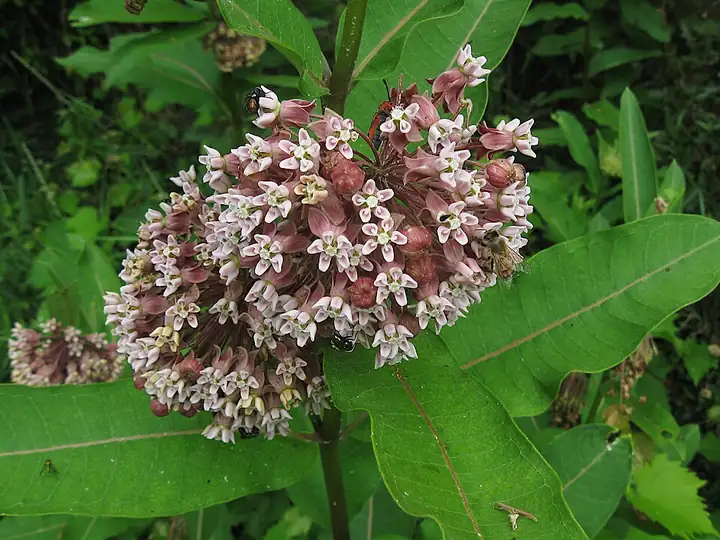
Milkweed
Asclepias tuberosa (butterfly weed), A. incarnata (swamp milkweed) and A. syriaca (common milkweed) · Dogbane family (Apocynaceae)
| Hardiness zones | 3 to 9 |
|---|---|
| Sun | full sun |
| Water | low |
| Life cycle | perennial |
| Frost | Hardy: takes frost |
| Spacing | 12 to 72 inches |
About Milkweed
Milkweeds are native perennials and the only plants monarch caterpillars can eat. Butterfly weed suits dry, sunny beds, swamp milkweed handles wet soil, and common milkweed spreads widely by roots.
All three species are hardy in zones 3-9 (NC State).
Planting
Grow from seed or root cuttings (USDA Forest Service). Seed needs cold stratification, and butterfly weed takes 2-3 years to flower; its deep taproot makes established plants hard to move (NC State). Common milkweed spreads and needs room; swamp milkweed needs 3-6 feet.
Soil
Butterfly weed and common milkweed like well-drained to dry soil, even poor soil; swamp milkweed tolerates moist, occasionally wet soil.
Plant in full sun in average, well-drained soil (swamp milkweed likes moist to wet soil); sow seed in loose soil after shallow cultivation. No fertilizer is needed.
Feeding
Look for: a balanced or all-purpose fertilizer at the label rate. Skip high-phosphorus "bloom boosters" unless a soil test shows low phosphorus: most garden soils already have enough, and the extra can wash into streams.
Milkweed generally needs no fertilizer. Keep weeds down, avoid overwatering, and do not use insecticides or herbicides near it.
Harvest
Grown for monarchs and pollinators rather than a harvest. Leave the leaves for caterpillars; milkweed bugs feed on seed pods (NC State).
Varieties (11)
Few named milkweed cultivars are described in extension sources, so this list is mostly species. Milkweeds are host plants for monarch caterpillars. NRCS recommends seed or plants from a local source.
| Variety | Type | Season and days | Zones | Notes |
|---|---|---|---|---|
| Swamp milkweed | A. incarnata | 3–9 | Pink or white flowers on 3-5 ft plants. A good choice for moist soils. Sources: [2] | |
| Showy milkweed | A. speciosa | 3–9typical for milkweed | Rose-purple flowers with pink hoods on 4-5 ft plants in sunny, dry sites. Native from California and British Columbia to Texas. Sources: [9] | |
| Common milkweed | A. syriaca | 3–9 | Big, rounded clusters of pinkish flowers on 3-5 ft stems. Spreads by roots and seed and can take over, so give it room. Tolerates poor, dry soils. Sources: [3] | |
| Butterfly weed | A. tuberosa | Blooms May to August | 3–9 | Bright orange to yellow-orange flowers on 1-2 ft plants. Drought-tolerant and deer-resistant. Deep taproot, so it moves poorly once planted. 2017 Perennial Plant of the Year. A yellow form also exists. Sources: [1] |
| Whorled milkweed | A. verticillata | 4–9 | Narrow leaves and white to greenish-white flowers, May to September, on 1-2.5 ft plants. Adapts to many soils. Sources: [10] | |
| Apollo Orange | Tropical milkweed (A. curassavica) | 8–11 | Orange flowers. NC State advises native milkweeds instead: tropical milkweed can bloom out of step with monarch migration and, where it survives winter, can build up a parasite (OE) that weakens monarchs. Cutting it back helps. Sources: [11] | |
| Apollo Yellow | Tropical milkweed (A. curassavica) | 8–11 | Yellow flowers. NC State advises native milkweeds instead: tropical milkweed can bloom out of step with monarch migration and, where it survives winter, can build up a parasite (OE) that weakens monarchs. Cutting it back helps. Sources: [11] | |
| Red Butterfly | Tropical milkweed (A. curassavica) | 8–11 | Dark red flowers. NC State advises native milkweeds instead: tropical milkweed can bloom out of step with monarch migration and, where it survives winter, can build up a parasite (OE) that weakens monarchs. Cutting it back helps. Sources: [11] | |
| Silky Deep Red | Tropical milkweed (A. curassavica) | 8–11 | Dark red flowers. NC State advises native milkweeds instead: tropical milkweed can bloom out of step with monarch migration and, where it survives winter, can build up a parasite (OE) that weakens monarchs. Cutting it back helps. Sources: [11] | |
| Silky Gold | Tropical milkweed (A. curassavica) | 8–11 | Yellow flowers. NC State advises native milkweeds instead: tropical milkweed can bloom out of step with monarch migration and, where it survives winter, can build up a parasite (OE) that weakens monarchs. Cutting it back helps. Sources: [11] | |
| Tropical milkweed | Tropical milkweed (A. curassavica) | 8–11 | Orange-red and yellow flowers on 2-3 ft plants with a very long bloom season. NC State advises native milkweeds instead: tropical milkweed can bloom out of step with monarch migration and, where it survives winter, can build up a parasite (OE) that weakens monarchs. Cutting it back helps. Sources: [11] |
Pests to watch for
Diseases and problems
In the kitchen
Safety: All parts contain cardiac glycosides, heart poisons that harm most vertebrates (USDA Forest Service); eating the plant can cause stomach upset, weakness and confusion. The milky sap can cause skin rashes and eye irritation, so wear gloves and wash your hands (NC State).
Pets: Toxic to dogs, cats and horses (ASPCA): cardiac glycosides (cardenolides) in some species and neurotoxins in others can cause vomiting, diarrhea, weakness, seizures, abnormal heart rhythm, trouble breathing and death
Sources
- plants.ces.ncsu.edu
- plants.ces.ncsu.edu
- plants.ces.ncsu.edu
- fs.usda.gov
- aspca.org
- nrcs.usda.gov
- nrcs.usda.gov
- hgic.clemson.edu
- plants.sc.egov.usda.gov
- plants.ces.ncsu.edu
- plants.ces.ncsu.edu
Photo: Photo: Cbaile19, CC0, via Wikimedia Commons (CC0). Photo resized for the web.

Planting dates and advice are general guidance; check with your local Cooperative Extension office for your area.