
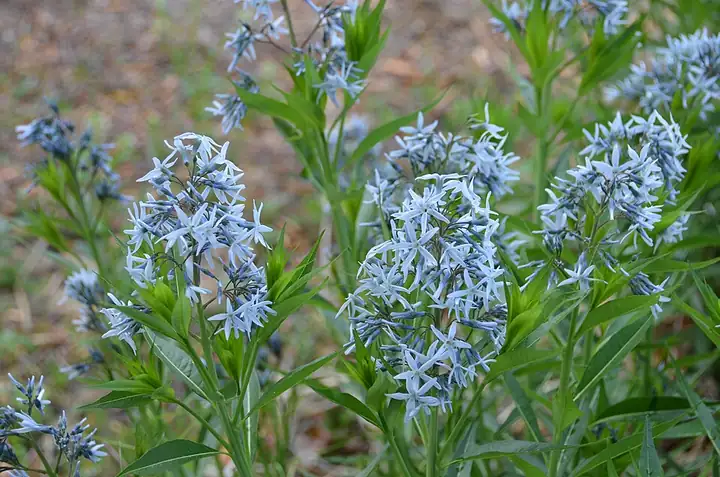
Amsonia (bluestar)
Amsonia tabernaemontana (eastern or willowleaf bluestar) and A. hubrichtii (Arkansas or threadleaf bluestar); also fringed bluestar (A. ciliata) and hybrids · Dogbane family (Apocynaceae)
When to plant: Plant in spring or fall where it can stay: the dense crown and taproot make older plants hard to move or divide (Iowa State, Wisconsin Extension).
| Hardiness zones | 3 to 9 |
|---|---|
| Sun | full sun to part shade |
| Water | moderate |
| Life cycle | perennial |
| Frost | Hardy: takes frost |
| Spacing | 12 to 36 inches |
About Amsonia (bluestar)
Bluestars are tidy, long-lived native perennials with clusters of small, pale-blue, star-shaped flowers in spring and willowy leaves that turn bright gold in fall, so they look good for three seasons (Iowa State, Mt. Cuba Center). Eastern bluestar is native from Maryland and southeast Virginia to southern Illinois and Kansas, south to Florida and east Texas, while threadleaf bluestar comes only from the Ouachita Mountains of Arkansas and Oklahoma (Wildflower Center, NC State) and was Perennial Plant of the Year in 2011. A milky sap makes deer leave them alone but can irritate skin.
Eastern bluestar is hardy in zones 3-9 and threadleaf bluestar in 5-8 (NC State, Wisconsin Extension); most other bluestars are hardy to zone 5 (Iowa State). Not listed as invasive; eastern bluestar has naturalized north to Massachusetts (Wildflower Center).
When to plant
Plant in spring or fall where it can stay: the dense crown and taproot make older plants hard to move or divide (Iowa State, Wisconsin Extension).
Divide in early spring or fall if needed, with at least one bud per piece (NC State). Fresh seed sown outdoors right after collection sprouts quickly; stored seed needs 4-6 weeks of cold, moist treatment, and seedlings bloom in their second or third year (Wildflower Center, Wisconsin Extension). Plants take a few years to fill out (Mt. Cuba Center). No sourced day count to first bloom.
Soil
Average, well-drained loam is ideal, but it adapts to clay and, once settled, dry soil. Eastern bluestar likes more moisture; threadleaf and fringed bluestars prefer drier ground. Rich soil or shade makes plants flop (NC State, Iowa State, Wisconsin Extension).
Average, well-drained soil is enough; don't enrich it heavily, because rich soil makes bluestars open and floppy (NC State, Wisconsin Extension).
Feeding
Look for: a balanced or all-purpose fertilizer at the label rate. Skip high-phosphorus "bloom boosters" unless a soil test shows low phosphorus: most garden soils already have enough, and the extra can wash into streams.
Over-fertilizing gives open, floppy plants (Wisconsin Extension), so feed only if a soil test calls for it (Penn State). Too much shade also causes flopping. Wear gloves when cutting: the milky sap can irritate skin.
Harvest
Blooms for 2-4 weeks from mid-April into May or early June (Iowa State, Wisconsin Extension); gold fall color follows, best in full sun. Flowers last well when cut (Wisconsin Extension). After bloom, cut stems back by a third to a half for a rounder, sturdier plant and to stop seedlings (Wisconsin Extension, Iowa State). Wear gloves: the sap can irritate skin.
Varieties (14)
Wisconsin Extension, Iowa State, NC State and Mt. Cuba Center's 2013-2023 bluestar trial document these 14 bluestars; some are close relatives (fringed bluestar and hybrids) rather than selections of the two main species.
| Variety | Type | Season and days | Zones | Notes |
|---|---|---|---|---|
| Blue Ice | Bluestar, possibly a hybrid | Spring | 4–9 | Larger, darker lavender-blue to periwinkle flowers on a low plant about 1-2 ft tall and 2 ft wide. Wisconsin Extension calls it possibly a hybrid; Iowa State lists it as a selection of European bluestar (A. orientalis). Sources: [1][3][4] |
| Ozark bluestar (var. illustris) | Eastern bluestar (A. tabernaemontana var. illustris) | Spring | 3–9typical for amsonia | A wild form found from Missouri and Kansas to Texas (the Wildflower Center lists it as A. illustris). Rated 4.4 of 5 at Mt. Cuba Center. Sources: [5][6] |
| Fontana | Eastern bluestar (A. tabernaemontana) | Spring | 3–9typical for amsonia | A taller selection, about 3.5 ft. Rated 4.4 of 5 at Mt. Cuba Center. Sources: [4][6] |
| Storm Cloud | Eastern bluestar (A. tabernaemontana) | Spring | 3–9typical for amsonia | Near-black stems, dark green leaves with silvery veins and sky-blue flowers; about 2-2.5 ft tall and 3 ft wide. Selected from Bibb County, Alabama; hardy to zone 5 (Wisconsin Extension). Sources: [1][3][4] |
| var. salicifolia | Eastern bluestar (A. tabernaemontana), botanical variety | Spring | 3–9typical for amsonia | Very narrow leaves (about 1/4 inch wide) and a vase-shaped habit, 2-3 ft tall and wide. Hardy to zone 3 (Wisconsin Extension). Sources: [1][3] |
| Montana | Eastern bluestar (A. tabernaemontana), dwarf form | Mid-April to May | 3–9typical for amsonia | Compact, 1-1.5 ft tall, with deeper blue flowers that open earlier and slightly wider leaves. First sold as 'Amsonia montana', a name now considered invalid; rated 4.7 of 5 at Mt. Cuba Center. Sources: [3][14] |
| Short Stack | Eastern bluestar (A. tabernaemontana), dwarf form | Mid-April to May | 3–9typical for amsonia | About 1 ft tall and 1.5 ft wide. Introduced by Plant Delights Nursery; hardy to zone 5; rated 4.8 of 5 at Mt. Cuba Center. Sources: [3][14] |
| Georgia Pancake | Fringed bluestar (A. ciliata) | Spring | 3–9typical for amsonia | A low, compact form only 9-10 inches tall. Sources: [4] |
| Spring Sky | Fringed bluestar (A. ciliata) | Spring | 3–9typical for amsonia | A shorter form under 2 ft tall. Sources: [4] |
| Fringed bluestar (A. ciliata) | Fringed bluestar (species) | Spring | 3–9typical for amsonia | Fine, threadlike leaves with tiny hairs when young; 2-3 ft in the wild but about 4 ft tall and 7 ft wide in Mt. Cuba's trial. Native to dry, sandy soils of the Southeast and south-central U.S.; rated 4.5 of 5 at Mt. Cuba Center. Sources: [4][7] |
| Seaford Skies | Hybrid bluestar (A. hubrichtii x A. tabernaemontana) | Late May | 3–9typical for amsonia | Cornflower-blue flowers, darker than other large bluestars, and fine leaves; a large clump. Found in Pamela Harper's Virginia garden and introduced by Plant Delights Nursery; rated 4.7 of 5 at Mt. Cuba Center. Sources: [7] |
| Halfway to Arkansas | Hybrid bluestar (parentage unknown) | Spring | 3–9typical for amsonia | Large, fine-leaved clump much like fringed bluestar, with an excellent flower show. Introduced by Intrinsic Perennial Gardens, Hebron, Illinois; rated 4.6 of 5 at Mt. Cuba Center. Sources: [7] |
| Midway to Montana | Hybrid bluestar (parentage unknown) | Spring | 3–9typical for amsonia | Large, fine-leaved clump much like 'Seaford Skies' and fringed bluestar. Introduced by Intrinsic Perennial Gardens, Hebron, Illinois; rated 4.7 of 5 at Mt. Cuba Center. Sources: [7] |
| String Theory | Threadleaf bluestar (A. hubrichtii) hybrid | Spring | 3–9typical for amsonia | A compact, fine-leaved plant about 2 ft tall. Sources: [4] |
Good neighbors
Iris, Milkweed, Daylily, Sedum (stonecrop), Garden ferns (ostrich, Christmas, lady, Japanese painted), Sedges (Carex), Bleeding heart
Wisconsin Extension suggests Siberian iris, butterfly weed, daylilies, fall sedums, ferns, sedges and bleeding heart as good-looking garden partners; this is a design pairing, not a pest-control claim.
Diseases and problems
In the kitchen
Safety: Leaves and stems bleed a white latex sap that is considered toxic and can irritate sensitive skin, so wear gloves when cutting it back (Wisconsin Extension, NC State, Iowa State). Not a food plant; keep children from chewing it.
Pets: Not listed by the ASPCA (no amsonia or bluestar entry on its dog, cat or horse lists). Its milky sap is considered potentially toxic (Iowa State), so keep pets from chewing it.
Sources
- plants.ces.ncsu.edu
- plants.ces.ncsu.edu
- hort.extension.wisc.edu
- yardandgarden.extension.iastate.edu
- wildflower.org
- mtcubacenter.org
- mtcubacenter.org
- aspca.org
- aspca.org
- aspca.org
- aspca.org
- aspca.org
- extension.psu.edu
- mtcubacenter.org
Photo: Photo: F. D. Richards / Wikimedia Commons, CC BY-SA 2.0 (CC BY-SA 2.0). Photo resized for the web.

Planting dates and advice are general guidance; check with your local Cooperative Extension office for your area.