
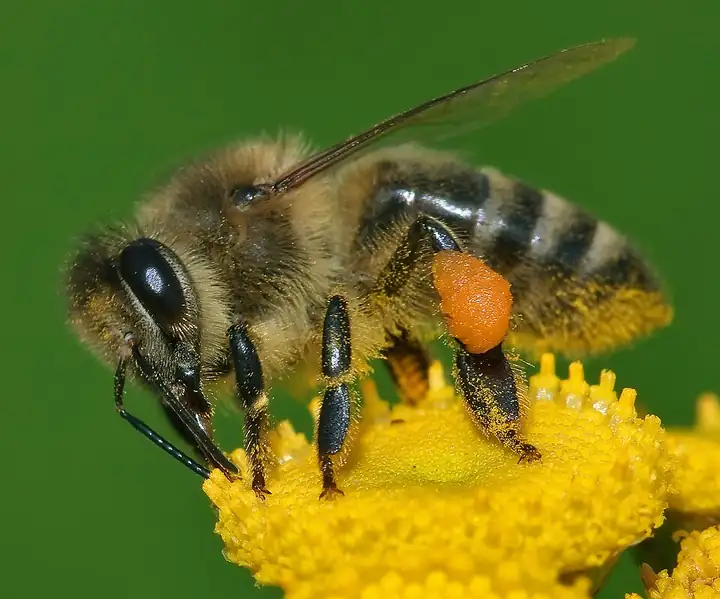
Honey bee
Apis mellifera (western honey bee), brought from Europe; Africanized honey bees are a more defensive strain of the same species in parts of the South and West
| Type | Insect |
|---|---|
| What it does | Pollinator |
| When | Active whenever it is warm and flowers are open; colonies live through winter |
| How common it is by region | Very common here: Northeast, Southeast, South Central, Midwest, Great Plains, Mountain West, Southwest, Pacific Northwest, California, Hawaii |
About
Honey bees are fuzzy, golden-brown bees that live in large colonies and make honey. They are not native to North America, but they pollinate a huge share of fruits, vegetables and other crops.
This one is already on your side. Broad sprays kill it along with the pest, which is why the guide puts sprays last.
What it eats
Workers collect nectar and pollen and carry pollen between flowers as they go. Oklahoma State says they pollinate about 120 cultivated crops.
Spotting it
How to find it early
Look for a golden-brown bee with a fuzzy thorax and flat hind legs carrying balls of pollen. A swarm is a big buzzing cluster hanging on a branch in spring.
Its young
Larvae are white grubs in wax comb inside a hive or hollow tree, out of sight.
When
Active whenever it is warm and flowers are open; colonies live through winter
Easy to mistake for
- Syrphid flies (hover flies, flower flies) — Honey bees have two pairs of wings, longer bent antennae and pollen baskets on the hind legs; hover flies have one pair of wings, huge eyes and stubby antennae.
- Yellowjackets (and baldfaced hornets) — Honey bees are fuzzy and golden-brown with flat pollen-carrying hind legs; yellowjackets are shiny, hairless and bright yellow.
- Squash bees — Squash bees are bulkier with longer antennae and fuzzy hind legs dusted in loose pollen, and they work squash flowers at dawn; honey bees carry neat pollen balls and come later.
Bringing more of them in
Plant a long season of flowers, including natives, and avoid spraying open blooms. If you must spray, do it in the evening when bees are not flying.
Plants that bring it in
Worth knowing
A honey bee can sting only once, and it dies afterward. Scrape the stinger out right away with a fingernail or card edge, because it keeps pumping venom for up to a minute. About 1 or 2 in 1,000 people are allergic (UC IPM); carry prescribed epinephrine if you are, and get emergency care for trouble breathing, throat swelling, dizziness or a sting in the mouth. Stay well away from hives and swarms, and call a beekeeper to remove one.
How common it is by region
| Northeast | Very common here |
|---|---|
| Southeast | Very common here |
| South Central | Very common here |
| Midwest | Very common here |
| Great Plains | Very common here |
| Mountain West | Very common here |
| Southwest | Very common here |
| Pacific Northwest | Very common here |
| California | Very common here |
| Alaska | Occasional here |
| Hawaii | Very common here |
Sources
- extension.okstate.edu
- pueblo.extension.colostate.edu
- ipm.ucanr.edu
- extension.umn.edu
- scholarspace.manoa.hawaii.edu
Photo: Photo: Andreas Trepte / Wikimedia Commons, CC BY-SA 2.5 (CC BY-SA 2.5). Photo resized for the web.

Planting dates and advice are general guidance; check with your local Cooperative Extension office for your area.