
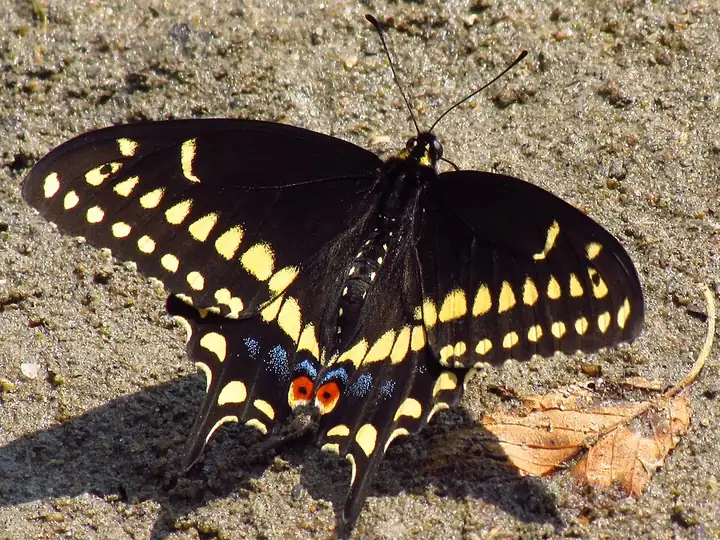
Black swallowtail (parsleyworm)
Papilio polyxenes; in the West the look-alike anise swallowtail (Papilio zelicaon) plays the same role
| Type | Insect |
|---|---|
| What it does | Pollinator |
| How common it is by region | Very common here: Northeast, Southeast, South Central, Midwest |
About
The black swallowtail is a large black butterfly with rows of yellow spots and blue on the hind wings. Its striped caterpillars, called parsleyworms, eat dill, parsley, fennel and carrot tops, so many gardeners simply plant extra to share.
This one is already on your side. Broad sprays kill it along with the pest, which is why the guide puts sprays last.
What it eats
Caterpillars eat leaves of the carrot family: dill, parsley, fennel, carrot, celery, parsnip and Queen Anne's lace, and sometimes rue. Adults drink flower nectar.
Spotting it
How to find it early
Check dill, parsley and fennel for the striped caterpillars. Poke one gently and it pushes out a forked orange 'horn' (osmeterium) that gives off a bad smell.
Its young
Eggs are tiny, round and pale yellow, laid one by one on new leaves. Young caterpillars are spiny and black with a white saddle, like a bird dropping; older ones are green with black bands dotted yellow or orange, up to about 2 inches long.
When
Mid-spring to fall; two generations in the North, three in the South. The chrysalis spends winter on a stem.
Easy to mistake for
- Monarch butterfly — Monarch caterpillars have yellow, black and white bands with black tentacles at both ends and live only on milkweed; black swallowtail caterpillars are green with black bands and yellow-orange dots on carrot-family plants.
- Garden butterflies — The pipevine and spicebush swallowtails are also black, but the pipevine has a blue-green sheen with faint spots and the spicebush has white spots on top instead of rows of yellow.
Bringing more of them in
Grow extra dill, parsley and fennel as host plants, plus nectar flowers for adults. If they're eating the crop you want, move the caterpillars by hand to a spare host plant instead of spraying; Bt and other insecticides kill them.
Plants that bring it in
Worth knowing
The caterpillars can strip a parsley or dill patch, especially the big last stage. The orange horn and its smell are harmless to people. In the West, anise swallowtail caterpillars do the same on fennel, parsley and citrus.
How common it is by region
| Northeast | Very common here |
|---|---|
| Southeast | Very common here |
| South Central | Very common here |
| Midwest | Very common here |
| Great Plains | Common here |
| Mountain West | Common here |
| Southwest | Occasional here |
| Pacific Northwest | Common here |
| California | Common here |
| Alaska | Not found here |
| Hawaii | Not found here |
Sources
Photo: Photo: D. Gordon E. Robertson / Wikimedia Commons, CC BY-SA 3.0 (CC BY-SA 3.0). Photo resized for the web.

Planting dates and advice are general guidance; check with your local Cooperative Extension office for your area.