
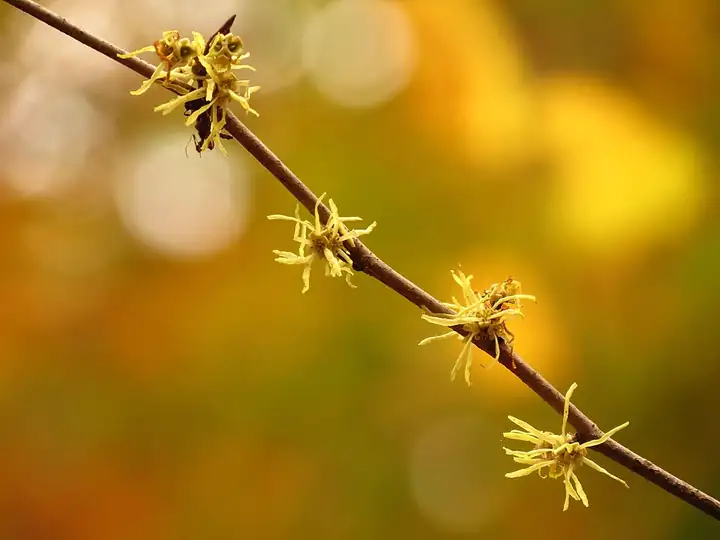
Witch hazel
Hamamelis virginiana (common witch hazel), H. vernalis (vernal or Ozark witch hazel) and the hybrid H. x intermedia (H. japonica x H. mollis) · Witch-hazel family (Hamamelidaceae)
When to plant: Plant container or balled shrubs in spring or fall and water deeply until established, at least two growing seasons (UMN).
| Hardiness zones | 3 to 9 |
|---|---|
| Sun | full sun to part shade |
| Water | moderate |
| Life cycle | perennial |
| Frost | Hardy: takes frost |
About Witch hazel
Witch hazels are big shrubs or small trees with spidery, ribbon-petaled flowers that open when almost nothing else is blooming. Common witch hazel flowers yellow and fragrant in fall as its leaves drop, and it's native across the eastern U.S. from Maine and Minnesota to Florida and Texas; vernal witch hazel is native to the Ozarks of Missouri, Arkansas and Oklahoma and blooms in mid to late winter (NC State, wildflower.org). The hybrid witch hazels from Asian parents bloom in late winter in yellow, orange, copper or red, and are usually grafted.
Common witch hazel is hardy in zones 3-9, vernal in 3-8 and the hybrids in 4-9 (NC State).
When to plant
Plant container or balled shrubs in spring or fall and water deeply until established, at least two growing seasons (UMN).
Give them room: common witch hazel grows 15-30 ft tall and the hybrids 15-20 ft (NC State). Flowering is best in full sun.
Soil
Moist, humus-rich, well-drained acid soil (pH below 6.0); it handles clay and brief flooding, but common witch hazel dislikes drought and vernal witch hazel may scorch in hot, dry summers (NC State).
Test the soil before planting; established shrubs in decent soil need little or no fertilizer (Clemson).
Feeding
- Spring to early summer after new growth starts, only if a soil test shows a need: slow-release complete fertilizer in a 3:1:2 ratio, or what the soil test calls for. Spread evenly from the trunk out to the drip line and water it in; a typical soil-test rate for shrubs is about 2 lb of 12-6-6 per 100 sq ft (Clemson). Follow a soil test.
Look for: mostly nitrogen, in spring as growth starts. Spring feeding grows the new shoots and leaves that carry flowers and fruit; feeding after midsummer pushes soft growth that may not harden before winter.
Water is what new shrubs need most: daily for the first 2 weeks, every 2-3 days through week 12, then weekly until the roots spread (at least two growing seasons), using about a quarter to a third of the nursery pot's volume each time (UMN). Common witch hazel doesn't tolerate drought, so keep it watered in dry spells, and don't feed drought-stressed shrubs (NC State, Clemson).
Harvest
Common witch hazel blooms October to December; vernal and hybrid witch hazels bloom January to March (NC State). Flowers form on old wood, so prune lightly, if at all, right after bloom in early spring; vernal witch hazel spreads by root suckers you can cut out (NC State). Small galls on the leaves are harmless (NC State).
Varieties (23)
| Variety | Type | Zones | Notes |
|---|---|---|---|
| Green Thumb | Common witch hazel (H. virginiana) | 3–9typical for witch hazel | Green leaves edged with a yellow band; yellow flowers in fall. Sources: [1] |
| Harvest Moon | Common witch hazel (H. virginiana) | 3–9typical for witch hazel | Vase-shaped, with lemon-yellow fall flowers. Sources: [1] |
| Little Suzie | Common witch hazel (H. virginiana) | 3–9typical for witch hazel | Small, about 5 ft tall, with yellow fall color. Sources: [1] |
| Mohonk Red | Common witch hazel (H. virginiana) | 3–9typical for witch hazel | Flowers red at the base fading to straw color at the tips. Sources: [1] |
| Allgold | Hybrid witch hazel (H. x intermedia) | 3–9typical for witch hazel | Yellow flowers with a reddish-purple calyx. Sources: [3] |
| Aphrodite | Hybrid witch hazel (H. x intermedia) | 3–9typical for witch hazel | Orange to copper-red flowers without scent; reddish fall leaves. Sources: [3] |
| Arnold Promise | Hybrid witch hazel (H. x intermedia) | 3–9typical for witch hazel | Large shrub with bright yellow flowers, reddish at the base, blooming later than most. Sources: [3] |
| Diane | Hybrid witch hazel (H. x intermedia) | 3–9typical for witch hazel | Copper-red early-spring flowers; red, orange and yellow fall color. Sources: [3] |
| Feuerzauber ('Magic Fire') | Hybrid witch hazel (H. x intermedia) | 3–9typical for witch hazel | Mildly fragrant red flowers; orange-red fall color. Also sold as 'Fire Charm'. Sources: [3] |
| Girard's Orange | Hybrid witch hazel (H. x intermedia) | 3–9typical for witch hazel | Fragrant orange flowers on a vigorous, fast plant. Sources: [3] |
| Hiltingbury | Hybrid witch hazel (H. x intermedia) | 3–9typical for witch hazel | Orange-red and purple flowers; orange and red fall color. Sources: [3] |
| Jelena | Hybrid witch hazel (H. x intermedia) | 3–9typical for witch hazel | Sweetly fragrant copper-orange winter flowers. Sources: [3] |
| Moonlight | Hybrid witch hazel (H. x intermedia) | 3–9typical for witch hazel | Fragrant yellow flowers with a deep red calyx; yellow fall color. Sources: [3] |
| Orange Beauty | Hybrid witch hazel (H. x intermedia) | 3–9typical for witch hazel | Mildly fragrant deep yellow to orange-yellow flowers; yellow, orange and red fall color. Sources: [3] |
| Primavera | Hybrid witch hazel (H. x intermedia) | 3–9typical for witch hazel | Very fragrant, abundant yellow flowers with a reddish base; blooms early; yellow fall color. Sources: [3] |
| Ruby Glow | Hybrid witch hazel (H. x intermedia) | 3–9typical for witch hazel | Deep coppery-red flowers without scent; orange-red fall color. Sources: [3] |
| Sunburst | Hybrid witch hazel (H. x intermedia) | 3–9typical for witch hazel | Abundant, intense yellow flowers. Sources: [3] |
| Autumn Embers | Vernal witch hazel (H. vernalis) | 3–9typical for witch hazel | Copper-red flowers. Sources: [2] |
| Carnea | Vernal witch hazel (H. vernalis) | 3–9typical for witch hazel | Pink flowers. Sources: [2] |
| Quasimodo | Vernal witch hazel (H. vernalis) | 3–9typical for witch hazel | Dwarf, 2-3 ft, with burnt-orange winter flowers. Sources: [1][2] |
| Red Imp | Vernal witch hazel (H. vernalis) | 3–9typical for witch hazel | Red petals tipped orange. Sources: [2] |
| Squib | Vernal witch hazel (H. vernalis) | 3–9typical for witch hazel | Vivid yellow flowers. Sources: [2] |
| Washington Park | Vernal witch hazel (H. vernalis) | 3–9typical for witch hazel | Reddish-purple flowers. Sources: [2] |
Pests to watch for
Diseases and problems
Powdery mildew, Leaf spots
In the kitchen
Safety: No poison listing in the sources we used. Drugstore witch hazel is a distilled or alcohol extract of the twigs, leaves or bark used as a skin astringent (wildflower.org, FDA); it's for the skin, not for drinking.
Pets: Not listed by the ASPCA.
Sources
- plants.ces.ncsu.edu
- plants.ces.ncsu.edu
- plants.ces.ncsu.edu
- wildflower.org
- henriettes-herb.com
- ecfr.gov
- extension.umn.edu
- aspca.org
- extension.rutgers.edu
- hgic.clemson.edu
Photo: Photo: Katja Schulz / Wikimedia Commons, CC BY 2.0 (CC BY 2.0). Photo resized for the web.

Planting dates and advice are general guidance; check with your local Cooperative Extension office for your area.