
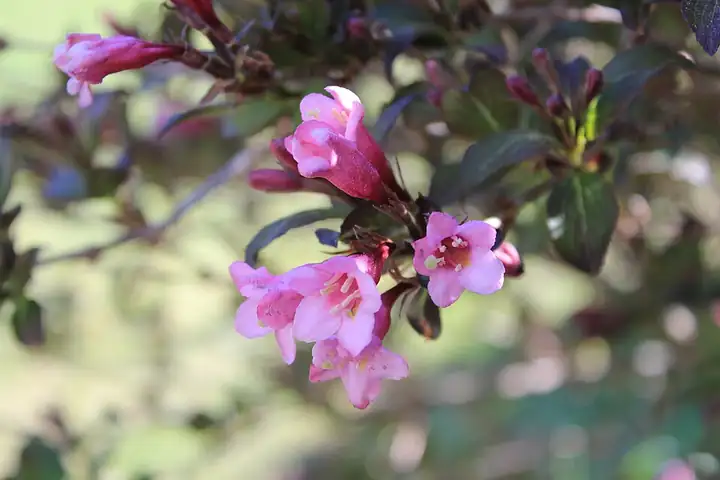
Weigela
Weigela florida and hybrids · Honeysuckle family (Caprifoliaceae)
| Hardiness zones | 4 to 8 |
|---|---|
| Sun | full sun to part shade |
| Water | moderate |
| Life cycle | perennial |
| Frost | Hardy: takes frost |
About Weigela
Weigela is an easy, arching shrub from East Asia that covers itself in pink, red or white trumpet flowers in late spring. Hummingbirds, butterflies and bees visit the blooms, and newer cultivars come in small sizes, dark or variegated leaves, and repeat-blooming forms.
Hardy in zones 4-8; tips often die back in cold winters, especially in northern Iowa.
Planting
It blooms best in full sun; part shade means fewer flowers (Iowa State). The old-fashioned species grows 6-10 ft tall and wider, so check the cultivar's size before you plant.
Soil
Moist, well-drained soil of moderate fertility; it takes clay, loam or sand and acid to alkaline pH.
Loosen the soil and work in compost; follow a soil test before adding fertilizer.
Feeding
- Established plants: spring as growth begins (a split feeding can follow in early summer): Slow-release shrub fertilizer, about 3-1-1 or 3-1-2 ratio (3-0-1 if the soil test shows enough phosphorus). Follow a soil test. Spread it evenly over the root zone and water it in; for slow-release types Clemson's upper limit is 2-4 lb of nitrogen per 1,000 sq ft per year.
Look for: a balanced or all-purpose fertilizer at the label rate. Skip high-phosphorus "bloom boosters" unless a soil test shows low phosphorus: most garden soils already have enough, and the extra can wash into streams.
Extra fertilizer won't fix poor bloom from shade or from pruning at the wrong time; prune only right after spring bloom.
Harvest
Main bloom is in May-June on last year's wood, with a few flowers later in summer. Prune right after the spring bloom, never in fall, and remove a few of the oldest stems in late winter to keep it vigorous.
Varieties (19)
| Variety | Type | Season and days | Zones | Notes |
|---|---|---|---|---|
| Sonic Bloom Pink ('Bokrasopin') | Reblooming | Spring to frost | 4–8 | Bright pink flowers in a big spring flush, then waves until frost. Sources: [4] |
| Verweig 6 | Reblooming | May to October in flushes | 4–9 | Upright shrub with red flowers in spring, summer and fall flushes. Sources: [7] |
| Alexandra | 4–8typical for weigela | Glossy burgundy leaves with rose-red flowers. Sources: [1] | ||
| Briant Rubidor ('Olympiade') | June-July, some repeat | 4–8 | Deep pink flowers on a round shrub up to 8 ft; takes heavy pruning and works as a hedge. Sources: [5] | |
| Bristol Ruby | 4–8typical for weigela | Deep red flowers; can reach 8 ft. Sources: [1] | ||
| Canary | 4–8typical for weigela | Yellow flowers that fade to pink. Sources: [1] | ||
| Candida | May-June | 5–9 | Pure white flowers on arching branches. Sources: [8] | |
| Eva Rathke | 4–8typical for weigela | Compact, 4-5 ft, with a long bloom period. Sources: [1] | ||
| Java Red | 4–8typical for weigela | Purple-red to bronze leaves and pink flowers; about 4 ft tall. Sources: [2] | ||
| Minuet | 4–8typical for weigela | Dwarf, about 2 ft tall, with ruby-red flowers and purple-tinged leaves. Sources: [2] | ||
| My Monet ('Verweig') | May-June | 5–8 | True dwarf, 12-18 inches, with white-edged leaves that blush pink in sun; bright pink flowers. Sources: [9] | |
| Newport Red ('Vanicek') | 4–8typical for weigela | Purple-red flowers; 5-6 ft tall. Sources: [2] | ||
| Pink Princess | 4–8typical for weigela | Lilac-pink flowers; 5-6 ft tall. Sources: [2] | ||
| Polka | 4–8typical for weigela | Deep pink flowers with yellow throats; about 4 ft tall. Sources: [2] | ||
| Red Prince | 4–8typical for weigela | Dark red flowers; cold hardy. Sources: [2] | ||
| Variegata | 4–8typical for weigela | Cream-edged leaves and rose-pink flowers; about 6 ft tall. Sources: [1][2] | ||
| Victoria | May-June, possible repeat | 4–8 | Bright pink flowers; young leaves burgundy-tinged, turning deep green; about 6 ft. Sources: [10] | |
| White Knight | 4–8typical for weigela | Pinkish buds open to white flowers; 5-6 ft tall. Sources: [2] | ||
| Wine and Roses | 4–8typical for weigela | Dark reddish-purple leaves with rosy-pink flowers. Sources: [1][2] |
Pests to watch for
In the kitchen
Pets: Not listed as toxic by the ASPCA (no weigela entry)
Sources
- plants.ces.ncsu.edu
- yardandgarden.extension.iastate.edu
- chicagobotanic.org
- chicagobotanic.org
- chicagobotanic.org
- hgic.clemson.edu
- chicagobotanic.org
- chicagobotanic.org
- chicagobotanic.org
- chicagobotanic.org
Photo: Photo: Trollhead, CC BY-SA 3.0, via Wikimedia Commons (CC BY-SA 3.0). Photo resized for the web.

Planting dates and advice are general guidance; check with your local Cooperative Extension office for your area.