
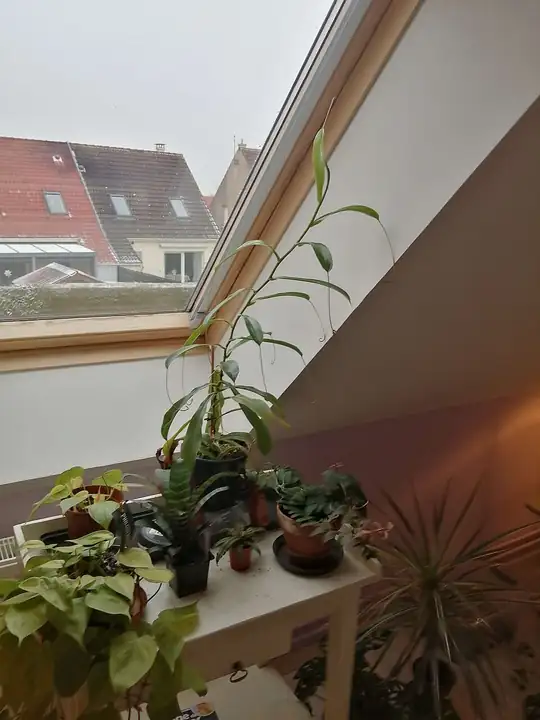
Tropical pitcher plant (nepenthes)
Nepenthes spp. and hybrids · Tropical pitcher plant family (Nepenthaceae)
When to plant: Any time of year, since it grows indoors. Repot gently into fresh sphagnum or orchid mix; the shallow roots are brittle.
| Hardiness zones | 10 to 13 |
|---|---|
| Sun | part shade |
| Water | high |
| Life cycle | perennial |
| Frost | Tender: killed by frost |
Will it grow in your window?
Pick the window it sits in. This is the same check Sow & Tell runs for every plant in your house.
It wants bright, indirect light.
Pick a window above and this will tell you whether the spot suits it.
Watering: keep it evenly moist — about every 4 days, stretching to every 7 from November to February.
Summering outside? Bring it in before nights drop below 60°F.
About Tropical pitcher plant (nepenthes)
Tropical pitcher plants, also called monkey cups, are climbing carnivorous vines from Southeast Asia, Madagascar and the western Pacific whose leaf tips grow into hanging pitchers that trap and digest insects (NC State). Most sold are easy hybrids grown from tissue culture or cuttings, best in a hanging basket in a bright, humid kitchen window or terrarium. Lowland kinds like it hot, highland kinds like cooler nights, and all need rain or distilled water and steady humidity.
Hardy outdoors only in zones 10-13 (NC State); it is grown indoors everywhere and can summer outdoors in bright shade where the air is humid, once nights stay above about 60 F.
When to plant
Any time of year, since it grows indoors. Repot gently into fresh sphagnum or orchid mix; the shallow roots are brittle.
Usually bought as a hybrid grown from tissue culture or cuttings, often in a hanging basket (NC State).
Growing it indoors
- Light: It wants bright light with a few hours of gentle direct sun, as in an east window or a lightly shaded south one (NC State).
- Water: Keep the mix moist but well drained, using only distilled water or rainwater, never tap water (NC State).
- Humidity: It needs high humidity; in dry air new pitchers fail to form or die back, so a kitchen window, terrarium or humidifier helps, and N. sanguinea copes best with drier air (NC State).
- Temperature: Lowland kinds like 70-95 F; highland kinds like 75-85 F days and nights in the low 60s (NC State), so keep both off cold glass and away from drafts.
- Feeding: It feeds on the insects it catches; if few insects reach it, give an organic fertilizer during the growing season, and never feed it meat (NC State).
- Repotting: The sources we opened give no schedule; NC State notes the shallow roots are brittle, so repot gently into fresh sphagnum or orchid mix.
- More plants: Stem cuttings (NC State); seed needs a male and a female plant blooming at once and stays viable only briefly.
If something looks wrong
| What you see | Likely cause | What to do |
|---|---|---|
| New leaves form no pitchers, or pitchers dry up | Air too dry | Raise the humidity with a terrarium, humidifier or grouping, or choose a forgiving kind such as N. sanguinea (NC State). |
| Spots or mold on leaves | Fungus from stale, still air | Improve air movement around the plant (NC State). |
| Slow decline even with good light and humidity | Tap water | Switch to rainwater or distilled water; NC State says tap water isn't recommended. |
| White tufts, small insects or brown bumps on leaves | Mealybugs, aphids, thrips or scale | Wipe them off with an alcohol-dipped swab and repeat as needed (NC State lists these pests; UF/IFAS gives the swab method). |
Soil
Sphagnum moss or an orchid mix with added peat and perlite, acid (pH below 6) and well drained; never garden soil (NC State).
Pot in sphagnum moss or orchid mix with added peat and perlite, acid and well drained, never garden soil (NC State).
Feeding
- Growing season, only if few insects reach it: organic fertilizer. Use sparingly as a supplement to the insects it catches; never feed it meat (NC State).
Don't feed it meat or protein, and don't water with tap water (NC State).
Varieties (9)
NC State Extension names 7 species and 2 hybrids.
| Variety | Type | Zones | Notes |
|---|---|---|---|
| Nepenthes 'St. Gaya' | Hybrid | 10+typical for tropical pitcher plant | Large upright yellow-green pitchers speckled red; cold tolerant. N. khasiana x (N. ventricosa x N. maxima). Sources: [1] |
| Nepenthes x miranda | Hybrid | 10+typical for tropical pitcher plant | Large green pitchers striped red, up to 1 ft; easy and good for beginners. N. maxima x N. northiana. Sources: [1] |
| Nepenthes alata (winged tropical pitcher plant) | Species | 10+typical for tropical pitcher plant | Green pitchers striped dark red; strap-shaped leaves; easy to grow. From the Philippines. Sources: [1] |
| Nepenthes aristolochioides | Species | 10+typical for tropical pitcher plant | Climbing shrub with tubular green pitchers speckled burgundy. From Sumatra. Sources: [1] |
| Nepenthes maxima | Species | 10+typical for tropical pitcher plant | Woody vine with striped pitchers and large, shiny leaves. Sources: [1] |
| Nepenthes sanguinea | Species | 10+typical for tropical pitcher plant | Woody vine with burgundy-red pitchers; tolerates lower humidity than most. Sources: [1] |
| Nepenthes ventricosa | Species | 10+typical for tropical pitcher plant | Green pitchers with red stripes; popular for beginners. From the Philippines. Sources: [1] |
| Nepenthes rajah | Species, giant | 10+typical for tropical pitcher plant | Pitchers up to 1 ft long on a scrambling shrub or vine; hard to grow because of its size. From Borneo. Sources: [1] |
| Nepenthes gracilis (slender pitcher plant) | Species, trailing | Trailing 6-20 ft with reddish-purple stems and narrow green pitchers speckled red. Sources: [1] |
Pests to watch for
Diseases and problems
Fungal leaf problems (poor air flow)
In the kitchen
Safety: Not listed as poisonous to people in the sources we opened; NC State tags it non-toxic to cats and dogs, and it is not on the ASPCA lists.
Pets: Not listed by the ASPCA (no Nepenthes entry; it lists only the unrelated California pitcher plant, Darlingtonia, as non-toxic to dogs, cats and horses); NC State tags tropical pitcher plants as non-toxic to cats and dogs.
Sources
Photo: Photo: Gaspard513, CC0, via Wikimedia Commons (CC0). Photo resized for the web.

Planting dates and advice are general guidance; check with your local Cooperative Extension office for your area.