
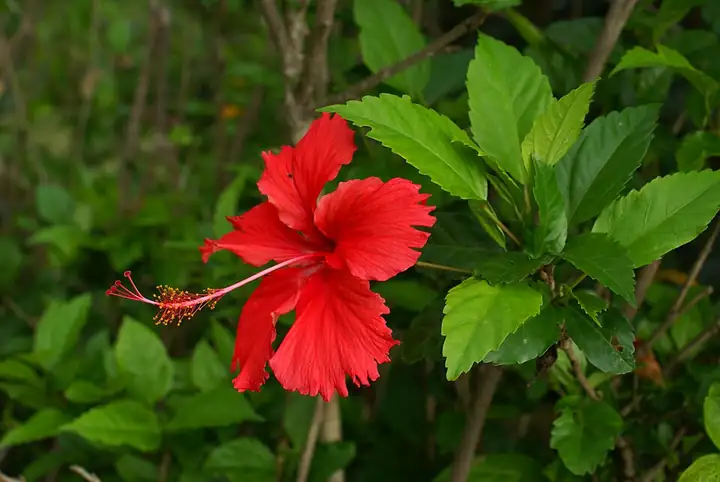
Tropical hibiscus
Hibiscus rosa-sinensis and hybrids · Mallow family (Malvaceae)
When to plant: Set plants out after frost danger has passed, where they get 6-8 hours of direct sun (LSU AgCenter).
| Hardiness zones | 9 to 11 |
|---|---|
| Sun | full sun |
| Water | high |
| Life cycle | tender perennial (grown as an annual) |
| Frost | Tender: killed by frost |
| Soil pH | 6.5–6.8 |
About Tropical hibiscus
Tropical hibiscus, also called Chinese hibiscus, is an evergreen shrub with glossy leaves and huge flowers 3-6 inches or more across in red, pink, orange, yellow, white and blends (NC State). Each flower lasts only about a day, but plants in sun bloom almost nonstop from spring to fall (LSU AgCenter; UF/IFAS), and hummingbirds and butterflies visit them. It isn't the cold-hardy hibiscus or rose of Sharon, which have their own entries; outside the Deep South it's a patio and container plant that spends winter indoors.
Grows outdoors all year in zones 9-11 (NC State); in north Florida it freezes to the ground but often regrows from the roots (UF/IFAS). Protect it from temperatures below 45 F (LSU AgCenter); elsewhere grow it in a pot and overwinter it indoors.
When to plant
Set plants out after frost danger has passed, where they get 6-8 hours of direct sun (LSU AgCenter).
Many bloom best a little root-bound, so don't over-pot, and expect some bud and leaf drop after a move (LSU AgCenter, NC State). For winter, bring it in before nights fall regularly below the mid-50s to 45 F: give it a sunny south or west window, water less and skip fertilizer until new growth starts, or let it go dormant in a cool spot with the roots barely moist (UMD, MU Extension, Smithsonian Gardens). Days to first bloom aren't documented; nursery plants are usually sold in bloom.
Soil
Rich, well-drained soil high in organic matter that stays evenly moist; work sand and organic matter such as pine bark into heavy clay (NC State, LSU AgCenter).
Test the soil and aim for pH 6.5-6.8; work sand and organic matter such as pine bark into heavy clay so it drains (LSU AgCenter).
Feeding
- Spring through fall, while it's growing and blooming: fertilizer with two to three times as much potassium as nitrogen, such as 12-4-18, or slow-release granules plus a water-soluble bloom fertilizer. Feed regularly through the season (Smithsonian Gardens); LSU AgCenter suggests pairing slow-release granules with water-soluble feed when you water. Follow label rates.
Look for: a balanced or all-purpose fertilizer at the label rate. Skip high-phosphorus "bloom boosters" unless a soil test shows low phosphorus: most garden soils already have enough, and the extra can wash into streams. - Late winter or spring, when an overwintered plant starts new growth: water-soluble fertilizer. Skip or cut back feeding over winter, then resume once new growth shows (Smithsonian Gardens, UMD).
Look for: a balanced or all-purpose fertilizer at the label rate. Skip high-phosphorus "bloom boosters" unless a soil test shows low phosphorus: most garden soils already have enough, and the extra can wash into streams.
Don't let it dry out: that's the main cause of bud drop and yellow leaves (LSU AgCenter). Never spray malathion on hibiscus (UF/IFAS).
Harvest
Flowers open on new growth from spring through fall, nearly all year in South Florida, and each lasts about a day (UF/IFAS, NC State). Cut plants back by about half in early spring for a compact shape; pruning delays flowers for a while but doesn't stop them (NC State, Smithsonian Gardens).
Varieties (3)
Sources we could open document only these 3 (two series and one patented cultivar); hundreds of named hybrids exist.
| Variety | Type | Notes |
|---|---|---|
| TradeWinds series | Hybrid series | A widely sold series offered in many colors. Sources: [2] |
| Cajun series | Hybrid series (Louisiana) | Bred in Louisiana by Bobby Dupont; some of the largest flowers of any tropical hibiscus, in a wide range of colors. Sources: [2] |
| Satin Pillow | Patented hybrid | Satiny warm pink flowers with a red eye and white veins, about 6.5 inches across, ruffled, each lasting about two days; upright, compact, free-flowering plant about 2 ft tall and wide in the patent's trial. Bred in Webster, Texas (US plant patent PP13651, 2003; now expired). Sources: [9] |
Pests to watch for
Aphids, Whiteflies, Mealybugs, Thrips, Twospotted spider mite, Scale insects
Diseases and problems
In the kitchen
NC State lists the flowers as edible; use only blooms from plants that haven't been sprayed.
Safety: Neither NC State nor the ASPCA lists toxic parts. If you eat the flowers, pick them from plants you haven't treated with pesticides.
Pets: Not listed separately by the ASPCA; its hibiscus entry (H. syriacus, which also gives the name rose of China) is non-toxic to dogs, cats and horses.
Sources
- plants.ces.ncsu.edu
- apps.lsuagcenter.com
- lsu.edu
- gardeningsolutions.ifas.ufl.edu
- gardens.si.edu
- extension.umd.edu
- extension.missouri.edu
- aspca.org
- patents.google.com
Photo: Photo: B.navez / Wikimedia Commons, CC BY-SA 4.0 (CC BY-SA 4.0). Photo resized for the web.

Planting dates and advice are general guidance; check with your local Cooperative Extension office for your area.