
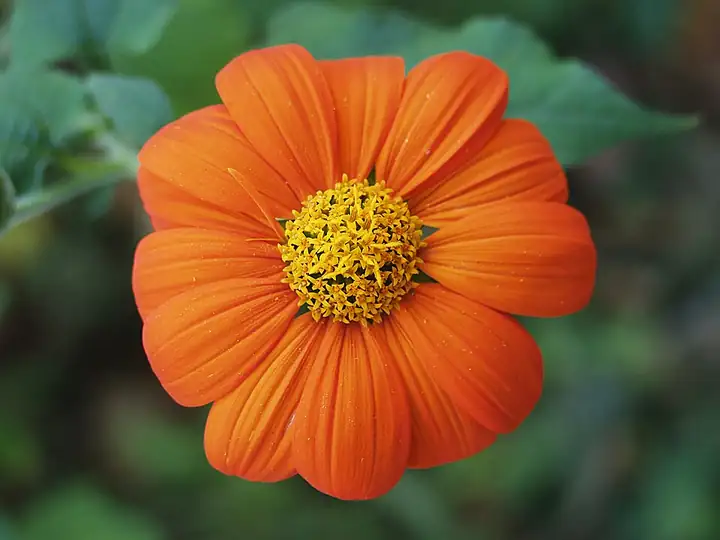
Mexican sunflower (tithonia)
Tithonia rotundifolia (syn. T. speciosa) · Aster family (Asteraceae)
When to plant: Start seeds indoors 6 to 8 weeks before the last frost, set out plants up to 2 weeks after the last frost and sow seeds outdoors up to 2 weeks after the last frost.
| Hardiness zones | 2 to 11 |
|---|---|
| Sun | full sun |
| Water | low |
| Life cycle | annual |
| Frost | Tender: killed by frost |
| Spacing | 24 to 48 inches |
About Mexican sunflower (tithonia)
Mexican sunflower is a fast, tall summer annual with 3-inch, orange-red daisies around a yellow center, blooming from midsummer until frost (NC State, Wisconsin Extension). It isn't native to the U.S.: it comes from Mexico and Central America. It shrugs off heat, drought and poor soil, and its flowers pull in butterflies such as eastern tiger swallowtails, plus bees and hummingbirds; goldfinches eat the seed (Clemson, NC State).
Grown as a summer annual in every zone; frost ends it. It has naturalized on Hawaii Island, and the Hawaii-Pacific Weed Risk Assessment rates it high risk (advisory, not a ban), so Hawaii gardeners should skip it or deadhead hard (Plant Pono). Don't confuse it with Bolivian sunflower (T. diversifolia), a different, invasive perennial that UF/IFAS doesn't recommend.
When to plant
Timing is counted from your average last spring frost (and first fall frost). Sow & Tell works out the actual dates for your ZIP code.
- Start seeds indoors: 6 to 8 weeks before the last frost
- Set out plants: up to 2 weeks after the last frost
- Sow seeds outdoors: up to 2 weeks after the last frost
Sow outdoors after the last frost, or start indoors 6-8 weeks earlier for earlier flowers; barely cover the seed, since light helps it sprout, and expect seedlings in 4-10 days at about 70 F (Wisconsin Extension, Cornell, Clemson). Space plants about 2 ft apart so they hold each other up, or 3-4 ft apart if you stake them (Wisconsin Extension). In Florida, sow in late winter or early spring (UF/IFAS). We found no sourced day count to first bloom, so days_to_harvest is empty.
Soil
Poor to average, well-drained soil, from sand to clay or rocky ground; rich soil and heavy feeding give lots of leaves, weak stems and fewer flowers (Wisconsin Extension, Clemson, Cornell).
No compost or fertilizer needed: poor to average, well-drained soil gives the most flowers and the sturdiest stems (Wisconsin Extension, Cornell).
Feeding
Look for: a balanced or all-purpose fertilizer at the label rate. Skip high-phosphorus "bloom boosters" unless a soil test shows low phosphorus: most garden soils already have enough, and the extra can wash into streams.
Rich soil and heavy nitrogen give big leafy plants with weak stems and fewer flowers (Wisconsin Extension, Clemson).
Harvest
Blooms from midsummer to frost; deadhead spent flowers to keep new ones coming, but leave some to ripen seed for goldfinches (NC State, Clemson). For the vase, cut once the petals have unfurled from the center and handle the stems gently: the neck just under the flower is hollow and snaps easily (Tennessee cut flower guide, Wisconsin Extension).
Varieties (5)
Extension sources document only 5 named Mexican sunflowers; Wisconsin Extension notes few cultivars are generally sold.
| Variety | Type | Season and days | Notes |
|---|---|---|---|
| Fiesta del Sol | Dwarf | Midsummer to frost | Compact, about 3 ft tall, with bright orange flowers and yellow centers; a better fit for small gardens. All-America Selections winner in 2000. Sources: [2][3][5] |
| Goldfinger | Dwarf | Midsummer to frost | Orange-gold, 3-inch flowers on shorter plants. Height is given as 2-2.5 ft (Cornell, Clemson) or 3-4 ft (Wisconsin Extension). Sources: [2][3][4] |
| Arcadian Blend | Dwarf mix | Midsummer to fall | A 2-2.5 ft mix with 3-inch flowers in orange, yellow or red. Sources: [4] |
| Torch | Tall | Midsummer to frost | The most widely offered kind, with bright orange-red flowers on tall plants. All-America Selections winner in 1951. Sources: [2][3][6] |
| Yellow Torch | Tall | Midsummer to frost | Yellow-orange flowers on 4-6 ft plants. Sources: [2][3] |
Pests to watch for
Aphids, Twospotted spider mite, Thrips, Slugs, Brown garden snail
Diseases and problems
Powdery mildew
In the kitchen
Safety: Not known to be poisonous: the Hawaii-Pacific Weed Risk Assessment lists it as non-toxic (Plant Pono). It isn't a food or herbal plant, and the hairy leaves are rough to handle.
Pets: Not listed by the ASPCA (no Tithonia or Mexican sunflower entry on its toxic and non-toxic plant lists).
Sources
- plants.ces.ncsu.edu
- hort.extension.wisc.edu
- hgic.clemson.edu
- gardening.cornell.edu
- publications.mgcafe.uky.edu
- blogs.ifas.ufl.edu
- cpa.tennessee.edu
- plantpono.org
- plantpono.org
- aspca.org
- aspca.org
- aspca.org
- aspca.org
- aspca.org
Photo: Photo: Cbaile19, CC0, via Wikimedia Commons (CC0). Photo resized for the web.

Planting dates and advice are general guidance; check with your local Cooperative Extension office for your area.