
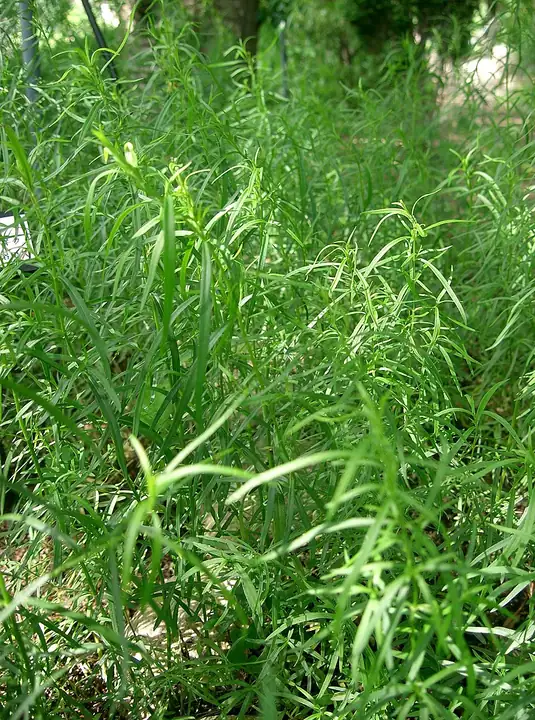
Tarragon (French)
Artemisia dracunculus 'Sativa' (French tarragon) · Daisy family (Asteraceae)
| Hardiness zones | 3 to 8 |
|---|---|
| Sun | full sun |
| Water | low |
| Life cycle | perennial |
| Frost | Hardy: takes frost |
| Soil pH | 6.0–8.0 |
| Spacing | 12 to 36 inches |
About Tarragon (French)
French tarragon is a hardy perennial herb with a sweet, anise-like flavor used in French cooking. It rarely flowers and sets no seed, so you must buy plants; seed sold as tarragon is the coarser, less flavorful Russian type.
NC State lists tarragon as hardy in zones 3-8; poor drainage, not cold, is what usually kills it in winter (Illinois).
Planting
French tarragon is only available as plants from cuttings or root divisions (Illinois). Divide plants every 3-4 years to keep them vigorous, and leave the tops standing over winter to help them survive, cutting back in spring (Illinois).
Soil
Well-drained soil with organic matter; wet soil causes root and crown rot and winter death.
Work organic matter into very well-drained soil; wet soil in winter kills tarragon. Like most herbs it does best at a pH of 6.0 to 7.5; base fertilizer on a soil test.
Feeding
- once during the growing season, only if the soil is poor or plants look pale: complete fertilizer such as 5-10-5. Scatter about 3 oz per 10 ft of row beside the plants and water it in; potted plants outdoors can get half-strength liquid fertilizer every 3-4 weeks.
Look for: a light, all-purpose or nitrogen fertilizer. Herbs are grown for fresh leaves to pick, so a little nitrogen keeps new growth coming; most need only light feeding.
Rich soil or heavy feeding gives fast, lush growth with less essential oil, so leaves have weaker flavor and scent.
Harvest
Snip young stem tips and leaves as needed through the season; the flavor is best fresh (Illinois).
Snip young stem tips and leaves as needed through the season, cut plants back in spring as growth resumes, and divide every 3 to 4 years to keep them productive.
Varieties (3)
No named tarragon cultivars beyond these types were found. Mexican tarragon is a different plant (a marigold relative) grown as a heat-tolerant substitute.
| Variety | Type | Zones | Notes |
|---|---|---|---|
| French tarragon | French tarragon (Artemisia dracunculus 'Sativa') | 3–8 | Strong licorice or anise flavor; the tarragon cooks want. Rarely flowers and makes no viable seed, so it is sold only as plants from cuttings or division. Needs well-drained soil. Clemson says it is very hard to grow in the South. Sources: [1][2][5] |
| Russian tarragon | Russian tarragon (Artemisia dracunculus) | 3–8typical for Tarragon (Artemisia dracunculus) | Much weaker scent and flavor; considered poor for cooking. Taller, coarser plant. Grows from seed. Seed packets labeled just 'tarragon' are usually this type. Sources: [1][2] |
| Mexican tarragon | Substitute (Tagetes lucida) | 8–11 | Anise-like flavor; used in place of tarragon. Heat- and drought-tolerant. Grown as an annual north of zone 8. A different plant from true tarragon. Also called Mexican mint marigold or Texas tarragon. Sources: [5][6] |
Diseases and problems
In the kitchen
Leaves flavor vinegars, oils, marinades, salads and egg and chicken dishes.
Keeping it: Stand fresh sprigs in a glass with an inch of water in the fridge, loosely covered, and change the water daily; use within about a week or freeze them. Dried leaves keep best airtight in a cool, dark cupboard.
Safety: Essential oils in the plant, especially the roots, can cause contact dermatitis in some people (NC State).
Pets: Toxic to dogs, cats and horses (ASPCA): essential oils can cause mild vomiting and diarrhea
Sources
- plants.ces.ncsu.edu
- extension.illinois.edu
- aspca.org
- extension.umn.edu
- hgic.clemson.edu
- plants.ces.ncsu.edu
Photo: Photo: KENPEI, CC BY-SA 3.0, via Wikimedia Commons (CC BY-SA 3.0). Photo resized for the web.

Planting dates and advice are general guidance; check with your local Cooperative Extension office for your area.