
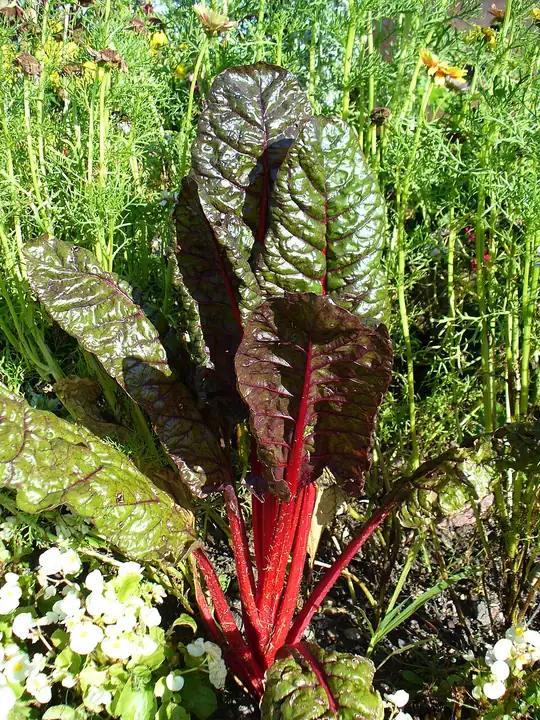
Swiss chard
Beta vulgaris (Cicla group) · Amaranth family (Amaranthaceae)
When to plant: Start seeds indoors 6 to 8 weeks before the last frost, set out plants 2 weeks before the last frost, sow seeds outdoors 2 to 4 weeks before the last frost and again in fall, 6 to 10 weeks before the first fall frost.
| Hardiness zones | 2 to 11 |
|---|---|
| Sun | full sun |
| Water | moderate |
| Life cycle | biennial |
| Frost | Half-hardy: takes a light frost |
| Soil pH | 6.0–6.5 |
| Spacing | 6 to 9 inches |
| Days to harvest | 45 to 60 days |
| Soil temperature to plant | at least 40°F |
About Swiss chard
Swiss chard is a beet grown for its big leaves and colorful stems instead of its root. It is one of the easiest greens: pick outer leaves and the plant keeps making more for months.
Grown as an annual in every zone; it tolerates light frost. As a biennial, it will not flower until it has lived through a winter.
When to plant
Timing is counted from your average last spring frost (and first fall frost). Sow & Tell works out the actual dates for your ZIP code.
- Start seeds indoors: 6 to 8 weeks before the last frost
- Set out plants: 2 weeks before the last frost
- Sow seeds outdoors: 2 to 4 weeks before the last frost
- Fall planting: 6 to 10 weeks before the first fall frost
Days count from seeding. In cold northern springs, waiting until after the last frost can help, because a long cold spell can make plants bolt; UMN suggests early to mid-May in Minnesota.
Soil
Well-drained soil improved with compost; chard tolerates slightly more acidic soil than spinach, down to about pH 6.
Follow a soil test and keep pH about 6.0 to 6.5; without a test, work in about 1 1/2 lb of balanced fertilizer such as 10-10-10 per 100 sq ft, or up to 1 inch of compost.
Feeding
- at thinning, or about 4 weeks after setting out transplants: nitrogen fertilizer such as 21-0-0. Spread about 1/4 cup per 10 ft of row beside the plants and water it in.
Look for: high nitrogen (the first number biggest), such as 21-0-0. Leafy crops are grown for their leaves, and nitrogen grows leaves. - after a big harvest of leaves: nitrogen fertilizer such as 21-0-0. Give a light side-dressing beside the row and water it in to help new leaves grow.
Look for: high nitrogen (the first number biggest), such as 21-0-0. Leafy crops are grown for their leaves, and nitrogen grows leaves.
Do not use weed-and-feed products, and skip extra phosphorus unless a soil test calls for it.
Harvest
Pick outer leaves once they are big enough to use, leaving the center to keep growing (cut-and-come-again), or cut the whole plant at once.
Pick outer leaves and leave the center growing for repeated harvests all season; a light nitrogen side-dressing after picking helps new leaves come.
Varieties (15)
| Variety | Type | Season and days | Notes |
|---|---|---|---|
| Charbell | Colored stems | 35 days | A vigorous chard with bright stems that is slow to bolt. Sources: [11] |
| Bright Lights | Multicolored stems | 55 to 60 days | Milder than ordinary chard. Stems in red, yellow, pink, orange and white with lightly crinkled green to bronze leaves. It won an All-America Selections award and is pretty enough for flower beds. Sources: [9][11][12][13][14][15][16][17][18][19] |
| Rainbow | Multicolored stems | Stems in red, pink, white, orange, yellow and striped colors. Sources: [12][16][20] | |
| Charlotte | Red stems | A red-stemmed chard on Wisconsin Extension's list. Sources: [16][20] | |
| Ruby Red | Red stems | Deep green, crinkled leaves with red veins and bright red, slightly flat stems. Oklahoma State treats Ruby Red and Rhubarb chard as the same variety; NC State describes them separately. Sources: [12][16][18][19] | |
| Vulcan | Red stems | A red-stemmed chard on Wisconsin Extension's list. Sources: [16][20] | |
| Rhubarb | Red stems, heirloom | 55 to 60 days | Reddish-green crinkled leaves on bright red, wide stems with an orange tint. Also sold as Rhubarb Red or Ruby chard. Sources: [9][12][14][15][20][21][22] |
| Fordhook Giant | White stems | 50 to 60 days | Dark green, crinkled leaves with white veins on broad white stems. It stands up well to heat. Sources: [9][12][13][14][15][16][17][19][22] |
| Large White Ribbed | White stems | Smooth, dark green leaves on broad, smooth, white stems that are a little flat. Sources: [12][16][20] | |
| Lucullus | White stems | 50 days | A standard chard recommended by Utah State, Oklahoma State, Wisconsin and UF/IFAS. Sources: [9][16][18][19][21][22] |
| Monstruoso | White stems | A white-stemmed chard on Wisconsin Extension's list. Sources: [16][20] | |
| Paros | White stems | Mild and sweet. Tall, shiny, upright green leaves on thick white stalks. Sources: [12] | |
| Silverado | White stems | Glossy, dark green leaves and white stems on a compact plant. Sources: [12] | |
| Argentata | White stems, Italian heirloom | Mild and sweet. Silvery-white midribs and broad, crinkled, deep green leaves. Sources: [12] | |
| Bright Yellow | Yellow stems | 28 days | Long, thick stems with yellow stems and veins. Sources: [11][19] |
Pests to watch for
Leafminers, Flea beetles, Aphids, Cutworms, Slugs, Brown garden snail, Blister beetles, Deer
Diseases and problems
In the kitchen
Young leaves go raw into salads; older leaves and stems are sauteed, added to soups or cooked like spinach.
Keeping it: Like spinach, keep leaves cold and moist in a bag in the fridge and use them within about a week. The thick stems keep a little longer than the leaves.
Pets: Listed as non-toxic to dogs, cats and horses (ASPCA 'Beets' entry, which names Swiss chard); large mature leaves contain oxalic acid.
Sources
- extension.umn.edu
- hgic.clemson.edu
- extension.unh.edu
- extension.colostate.edu
- agrilifeextension.tamu.edu
- warren.cce.cornell.edu
- extension.purdue.edu
- aspca.org
- extension.usu.edu
- fieldreport.caes.uga.edu
- extension.msstate.edu
- cucurbit.info
- publications.mgcafe.uky.edu
- agrilifeextension.tamu.edu
- agrilifeextension.tamu.edu
- florence.extension.wisc.edu
- bookstore.ksre.ksu.edu
- extension.okstate.edu
- ask.ifas.ufl.edu
- hort.extension.wisc.edu
- extension.usu.edu
- agrilife.org
Photo: Photo: Neelix, Public domain, via Wikimedia Commons. Photo resized for the web.

Planting dates and advice are general guidance; check with your local Cooperative Extension office for your area.