
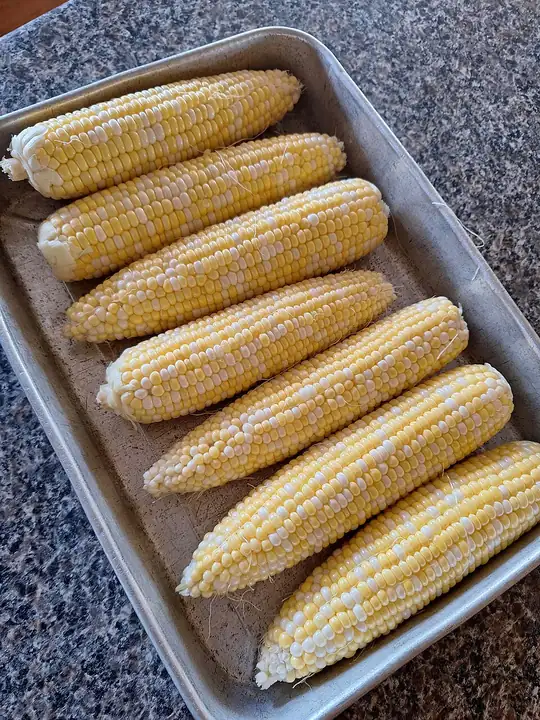
Sweet corn
Zea mays · Grass family (Poaceae)
When to plant: Sow seeds outdoors up to 2 weeks after the last frost.
| Hardiness zones | 3 to 11 |
|---|---|
| Sun | full sun |
| Water | moderate |
| Life cycle | annual |
| Frost | Tender: killed by frost |
| Soil pH | 5.8–7.0 |
| Spacing | 8 to 12 inches |
| Days to harvest | 63 to 92 days |
| Soil temperature to plant | at least 55°F |
About Sweet corn
Sweet corn is a summer favorite that is wind-pollinated, so it must be planted in blocks rather than a single row. Standard, sugar-enhanced and supersweet types differ in sweetness and must be kept apart to avoid cross-pollination.
Grown as a warm-season annual in every zone; it is killed by frost, so plant it out after the danger of frost has passed.
When to plant
Timing is counted from your average last spring frost (and first fall frost). Sow & Tell works out the actual dates for your ZIP code.
- Sow seeds outdoors: up to 2 weeks after the last frost
Days count from seeding. Standard types need soil above 55F and supersweets about 65F. Plant at least four short rows side by side, and sow again when the last planting has 3 to 4 leaves.
Soil
Well-drained soil with plenty of organic matter; corn is a heavy feeder with shallow roots.
Follow a soil test and keep pH about 6.0 to 7.0; work in compost, and without a test add about 30 lb of 5-10-10 per 1,000 sq ft (about 3 lb per 100 sq ft) before planting.
Feeding
- when plants are about knee high (12 to 18 inches, about 8 to 10 leaves): nitrogen fertilizer such as 21-0-0 or 46-0-0. Use about 1/2 lb of 21-0-0 per 100 sq ft, or 1/2 cup of 46-0-0 per 100 ft of row, about 6 inches from the plants, then water it in.
Look for: nitrogen, such as 21-0-0 or 46-0-0. Corn is a heavy nitrogen feeder and needs it most while it grows fast, before the tassels. - when the first tassels or silks appear: nitrogen fertilizer such as 21-0-0. Add about 1/4 lb of 21-0-0 per 100 sq ft about 6 inches from the plants and water it in.
Look for: nitrogen, such as 21-0-0 or 46-0-0. Corn is a heavy nitrogen feeder and needs it most while it grows fast, before the tassels.
Keep fertilizer about 6 inches from the stalks because corn is easily hurt by fertilizer salts; never use weed-and-feed products.
Harvest
Pick about 18 to 24 days after silks appear, when silks are dry and brown, the ear feels full to the tip, and a punctured kernel gives milky juice.
Pick ears once, when kernels in the middle of the ear are full and give milky juice; the stalk is then done.
Varieties (51)
| Variety | Type | Season and days | Notes |
|---|---|---|---|
| Golden Bantam | Heirloom, yellow | An heirloom yellow sweet corn first introduced in 1902. Sources: [14] | |
| Bi-Queen | Standard (su), bicolor | Late | Very sweet with a very tender kernel skin. Hybrid bicolor version of Silver Queen. Also listed as Bicolor Silver Queen. Sources: [15][16] |
| Butter and Sugar | Standard (su), bicolor | 75 to 82 days | Classic sweet corn flavor with creamy kernels; eat soon after picking because sugar turns to starch quickly. Bicolor ears with 12 to 14 rows of yellow and white kernels. Standard (su) type. Keep it away from supersweet (sh2) corn that silks at the same time. Sources: [15][17][18] |
| Honey and Cream | Standard (su), bicolor | 80 days | Yellow and white kernels on ears with 12 to 14 rows. Sources: [15][19] |
| Sweet G90 | Standard (su), bicolor | 80 to 90 days | Very tender and sweet. Bicolor hybrid recommended across several Texas regions and Mississippi. Also written Sweet G-90. Sources: [20][21][22] |
| Silver Queen | Standard (su), white | Late · 91 to 95 days | Standard (su) sweetness; sugar turns to starch soon after picking, so harvest it the day it will be eaten. Late, white corn with 14 to 18 rows of kernels. Resists rust, Stewart's wilt and corn leaf blights. Standard (su) type. Keep it away from supersweet (sh2) corn that silks at the same time. Sources: [11][17][19][20][23][24] |
| Earlivee | Standard (su), yellow | Very early · 63 days | Very early hybrid with well-filled, attractive ears of 10 to 14 rows and almost no suckers. Sources: [15][25] |
| Early Sunglow | Standard (su), yellow | Early · 63 days | Classic sweet corn flavor with creamy kernels; eat soon after picking because sugar turns to starch quickly. An early yellow sweet corn. Standard (su) type. Keep it away from supersweet (sh2) corn that silks at the same time. Sources: [11][15][16][26] |
| Golden Cross Bantam | Standard (su), yellow | 80 to 85 days | Yellow-kerneled corn with 12 to 14 rows per ear. Sources: [15] |
| Golden Queen | Standard (su), yellow | Late · 92 days | Classic sweet corn flavor with creamy kernels; eat soon after picking because sugar turns to starch quickly. Late yellow corn with northern corn leaf blight resistance. Standard (su) type. Keep it away from supersweet (sh2) corn that silks at the same time. Sources: [18][24][26] |
| Jubilee | Standard (su), yellow | 82 days | Classic sweet corn flavor with creamy kernels; eat soon after picking because sugar turns to starch quickly. A yellow hybrid on Utah State's and Kansas State's lists. Standard (su) type. Keep it away from supersweet (sh2) corn that silks at the same time. Sources: [19][25] |
| Merit | Standard (su), yellow | 75 to 84 days | Classic sweet corn flavor with creamy kernels; eat soon after picking because sugar turns to starch quickly. Yellow corn with 16 to 20 rows of kernels. Standard (su) type. Keep it away from supersweet (sh2) corn that silks at the same time. Sources: [11][16][19][20][23] |
| Sundance | Standard (su), yellow | Early · 71 days | Short, sturdy hybrid with 7.5 to 8-inch ears of 12 to 16 rows. Sources: [19][23] |
| Stowell's Evergreen | Standard, white, heirloom | Late | An heirloom, late-season white sweet corn. Sources: [14] |
| Luscious | Sugar-enhanced (se) | 75 days | Large, blocky ears filled with sweet kernels. Easy to pick. Sources: [27][28][29] |
| Ambrosia | Sugar-enhanced (se), bicolor | Midseason · 75 days | Sweeter and more tender than standard types, and holds its sweetness a few days longer. Main-season bicolor hybrid. Resists Stewart's wilt. Sugar-enhanced (se) type. Keep it away from supersweet (sh2) and field corn that silk at the same time. Sources: [11][15][17][18][19][24] |
| Delectable | Sugar-enhanced (se), bicolor | 80 days | Sweeter and more tender than standard types, and holds its sweetness a few days longer. Main-season bicolor hybrid. Resists rust. Sugar-enhanced (se) type. Keep it away from supersweet (sh2) and field corn that silk at the same time. Sources: [15][17][19][29] |
| Peaches and Cream | Sugar-enhanced (se), bicolor | 83 days | Tender, with very good eating quality. Productive bicolor hybrid with tender kernels. Resists southern and northern corn leaf blight. Sugar-enhanced (se) type. Keep it away from supersweet (sh2) and field corn that silk at the same time. Sources: [11][18][23][24] |
| Trinity | Sugar-enhanced (se), bicolor | Early · 68 days | Sweeter and more tender than standard types, and holds its sweetness a few days longer. Early to midseason bicolor hybrid. Sugar-enhanced (se) type. Keep it away from supersweet (sh2) and field corn that silk at the same time. Sources: [17][18][23][29] |
| Argent | Sugar-enhanced (se), white | 80 to 86 days | Excellent eating quality. Midseason white hybrid. Resists northern corn leaf blight, rust and Stewart's wilt. Sugar-enhanced (se) type. Keep it away from supersweet (sh2) and field corn that silk at the same time. Sources: [15][19][24][26] |
| Platinum Lady | Sugar-enhanced (se), white | Early · 80 days | High eating quality. White kernels and white silks, with about 14 rows per ear. Sources: [23][25] |
| Silver King | Sugar-enhanced (se), white | 82 days | Sweeter and more tender than standard types, and holds its sweetness a few days longer. White hybrid with large ears. Resists northern corn leaf blight, Stewart's wilt and rust. Sugar-enhanced (se) type. Keep it away from supersweet (sh2) and field corn that silk at the same time. Sources: [11][18][19][23][24] |
| Silver Princess | Sugar-enhanced (se), white | 75 days | Sweeter and more tender than standard types, and holds its sweetness a few days longer. White hybrid that resists northern corn leaf blight, Stewart's wilt and rust. Sugar-enhanced (se) type. Keep it away from supersweet (sh2) and field corn that silk at the same time. Sources: [11][18][24][30] |
| Sweet Ice | Sugar-enhanced (se), white | 74 days | White corn with 7-inch ears of 14 to 16 rows, good tip fill and dark green husks. Sources: [23][24] |
| Bodacious | Sugar-enhanced (se), yellow | 75 days | Excellent eating quality; sweeter and more tender than standard types, and holds its sweetness a few days longer. Yellow hybrid that adapts to many regions. Resists rust. Sugar-enhanced (se) type. Keep it away from supersweet (sh2) and field corn that silk at the same time. Sources: [15][16][17][18][19][26] |
| Incredible | Sugar-enhanced (se), yellow | Late · 85 days | Sweeter and more tender than standard types, and holds its sweetness a few days longer. Late yellow hybrid. Resists northern corn leaf blight, rust and Stewart's wilt. Sugar-enhanced (se) type. Keep it away from supersweet (sh2) and field corn that silk at the same time. Sources: [19][24][25] |
| Kandy Korn | Sugar-enhanced (se), yellow | 83 to 89 days | Sweeter and more tender than standard types, and holds its sweetness a few days longer. A long-standing yellow se hybrid. Sugar-enhanced (se) type. Keep it away from supersweet (sh2) and field corn that silk at the same time. Sources: [17][19][20][31] |
| Miracle | Sugar-enhanced (se), yellow | 82 to 85 days | Sweeter and more tender than standard types, and holds its sweetness a few days longer. Yellow hybrid with large ears. Resists northern corn leaf blight, rust and Stewart's wilt. Sugar-enhanced (se) type. Keep it away from supersweet (sh2) and field corn that silk at the same time. Sources: [19][23][24][25] |
| Sugar Buns | Sugar-enhanced (se), yellow | Early · 70 to 72 days | Sweeter and more tender than standard types, and holds its sweetness a few days longer. An early, high-quality yellow se hybrid. Sugar-enhanced (se) type. Keep it away from supersweet (sh2) and field corn that silk at the same time. Sources: [11][17][18][23][25] |
| Troubadour | Supersweet (sh2) | Late · 82 days | Outstanding flavor. Holds well in the field. Germinated well and produced large ears in North Dakota trials. Sources: [32][33][34] |
| Xtra-Tender 274A | Supersweet (sh2) | Midseason | Tender kernels. Ripened early and produced large ears in North Dakota trials. Sources: [33][34][35] |
| American Dream | Supersweet (sh2), bicolor | Bicolor supersweet recommended in both Georgia and North Dakota. Sources: [18][34][36] | |
| Candy Store | Supersweet (sh2), bicolor | 81 days | Bicolor supersweet hybrid from Harris Moran. Sources: [15][19] |
| Honey 'n Pearl | Supersweet (sh2), bicolor | 76 to 78 days | Very sweet, crisp kernels that stay sweet for about a week in the refrigerator. Sturdy plants with large, well-filled ears about 8.5 inches long and 16 to 18 rows. An All-America Selections winner. Supersweet (sh2) type. Isolate from su, se and field corn by about 300 feet or by at least two weeks of silking time, or both kinds lose quality. Needs warmer soil (about 65F) to germinate well. Sources: [15][16][17][20][25] |
| Obsession | Supersweet (sh2), bicolor | 73 to 79 days | Very sweet, crisp kernels that stay sweet for about a week in the refrigerator. Bicolor with ears about 8.5 inches long and 18 to 20 rows. Resists northern corn leaf blight, rust and Stewart's wilt. Supersweet (sh2) type. Isolate from su, se and field corn by about 300 feet or by at least two weeks of silking time, or both kinds lose quality. Needs warmer soil (about 65F) to germinate well. Sources: [18][23][24] |
| How Sweet It Is | Supersweet (sh2), white | Late · 85 to 87 days | Very sweet, crisp kernels that stay sweet for about a week in the refrigerator. One of the first white supersweet hybrids and an All-America Selections winner. Supersweet (sh2) type. Isolate from su, se and field corn by about 300 feet or by at least two weeks of silking time, or both kinds lose quality. Needs warmer soil (about 65F) to germinate well. Sources: [15][17][18][19][20][25] |
| Early Xtra Sweet | Supersweet (sh2), yellow | Early · 68 to 70 days | Very sweet, crisp kernels that stay sweet for about a week in the refrigerator. Early yellow supersweet with ears about 7.5 inches long. Supersweet (sh2) type. Isolate from su, se and field corn by about 300 feet or by at least two weeks of silking time, or both kinds lose quality. Needs warmer soil (about 65F) to germinate well. Sources: [15][17] |
| Illini Xtra Sweet | Supersweet (sh2), yellow | 85 days | Very sweet, crisp kernels that stay sweet for about a week in the refrigerator. A yellow supersweet hybrid on Utah State's list. Supersweet (sh2) type. Isolate from su, se and field corn by about 300 feet or by at least two weeks of silking time, or both kinds lose quality. Needs warmer soil (about 65F) to germinate well. Sources: [25] |
| Northern Xtra Sweet | Supersweet (sh2), yellow | Early · 63 to 67 days | Very sweet, crisp kernels that stay sweet for about a week in the refrigerator. Very early yellow supersweet with ears about 9 inches long. Supersweet (sh2) type. Isolate from su, se and field corn by about 300 feet or by at least two weeks of silking time, or both kinds lose quality. Needs warmer soil (about 65F) to germinate well. Sources: [17][23] |
| Supersweet Jubilee | Supersweet (sh2), yellow | Late · 82 to 87 days | Very sweet, crisp kernels that stay sweet for about a week in the refrigerator. Late yellow supersweet that resists rust. Supersweet (sh2) type. Isolate from su, se and field corn by about 300 feet or by at least two weeks of silking time, or both kinds lose quality. Needs warmer soil (about 65F) to germinate well. Sources: [17][25] |
| Vision | Supersweet (sh2), yellow | 75 days | Very sweet, crisp kernels that stay sweet for about a week in the refrigerator. Yellow supersweet that resists rust and southern corn leaf blight. Supersweet (sh2) type. Isolate from su, se and field corn by about 300 feet or by at least two weeks of silking time, or both kinds lose quality. Needs warmer soil (about 65F) to germinate well. Sources: [17][24] |
| Montauk | Synergistic (se + su), bicolor | 81 days | Very sweet, crisp and tender kernels. Bicolor synergistic hybrid. University of Minnesota advises isolating it from su, sh2 and other synergistic types. Sources: [17][18][29] |
| Mirai | Synergistic (su + se + sh2) | 70 to 76 days | Very sweet, crisp and tender kernels. A family of hybrids (yellow, bicolor and others) with ears around 7.75 inches and good tip fill. University of Minnesota advises isolating Mirai from all other genetic types. Sources: [17][18][20][23] |
| Honey Select | Synergistic / triple sweet (se + sh2), yellow | 79 days | Very sweet, crisp and tender kernels. Yellow triple-sweet hybrid. Resists Stewart's wilt. Contains sh2 kernels, so isolate it from sh2 varieties (University of Minnesota). Sources: [15][17][18][24][30][31] |
| Providence | Synergistic / triple sweet, bicolor | Main season | Triple-sweet type with long, well-filled, slightly tapered ears. Sources: [18][23] |
| Serendipity | Synergistic / triple sweet, bicolor | 82 days | Very sweet, crisp and tender kernels. Bicolor triple-sweet hybrid. Synergistic type. Isolate from other genetic types by distance or by at least two weeks of maturity. Sources: [18][23] |
| Avalon | Synergistic / triple sweet, white | 82 to 84 days | Very sweet, crisp and tender kernels. The first white variety in the Triple Sweet line. Synergistic type. Isolate from other genetic types by distance or by at least two weeks of maturity. Sources: [15][18][24] |
| Celestial | Synergistic, white | 87 days | White synergistic corn listed with resistance to northern corn leaf blight and rust. Sources: [24] |
| Country Gentleman | White, Country Gentleman type | Late · 92 days | White corn of the old Country Gentleman type. Sources: [15] |
| Snowbelle | White, hybrid | Midseason · 79 to 85 days | Very tender and sweet, with a creamy texture. White hybrid that ripens about 5 to 7 days before Silver Queen. Sources: [16][20][21][23] |
| Spring Treat | Yellow | Very early · 66 days | Very sweet yellow kernels. Very early corn that does well in cool soils and is easy to harvest. Sources: [37][38] |
Good neighbors
Green beans (snap beans), Winter squash and pumpkin, Lettuce
UMN and UMD Extension describe the Three Sisters (corn, beans, squash) as a long-used Indigenous system; shade-tolerant greens can go on the north side of corn.
Pests to watch for
Corn earworm (tomato fruitworm), Flea beetles, White grubs, Aphids, Cutworms, Grasshoppers, Stink bugs, Harlequin bug, European earwig, Squash beetle, Corn rootworms, Raccoon, Red imported fire ant, Garden symphylan, Rose chafer, Green June beetle (fig-eater), Fall armyworm, Beet armyworm, European corn borer, Seedcorn maggot, Blister beetles, Deer, Tree squirrels
Diseases and problems
Smut, Stewart's wilt, Leaf rust, Poor pollination, Hail and wind damage, Nitrogen deficiency, Magnesium deficiency, Frost and freeze injury
In the kitchen
Boiled, grilled or roasted on the cob, or cut off for salads, soups and salsas; sugary types lose sweetness fast after picking.
Keeping it: Corn loses sweetness fast: refrigerate ears in their husks and eat them within 1 to 2 days. For preserving, work within a few hours of picking.
Pets: Not listed as toxic by the ASPCA (its toxic 'corn plant' entry is the houseplant Dracaena fragrans, not sweet corn).
Sources
- extension.umn.edu
- extension.illinois.edu
- extension.unh.edu
- extension.colostate.edu
- extension.umn.edu
- extension.umd.edu
- extension.psu.edu
- aspca.org
- extension.usu.edu
- extension.wvu.edu
- hgic.clemson.edu
- riley.k-state.edu
- extension.oregonstate.edu
- hort.extension.wisc.edu
- cucurbit.info
- extension.okstate.edu
- extension.umn.edu
- fieldreport.caes.uga.edu
- bookstore.ksre.ksu.edu
- agrilifeextension.tamu.edu
- extension.msstate.edu
- agrilife.org
- cucurbit.info
- publications.mgcafe.uky.edu
- extension.usu.edu
- agrilifeextension.tamu.edu
- ndsu.edu
- agrilifeextension.tamu.edu
- florence.extension.wisc.edu
- aces.edu
- franklin.ces.ncsu.edu
- ndsu.edu
- ndsu.edu
- ndsu.edu
- ndsu.edu
- ndsu.edu
- ndsu.edu
- ndsu.edu
Photo: Photo: Heidi Meudt, CC BY-SA 4.0, via Wikimedia Commons (CC BY-SA 4.0). Photo resized for the web.

Planting dates and advice are general guidance; check with your local Cooperative Extension office for your area.