
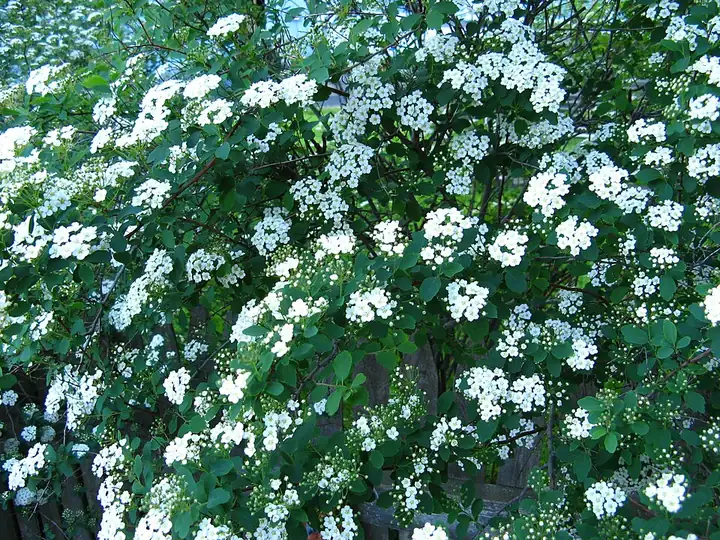
Spirea
Spiraea prunifolia (bridalwreath), S. x vanhouttei (Vanhoutte), S. thunbergii, S. betulifolia (birchleaf), S. japonica and S. x bumalda (Japanese spirea) · Rose family (Rosaceae)
When to plant: Fall is the best planting time, and late fall after the leaves drop is best for moving plants (Clemson).
| Hardiness zones | 3 to 9 |
|---|---|
| Sun | full sun to part shade |
| Water | moderate |
| Life cycle | perennial |
| Frost | Hardy: takes frost |
About Spirea
Spireas are some of the easiest flowering shrubs: fast-growing and generally deer resistant, with spring kinds covered in tiny white flowers and summer kinds with flat pink clusters that draw butterflies (Clemson). Japanese spirea (S. japonica) and its bumalda hybrids escape into woods and are listed as invasive in Virginia, Georgia, South Carolina, Tennessee, Kentucky and North Carolina, so Southeastern extension services don't recommend them. NC State suggests native alternatives such as New Jersey tea, dwarf fothergilla, Virginia sweetspire, mountain laurel and ninebark.
Most spireas grow in zones 3-8 (Clemson, NC State). Japanese spirea is invasive in the Southeast and in the Great Smoky Mountains (NC State, Clemson).
When to plant
Fall is the best planting time, and late fall after the leaves drop is best for moving plants (Clemson).
Mulch, and water in summer with drip rather than sprinklers.
Soil
Almost any well-drained soil; avoid soggy spots, where Phytophthora and Pythium root rots strike (Clemson).
Test the soil before planting; mature shrubs in decent soil need little or no fertilizer (Clemson).
Feeding
- Spring to early summer after new growth starts, only if a soil test shows a need: slow-release complete fertilizer in a 3:1:2 ratio, or what the soil test calls for. Spread evenly from the trunk out to the drip line and water it in; a typical soil-test rate for shrubs is about 2 lb of 12-6-6 per 100 sq ft (Clemson). Follow a soil test.
Look for: mostly nitrogen, in spring as growth starts. Spring feeding grows the new shoots and leaves that carry flowers and fruit; feeding after midsummer pushes soft growth that may not harden before winter.
Water is what new shrubs need most: daily for the first 2 weeks, every 2-3 days through week 12, then weekly until the roots spread (at least two growing seasons), using about a quarter to a third of the nursery pot's volume each time (UMN). Mulch and water in summer, using drip rather than overhead sprinklers (Clemson).
Harvest
Spring bloomers (bridalwreath, Vanhoutte, Thunberg) flower white in early to mid spring: prune them right after bloom and take a few old canes to the ground each year. Summer bloomers (Japanese and bumalda types) flower pink in June-July on new wood: prune in late winter or early spring, and shear off spent flowers for a second flush (Clemson).
Varieties (13)
Clemson and NC State document these. Japanese and bumalda spireas are invasive in the Southeast and not recommended; the last group is listed so gardeners can recognize them.
| Variety | Type | Season and days | Zones | Notes |
|---|---|---|---|---|
| Glow Girl ('Tor Gold') | Birchleaf | Late spring | 3–8 | 3-4 ft; lemon-lime leaves; white flowers. Sources: [1] |
| Tor | Birchleaf (S. betulifolia) | Late spring | 4–8 | Rounded 2-3 ft; tiny white flowers; orange, red and purple fall leaves. Sources: [1] |
| Anthony Waterer | Bumalda (Japanese spirea hybrid), not recommended | Summer | 4–8 | 2-3 ft tall; carmine-red flat clusters; purple fall color. Sources: [1] |
| Goldflame | Bumalda, not recommended | Summer | 4–8 | 2-3 ft; orange-gold new leaves; bright pink flowers. Sources: [1] |
| Limemound ('Monhub') | Bumalda, not recommended | Early summer | 3–8 | 3 ft tall, 4 ft wide; lemon-yellow new growth; hot pink flowers. Sources: [1] |
| Double Play Doozie ('NCSX2') | Hybrid | Late spring, summer and fall | 3–9typical for spirea | Sterile, repeat-blooming, 2-3 ft; red to purplish-red flowers. Sources: [1] |
| Little Princess | Japanese spirea, not recommended | 3–9typical for spirea | Compact, 2-3 ft; small pink clusters. Sources: [2] | |
| Shirobana | Japanese spirea, not recommended | 3–9typical for spirea | Rose, pink and white flowers on one plant; about 3 ft. Sources: [2] | |
| Snowmound | Nippon (S. nipponica) | Late spring | 3–8 | 2-4 ft; dark blue-green leaves; white flowers. Sources: [1] |
| Lanceolata | Reeves (S. cantoniensis) | Spring | 5–9 | 4-6 ft tall, 6 ft wide; double, rose-like white flowers. Sources: [1] |
| Grefsheim (First Snow) | S. x cinerea | Early spring | 4–7 | 4-5 ft; fragrant white flowers before the leaves. Sources: [1] |
| Ogon (Gold Thread) | Thunberg (S. thunbergii) | Early spring | 3–8 | 3-4 ft; chartreuse willow-like leaves; white flowers before the leaves. Sources: [1] |
| Renaissance | Vanhoutte (S. x vanhouttei) | Spring | 3–8 | Arching, about 5 ft tall and 6 ft wide; white flowers; bred for leaf disease resistance; orange-red fall color. Sources: [1] |
Pests to watch for
Diseases and problems
Phytophthora root rot, Leaf spot, Powdery mildew, Fire blight
In the kitchen
Safety: No toxicity is listed for spirea in the extension sources we used.
Pets: Not on the ASPCA toxic plant lists.
Sources
- hgic.clemson.edu
- plants.ces.ncsu.edu
- aspca.org
- aspca.org
- extension.rutgers.edu
- extension.rutgers.edu
- extension.rutgers.edu
- hgic.clemson.edu
- extension.umn.edu
Photo: Photo: Rgm3 at English Wikipedia / Wikimedia Commons, CC BY 2.5 (CC BY 2.5). Photo resized for the web.

Planting dates and advice are general guidance; check with your local Cooperative Extension office for your area.