
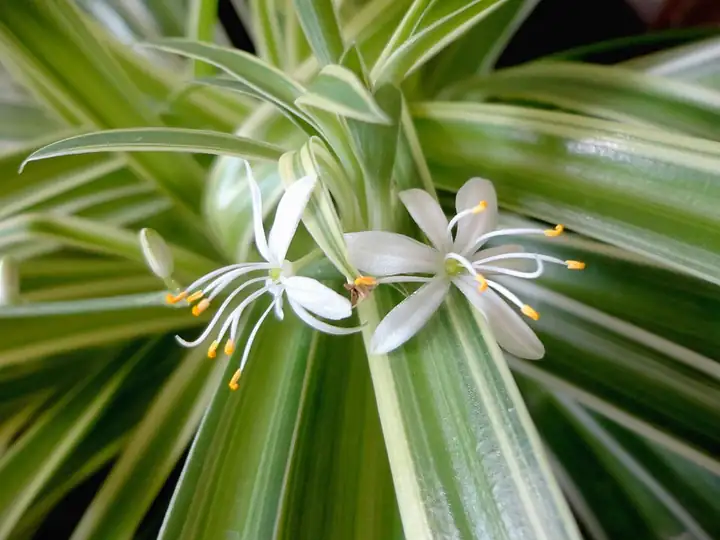
Spider plant
Chlorophytum comosum · Asparagus family (Asparagaceae)
When to plant: Any time of year, since it grows indoors. Repot yearly while young and every other year once mature; outdoors, set it out only after the last frost.
| Hardiness zones | 9 to 11 |
|---|---|
| Sun | part shade |
| Water | moderate |
| Life cycle | perennial |
| Frost | Tender: killed by frost |
Will it grow in your window?
Pick the window it sits in. This is the same check Sow & Tell runs for every plant in your house.
It wants bright, indirect light.
Pick a window above and this will tell you whether the spot suits it.
Watering: water when the top inch is dry — about every 7 days, stretching to every 12 from November to February.
Summering outside? Bring it in before nights drop below 50°F.
About Spider plant
The spider plant is a fountain of grassy, usually white-striped leaves from southern and tropical Africa that sends out long stems tipped with tiny white flowers and baby plants, the 'spiders', that root wherever they touch soil (NC State, Wisconsin Horticulture). Thick, fleshy roots store water, so it forgives a missed watering, and it is safe around cats and dogs. In Florida it escapes into shady landscapes, and UF/IFAS no longer recommends planting it outdoors there.
Hardy outdoors in zones 9-11 (NC State); it is grown indoors everywhere, used as a summer annual in cool climates, and can summer outdoors in shade once nights stay above about 50 F.
When to plant
Any time of year, since it grows indoors. Repot yearly while young and every other year once mature; outdoors, set it out only after the last frost.
Usually bought as a nursery plant or started from a plantlet pinned into a pot of mix (Wisconsin Horticulture); in cool climates it is set outdoors only after the last frost.
Growing it indoors
- Light: Medium to bright indirect light year-round; it tolerates low light but not hot direct sun, which scorches the leaves (NC State, Wisconsin Horticulture).
- Water: Let the top inch of mix dry briefly between thorough waterings (UF/IFAS); the thick roots forgive a missed one (Wisconsin Horticulture). Water less in winter (NC State), and if your tap water is fluoridated use rainwater or distilled water, since fluoride, chlorine and salt buildup brown the leaf tips.
- Humidity: Average room humidity is fine; very dry air adds brown tips, so a pebble tray or humidifier helps in winter (NC State, Wisconsin Horticulture).
- Temperature: MU Extension suggests 50 F nights and NC State says keep it above 45 F; UF/IFAS calls anything below 55 F too cool and above 80 F too warm, so it likes a cool room.
- Feeding: Feed only every 3-4 months, or more often at half strength; heavy feeding cuts plantlet production and browns the leaf tips (Wisconsin Horticulture, NC State).
- Repotting: Repot yearly while young and every other year once mature (UF/IFAS); the fleshy roots crowd a pot fast, but a slightly pot-bound plant makes the most plantlets (Wisconsin Horticulture).
- More plants: Pin a plantlet to a small pot of mix with a bent paper clip while it is still attached, cut it free once rooted, or snip plantlets off and pot them; big plants can be divided (Wisconsin Horticulture, NC State).
If something looks wrong
| What you see | Likely cause | What to do |
|---|---|---|
| Brown, dry leaf tips | Fluoride or chlorine in tap water, fertilizer salts, dry air or dry soil | Switch to rainwater or distilled water, flush the pot, ease off fertilizer and raise humidity (Wisconsin Horticulture, UF/IFAS). |
| Pale, bleached or scorched leaves | Direct sun | Move it back from the window into bright indirect light (Wisconsin Horticulture). |
| Yellow leaves, soggy mix, mushy roots | Root rot from overwatering or poor drainage | Let it dry, check the drainage hole and repot in fresh mix (Wisconsin Horticulture). |
| No baby plants | Too much fertilizer, or nights broken by lamp light | Feed less and give it long, dark nights for a few weeks (NC State, Wisconsin Horticulture). |
Soil
Any good potting mix with drainage; it tolerates a wide range of soils (NC State, UF/IFAS).
Pot in any good potting mix with drainage; keep it slightly pot-bound for the most plantlets (Wisconsin Horticulture).
Feeding
- Spring through fall: balanced houseplant fertilizer. Every 3-4 months at label strength, or more often at half strength (Wisconsin Horticulture).
- Winter: none. Skip feeding and water less (NC State, MU Extension).
Heavy feeding cuts plantlet production and browns the leaf tips, and fertilizer salts add to the tip burn caused by fluoridated tap water (Wisconsin Horticulture, NC State).
Varieties (8)
NC State, Wisconsin Horticulture and UF/IFAS name 8 cultivars.
| Variety | Type | Zones | Notes |
|---|---|---|---|
| Bonnie | Curly | 9–11typical for spider plant | Green leaves that curl and twist; compact. Sources: [1] |
| Bonnie Variegated | Curly | 9–11typical for spider plant | Curled green leaves with creamy-white stripes. Sources: [1] |
| Hawaiian | Fading variegation | 9–11typical for spider plant | New leaves come in variegated and fade to green with age. Sources: [1] |
| Milky Way | White center stripe | 9–11typical for spider plant | Broad white or cream center with green margins. Sources: [1][2] |
| Vittatum | White center stripe | 9–11typical for spider plant | The most common spider plant: medium green leaves with a wide creamy-white center stripe. Sources: [1][3] |
| White Stripe | White center stripe | 9–11typical for spider plant | A narrow white or cream vein line down the center; cream to yellowish flower stalks. Sources: [1][2] |
| Variegatum | White edge | 9–11typical for spider plant | Green leaves edged in white or cream. Sources: [1][2] |
| Picturatum | Yellow center stripe | 9–11typical for spider plant | A central yellow stripe instead of white. Sources: [1] |
Pests to watch for
Diseases and problems
Root and crown rot, Brown leaf tips (tip burn)
In the kitchen
Safety: No poisonous parts are reported; NC State tags it non-toxic to people, cats, dogs and horses. Fluoride and chlorine in tap water harm the plant's leaf tips, not people.
Pets: Clemson HGIC lists it among pet-safe houseplants and NC State tags it non-toxic to cats, dogs and horses; the ASPCA's own spider plant page would not load for us, so check it before you rely on this.
Sources
- plants.ces.ncsu.edu
- hort.extension.wisc.edu
- gardeningsolutions.ifas.ufl.edu
- assessment.ifas.ufl.edu
- extension.missouri.edu
- hgic.clemson.edu
Photo: Photo: Juan Carlos Fonseca Mata, CC BY-SA 4.0, via Wikimedia Commons (CC BY-SA 4.0). Photo resized for the web.

Planting dates and advice are general guidance; check with your local Cooperative Extension office for your area.