
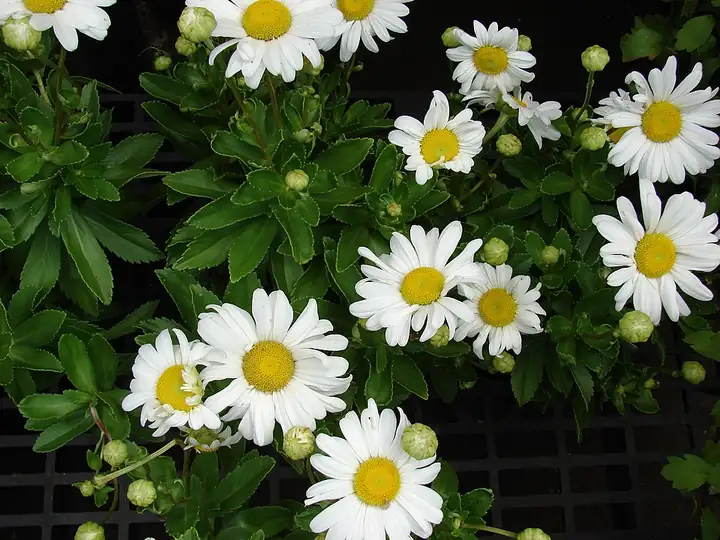
Shasta daisy
Leucanthemum x superbum · Daisy family (Asteraceae)
When to plant: Plant in spring or fall and divide every 2-3 years to keep clumps vigorous (NC State).
| Hardiness zones | 5 to 9 |
|---|---|
| Sun | full sun to part shade |
| Water | moderate |
| Life cycle | perennial |
| Frost | Hardy: takes frost |
| Spacing | 12 to 36 inches |
About Shasta daisy
Shasta daisies are the classic white-and-yellow summer daisy, bred by Luther Burbank in Santa Rosa, California, in the 1890s and named for the snowy peak of Mount Shasta. They are great cut flowers and draw bees and butterflies. They are often short-lived, mostly because they rot in wet winter soil, so give them good drainage. Their weedy cousin oxeye daisy (Leucanthemum vulgare) is a noxious weed in Washington and other states; don't plant it by mistake.
Hardy in zones 5-9; in central and south Florida summer heat kills it, so it is grown as an annual there (UF/IFAS).
When to plant
Plant in spring or fall and divide every 2-3 years to keep clumps vigorous (NC State).
Heavy, wet winter soil, not cold, killed most plants in Chicago's trial, so a raised or well-drained spot matters most.
Soil
Fertile, well-drained soil; plants rot and die over winter in heavy, wet clay (Chicago Botanic Garden, NC State).
Follow a soil test; loosen the bed 8-10 inches deep and work in compost, and make sure it drains well (Clemson; Chicago Botanic Garden).
Feeding
- early spring, before new growth starts: slow-release complete fertilizer such as 12-6-6. Scatter 1-2 lb per 100 sq ft and water it in (Clemson).
Look for: a balanced or all-purpose fertilizer at the label rate. Skip high-phosphorus "bloom boosters" unless a soil test shows low phosphorus: most garden soils already have enough, and the extra can wash into streams.
Wet, heavy winter soil kills more Shasta daisies than cold (Chicago Botanic Garden).
Harvest
Blooms from June into September. Deadhead regularly for more flowers and to limit self-seeding (UF/IFAS; Chicago Botanic Garden). Cut for vases when flowers are open.
Varieties (21)
| Variety | Type | Season and days | Zones | Notes |
|---|---|---|---|---|
| Sunnyside Up | Crested | Late June to early August | 5–9typical for shasta daisy | 36 in plants. 3-star rating. Sources: [2] |
| T.E. Killin | Crested | Late June to early August | 5–9typical for shasta daisy | 24 in plants with a raised, crested center. 4-star rating. Sources: [2] |
| Wirral Pride | Crested | Late June to early August | 5–9typical for shasta daisy | 36 in plants. 3-star rating. Sources: [2] |
| Real Glory | Frilly | 5–9typical for shasta daisy | Frilly, ribbon-like petals. Sources: [4] | |
| Aglaia | Frilly double | Late June to late August | 5–9typical for shasta daisy | Double flowers on 34 in plants. 3-star rating. Sources: [2] |
| Crazy Daisy | Frilly double | 5–9typical for shasta daisy | Frilly, ribbon-like petals. Did not finish the Chicago trial. Sources: [4] | |
| Snowdrift | Frilly double | Late June to early August | 5–9typical for shasta daisy | Double flowers on 34 in plants with excellent bloom. 4-star rating; flower form varies. Sources: [2] |
| Alaska | Single | Late June to early September | 5–9typical for shasta daisy | An old, widely sold single on 40 in plants. Only 2 stars in Chicago because of root rot. Sources: [2] |
| Amelia | Single | Mid-June to early August | 5–9typical for shasta daisy | The largest flowers in the trial, about 5 in across, on 40 in plants. 5-star rating; seed-grown, so plants vary a little. Sources: [2] |
| Becky | Single | Early July to early September | 5–9typical for shasta daisy | Single white daisies on uniform 40 in plants; excellent resistance to Phytophthora root rot. 5-star rating in Chicago; 2003 Perennial Plant of the Year. UF/IFAS notes it resists rot and leaf spot. Sources: [1][2][4] |
| Hebron Hardy | Single | Late June to late August | 5–9typical for shasta daisy | 34 in plants. 3-star rating. Sources: [2] |
| Nordlicht | Single | Late June to mid-August | 5–9typical for shasta daisy | 30 in plants. 4-star rating. Sources: [2] |
| Rijnsburg Glory | Single | Late May to mid-July | 5–9typical for shasta daisy | 28 in plants with heavy early bloom; spreads by rhizomes. 4-star rating. Sources: [2] |
| Supra | Single | Late June to late August | 5–9typical for shasta daisy | 39 in plants. 4-star rating; seed-grown. Sources: [2] |
| Switzerland | Single | Late June to early September | 5–9typical for shasta daisy | Uniform plants about 32 in tall with heavy bloom. 4-star rating. Sources: [2] |
| White Knight | Single | Early June to late August | 5–9typical for shasta daisy | 24 in plants that always started blooming in early June. 4-star rating. Sources: [2] |
| Exhibition | Single to semi-double | Late June to late August | 5–9typical for shasta daisy | 36 in plants. 4-star rating; seed-grown. Sources: [2] |
| Daisy May | Single, compact | 5–9typical for shasta daisy | 1-2 ft plants that bloom spring to fall. Sources: [1] | |
| Snow Lady | Single, dwarf | 5–9typical for shasta daisy | Dwarf plants 9-26 in tall. Only 2 stars in Chicago because of winter losses; NC State notes poor leaf spot resistance. Sources: [1][2] | |
| Snowcap | Single, dwarf | Late June to early August | 5–9typical for shasta daisy | Compact plants 12-20 in tall. 4-star rating. Sources: [1][2] |
| Tinkerbelle | Single, dwarf | Late June to early August | 5–9typical for shasta daisy | 16 in plants with heavy bloom. 3-star rating. Sources: [2] |
Pests to watch for
Aphids, Leafminers, Twospotted spider mite, Slugs, Four-lined plant bug
Diseases and problems
Phytophthora root rot, Leaf spot, Powdery mildew, Verticillium wilt
In the kitchen
Safety: Mildly toxic if eaten: it can cause drooling, mouth irritation, vomiting and diarrhea, and handling it can irritate skin (NC State).
Pets: Not listed by name by the ASPCA, but its 'Daisy' entry (Chrysanthemum species, a close relative) is toxic to dogs and cats; NC State says Shasta daisy can cause drooling, mouth irritation, vomiting and diarrhea, and lists it as a problem for cats and dogs.
Sources
- plants.ces.ncsu.edu
- chicagobotanic.org
- extension.illinois.edu
- gardeningsolutions.ifas.ufl.edu
- extension.okstate.edu
- nwcb.wa.gov
- aspca.org
- aspca.org
- aspca.org
- aspca.org
- hgic.clemson.edu
Photo: Photo: Forest and Kim Starr, CC BY 3.0, via Wikimedia Commons (CC BY 3.0). Photo resized for the web.

Planting dates and advice are general guidance; check with your local Cooperative Extension office for your area.