
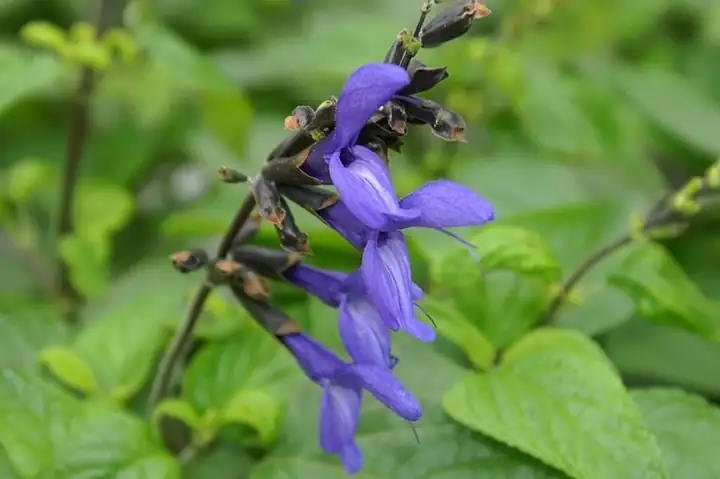
Salvia (ornamental sage)
Salvia spp. (ornamental kinds such as S. nemorosa, S. guaranitica, S. greggii, S. elegans, S. splendens and S. coccinea) · Mint family (Lamiaceae)
When to plant: Start seeds indoors 6 to 8 weeks before the last frost.
| Hardiness zones | 4 to 11 |
|---|---|
| Sun | full sun |
| Water | moderate |
| Life cycle | perennial |
| Frost | Tender: killed by frost |
About Salvia (ornamental sage)
Ornamental salvias are the flowering cousins of kitchen sage (see the separate "sage" entry), with spikes of tubular flowers in red, blue, purple, pink and white from early summer to frost. They are some of the most reliable hummingbird plants you can grow: Clemson calls them hummingbird favorites, and in Chicago Botanic Garden's trial the dark purple 'Amistad' drew hummingbirds all season. Some are hardy perennials (woodland sage S. nemorosa, autumn sage S. greggii), while scarlet sage, pineapple sage, anise sage and bedding sage are tender and are grown as annuals in colder zones. One catch: NC State notes that many bedding cultivars of S. splendens have been bred with no nectar, so pick nectar-rich kinds for hummingbirds.
Depends on the species: woodland sage is hardy in zones 4-8, autumn sage 6-9, anise sage ('Black and Blue') about 7-10, pineapple and scarlet sage 8-10, and bedding sage only 10-11 (NC State); the tender kinds are grown as summer annuals everywhere else. Heads-up: meadow clary (Salvia pratensis) is a Class A noxious weed in Washington, where it is illegal to buy, sell or plant (Washington State Noxious Weed Control Board).
When to plant
Timing is counted from your average last spring frost (and first fall frost). Sow & Tell works out the actual dates for your ZIP code.
- Start seeds indoors: 6 to 8 weeks before the last frost
Set plants out in spring after the danger of frost has passed (Clemson). Start bedding sage indoors 6-8 weeks ahead and don't cover the seed, since it needs light to sprout (Clemson; NC State); Clemson starts other salvias about 12 weeks ahead. Woodland sage and autumn sage are hardy perennials; the rest are frost-tender.
Soil
Well-drained soil; most salvias are quite drought-tolerant once established, and too much water or fertilizer invites fungal disease (Clemson). Bedding sage (S. splendens) is the exception and needs regular water (NC State).
Follow a soil test; work compost into the bed and make sure it drains well. Clemson amends the soil only as a soil test directs.
Feeding
- perennial salvias, early spring as new growth starts (only if a soil test or weak growth calls for it): complete slow-release fertilizer such as 12-6-6. Clemson says perennial salvias in compost-enriched soil usually need no extra feeding; if you do feed, use a light hand (about 1-2 lb of 12-6-6 per 100 sq ft) and water it in.
Look for: a balanced or all-purpose fertilizer at the label rate. Skip high-phosphorus "bloom boosters" unless a soil test shows low phosphorus: most garden soils already have enough, and the extra can wash into streams.
Too much fertilizer and water make salvias more prone to fungal diseases (Clemson).
Harvest
Most kinds bloom from early summer until frost. Cut faded spikes back during summer to push out new flowers; woodland sage reblooms if you cut spent stems back to the leaves at the base (Clemson; NC State). Leave the stems of hardy salvias standing over winter and cut them back in spring when new growth shows (Clemson).
Varieties (24)
| Variety | Type | Zones | Notes |
|---|---|---|---|
| Argentina Skies | Anise sage (S. guaranitica) | 8–10 | Light blue flowers and licorice-scented leaves; 4-5 ft tall. Sources: [1][5] |
| Black and Blue | Anise sage (S. guaranitica) | 7–10 | Deep royal blue flowers set off by black calyces; vigorous, 5-6 ft (Clemson). A hummingbird favorite that blooms from late spring to frost (Clemson); carpenter bees sometimes rob nectar by biting holes in the tubes (NC State). Sources: [1][2][5] |
| Furman's Red | Autumn sage (S. greggii) | 6–9 | Red flowers on a drought-tolerant shrubby plant. Sources: [4] |
| Mirage series | Autumn sage (S. greggii) | 6–9 | Compact 12-14 in plants in more than a dozen colors, including cherry red, hot pink, violet and white. Several colors rated excellent as summer annuals in Chicago Botanic Garden's tender salvia trial, blooming June to frost. Sources: [1][9] |
| Radio Red | Autumn sage (S. greggii) | 6–9 | Fade-resistant true red flowers; about 18 in tall. Patented plant (PP 26,362) (Clemson). Sources: [1] |
| Dancing Flames | Bedding sage (S. splendens) | 10–11 | Dark orange flowers over yellow-speckled leaves; about 31 in. Rated excellent at Chicago Botanic Garden. Sources: [9] |
| Vista series | Bedding sage (S. splendens) | 10–11 | Compact 12-in plants in seven colors, including bicolors. Grown as an annual. NC State warns many bedding cultivars have little or no nectar, so check that your pick actually feeds hummingbirds. Sources: [1][7] |
| Hot Lips | Graham's sage (S. microphylla) | 4–11typical for salvia | Red-and-white bicolor flowers that vary with the weather; 3-4 ft. Sources: [1] |
| Amistad | Hybrid sage | 8–10 | Large royal purple flowers with black calyces; about 3.5-4 ft tall and wide. Rated excellent in Chicago Botanic Garden's tender salvia trial, where its flowers were a constant draw for hummingbirds from mid-June to frost. Sources: [1][2][9] |
| Anthony Parker | Hybrid sage | 4–11typical for salvia | Blue-purple to dark purple flowers on a 4-5 ft plant. Late bloomer (late September in Chicago), so it suits long-season areas best (Chicago Botanic Garden). Sources: [1][9] |
| Indigo Spires | Hybrid sage | 4–11typical for salvia | Dark blue-purple flowers on long arching spikes; about 4.5 ft tall and wide. Blooms summer to frost (Clemson). Sources: [1] |
| Wendy's Wish | Hybrid sage | 4–11typical for salvia | Magenta-pink flowers on a 4-ft plant. Sterile hybrid grown from cuttings, not seed (Clemson). Sources: [2] |
| Golden Delicious | Pineapple sage (S. elegans) | 8–10 | Chartreuse to golden leaves with red flowers; about 4 ft tall. Blooms late (October in Chicago); rated excellent in Chicago Botanic Garden's trial, though leaves can sunscald in heat. Sources: [1][6][9] |
| Coral Nymph | Scarlet sage (S. coccinea) | 8–10 | Salmon-pink and white bicolor flowers; compact, about 2 ft. Reseeds easily (NC State). Sources: [1][8] |
| Lady in Red | Scarlet sage (S. coccinea) | 8–10 | Shorter plant with lots of bright red flowers; up to about 2 ft. All-America Selections winner; part of the Hummingbird series with 'Snow Nymph' and 'Coral Nymph' (NC State; Clemson). Sources: [2][8] |
| Snow Nymph | Scarlet sage (S. coccinea) | 8–10 | White flowers over dark green leaves; about 2 ft. Sources: [1][8] |
| Summer Jewel series | Scarlet sage (S. coccinea) | 8–10 | Compact plants, 14-19 in, in red, pink, white and lavender. Sources: [1][2][8] |
| Blue By You | Woodland sage (S. nemorosa) | 4–8 | Medium violet flowers with white accents; about 25 in tall and 29 in wide. Rated excellent in Chicago Botanic Garden's 10-year hardy salvia trial. Sources: [10] |
| Caradonna | Woodland sage (S. nemorosa) | 4–8 | Bright blue flowers on deep purple stems; about 30 in tall. Sources: [1][3] |
| East Friesland (Ostfriesland) | Woodland sage (S. nemorosa) | 4–8 | Compact, about 18 in, with deep purple spikes. Sources: [1][3] |
| Indiglo Girl | Woodland sage (S. nemorosa) | 4–8 | Indigo flowers with heavy flower production; about 22 in tall. Rated excellent at Chicago Botanic Garden. Sources: [10] |
| May Night | Woodland sage (S. nemorosa) | 4–8 | Compact plant with dark violet-blue spikes. Perennial Plant of the Year in 1997 (Clemson). Sources: [1][3] |
| Rose Marvel | Woodland sage (S. nemorosa) | 4–8 | Large pink flowers with purplish-red calyces; compact, about 16 in. Rated excellent at Chicago Botanic Garden. Sources: [10] |
| Violet Profusion | Woodland sage (S. nemorosa) | 4–8 | Violet flowers to nearly the base of a full plant, about 19 in tall. Rated excellent at Chicago Botanic Garden. Sources: [3][10] |
Pests to watch for
Aphids, Twospotted spider mite, Whiteflies, Mealybugs, Thrips
Diseases and problems
Powdery mildew, Gray mold, Damping off, Root rot, Southern blight, Rust
In the kitchen
Pineapple sage flowers are edible, with a sweet, fruity, slightly minty taste, and its pineapple-scented leaves are used in tea, jams, jellies and cream cheese (NC State). For kitchen sage, see the separate sage entry.
Safety: The extension sources we checked list no toxic parts for these ornamental salvias. Only eat pineapple sage blooms you have grown without pesticides.
Pets: Scarlet sage (Salvia coccinea) and common sage are listed as non-toxic to dogs, cats and horses (ASPCA); other ornamental salvias have no ASPCA entry.
Sources
- hgic.clemson.edu
- hgic.clemson.edu
- plants.ces.ncsu.edu
- plants.ces.ncsu.edu
- plants.ces.ncsu.edu
- plants.ces.ncsu.edu
- plants.ces.ncsu.edu
- plants.ces.ncsu.edu
- chicagobotanic.org
- chicagobotanic.org
- nwcb.wa.gov
- aspca.org
- aspca.org
- aspca.org
- hgic.clemson.edu
Photo: Photo: David J. Stang, CC BY-SA 4.0, via Wikimedia Commons (CC BY-SA 4.0). Photo resized for the web.

Planting dates and advice are general guidance; check with your local Cooperative Extension office for your area.