
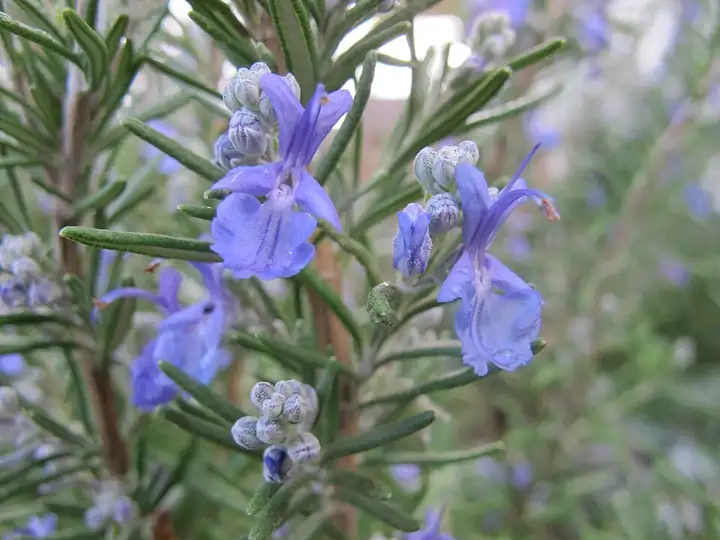
Rosemary
Salvia rosmarinus (formerly Rosmarinus officinalis) · Mint family (Lamiaceae)
When to plant: Plant in spring and it will grow into a sizeable plant in one season.
| Hardiness zones | 7 to 10 |
|---|---|
| Sun | full sun |
| Water | low |
| Life cycle | perennial |
| Frost | Half-hardy: takes a light frost |
| Soil pH | 6.0–7.5 |
| Spacing | 36 to 72 inches |
| Soil temperature to plant | at least 60°F |
About Rosemary
Rosemary is a woody, evergreen Mediterranean shrub grown for its piney, needle-like leaves. It loves sun and sharp drainage, and in cold climates it is usually grown in a pot and brought indoors for winter.
Typically hardy only to zone 7 (Illinois Extension), and single-digit temperatures often kill it; 'Arp' and 'Hill Hardy' may survive zone 6 with protection. Elsewhere, overwinter it indoors.
When to plant
Plant in spring and it will grow into a sizeable plant in one season.
It is slow from seed, so most gardeners buy plants or root stem-tip cuttings. Indoors in winter it needs cool temperatures (about 50-60 F) and very bright light.
Soil
Very well-drained soil; it has a low tolerance for wet, humid conditions.
Plant in full sun in light, sandy or gravelly, well-drained soil with a pH of about 6.5 to 7.0; avoid heavy clay.
Feeding
- during the growing season, only if growth is weak: light feeding of a general garden fertilizer. Fertilize lightly; rosemary in native garden soil usually needs no extra fertilizer once established.
Look for: a light, all-purpose or nitrogen fertilizer. Herbs are grown for fresh leaves to pick, so a little nitrogen keeps new growth coming; most need only light feeding.
Too much fertilizer reduces flowering and fragrance.
Harvest
Snip sprigs year-round as needed; the flowers, which appear in spring and summer, are edible too.
Snip sprigs as needed; regular harvesting or pruning keeps the plant vigorous, and a hard prune after bloom makes it denser. In cold areas bring it indoors to a cool (50 to 60F), very bright spot for winter.
Varieties (18)
| Variety | Type | Zones | Notes |
|---|---|---|---|
| Foxtail | Arching | 8–10typical for Rosemary (Salvia rosmarinus) | Dense, plume-like arching branches; 4-6 feet tall and wide; attractive in containers. Sources: [1][6] |
| Severn Sea | Arching | 8–10typical for Rosemary (Salvia rosmarinus) | Arching habit with bright blue flowers; up to 3 feet tall. Sources: [1] |
| Blue Boy | Prostrate (creeping) | 8–10typical for Rosemary (Salvia rosmarinus) | Prostrate rosemary for groundcovers, walls and containers. Prostrate rosemaries are generally less cold hardy than upright types. Sources: [1][8][9] |
| Huntington Carpet | Prostrate (creeping) | 8–10typical for Rosemary (Salvia rosmarinus) | 6-12 inches tall and 4-6 feet wide with small dark green leaves and light blue flowers; good for hanging baskets. Prostrate rosemaries are generally less cold hardy than upright types. Sources: [1][6] |
| Irene | Prostrate (creeping) | 8–10typical for Rosemary (Salvia rosmarinus) | Low, trailing habit. Prostrate rosemaries are generally less cold hardy than upright types. Sources: [1][8] |
| Lockwood de Forest | Prostrate (creeping) | 8–10typical for Rosemary (Salvia rosmarinus) | 1-2 feet tall and 3-6 feet wide with pale green leaves and light blue flowers. Prostrate rosemaries are generally less cold hardy than upright types. Sources: [1][6][8] |
| Prostratus | Prostrate (creeping) | 8–10typical for Rosemary (Salvia rosmarinus) | Low, creeping rosemary, usually under 2 feet tall and spreading 2-3 feet, with a long bloom season. Clemson notes prostrate rosemaries are less cold hardy than upright types. Prostrate rosemaries are generally less cold hardy than upright types. Sources: [1][6][8][10] |
| Athens Blue Spire | Upright | 7–10 | Upright form well suited to topiary. Listed as a hardier cultivar (zone 7, or 6b with protection); upper limit is the species range on the same page. Sources: [8] |
| Barbeque | Upright | 8–10typical for Rosemary (Salvia rosmarinus) | Good fragrance and flavor. Upright, 4-6 feet tall, with straight, sturdy stems strong enough to use as grilling skewers. Sources: [1][6] |
| Gorizia | Upright | 8–10typical for Rosemary (Salvia rosmarinus) | Leaves about twice the usual size; mature plants reach about 5 feet tall and wide. Sources: [1][8][9] |
| Majorca Pink | Upright | 8–10typical for Rosemary (Salvia rosmarinus) | Upright, 2-3 feet tall, with pinkish-purple flowers that can be sparse. Sources: [1][6][8] |
| Miss Jessop's Upright | Upright | 7–10 | Upright rosemary that Penn State lists among the more cold-tolerant types. Listed as a hardier cultivar (zone 7, or 6b with protection); upper limit is the species range on the same page. Sources: [8] |
| Salem | Upright | 8–10typical for Rosemary (Salvia rosmarinus) | Pine-like scent. Upright shrub with blue flowers. Sources: [1][9] |
| Spice Island | Upright | 8–10typical for Rosemary (Salvia rosmarinus) | Very aromatic; a good cooking rosemary. 2-3 feet tall with thick leaves and blue flowers. Sources: [1][6] |
| Tuscan Blue | Upright | 8–10typical for Rosemary (Salvia rosmarinus) | Vigorous, fast-growing upright shrub with thick stems, wide leaves and deep blue-violet flowers; can top 6 feet. Sources: [1][6][8][9] |
| Arp | Upright, cold-hardy | 7–10 | Upright, 3-4 feet tall, with light blue flowers and grayer foliage than most rosemary. One of the most cold-tolerant rosemaries. Illinois and Arizona Extension rate it to about zone 6; Penn State says zone 7, or 6b with protection; Wisconsin rates it zone 7a (possibly 6a with protection). Listed as a hardier cultivar (zone 7, or 6b with protection); upper limit is the species range on the same page. Sources: [1][2][6][7][8][10] |
| Madeline Hill (Hill Hardy) | Upright, cold-hardy | 7–10 | About 3 feet tall and 1.5-2 feet wide with light green leaves and better-than-average cold tolerance. Also spelled 'Madalene Hill'. Clemson calls it reliably hardy in the South Carolina Upstate. Listed as a hardier cultivar (zone 7, or 6b with protection); upper limit is the species range on the same page. Sources: [2][6][8][10] |
| Albus | Upright, white-flowered | 8–10typical for Rosemary (Salvia rosmarinus) | Dense, upright plant with white flowers. Also sold as 'Albiflorus'. Sources: [1][6] |
Pests to watch for
In the kitchen
Leaves flavor meats, stews, vegetables, breads, vinegars and teas.
Keeping it: Stand fresh sprigs in a glass with an inch of water in the fridge, loosely covered, and change the water daily; use within about a week or freeze them. Dried leaves keep best airtight in a cool, dark cupboard.
Safety: The European Medicines Agency advises against medicinal rosemary products in pregnancy, while breastfeeding, for children under 12, and for people with gallstones, bile duct problems or liver disease. It can cause allergic skin reactions (contact dermatitis) and should not go on broken or irritated skin. Cooking amounts are a different matter.
Pets: Not toxic to dogs, cats or horses (ASPCA)
Sources
- plants.ces.ncsu.edu
- extension.illinois.edu
- extension.umn.edu
- ema.europa.eu
- aspca.org
- hort.extension.wisc.edu
- extension.arizona.edu
- extension.psu.edu
- extensiongardener.ces.ncsu.edu
- hgic.clemson.edu
Photo: Photo: Margalob, CC BY-SA 4.0, via Wikimedia Commons (CC BY-SA 4.0). Photo resized for the web.

Planting dates and advice are general guidance; check with your local Cooperative Extension office for your area.