
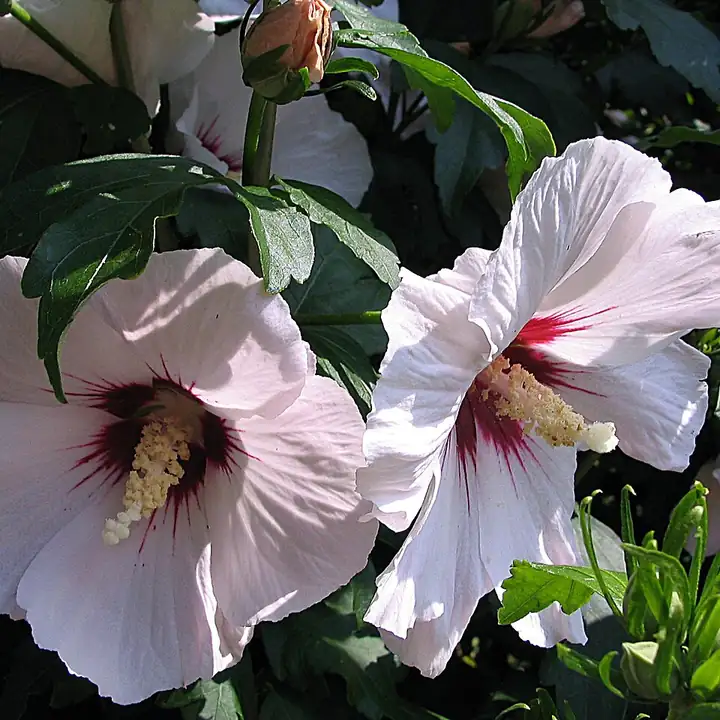
Rose of Sharon (shrub althea)
Hibiscus syriacus · Mallow family (Malvaceae)
| Hardiness zones | 5 to 9 |
|---|---|
| Sun | full sun to part shade |
| Water | moderate |
| Life cycle | perennial |
| Frost | Hardy: takes frost |
| Spacing | 72 to 144 inches |
About Rose of Sharon (shrub althea)
Rose of Sharon is a tough, upright Asian shrub that blooms in the hottest part of summer with hibiscus flowers in white, pink, red, lavender and blue. Hummingbirds, butterflies and bees visit, and the flowers are edible. It is listed as invasive in Kentucky and Georgia and in parts of Virginia, because seedy types scatter seedlings that are hard to pull; plant low-seed or sterile cultivars.
Hardy in zones 5-9. Listed as invasive by the Kentucky and Georgia Exotic Pest Plant Councils and by Arlington County and the City of Alexandria, Virginia; seedy cultivars self-sow heavily.
Planting
Choose a low-seed or sterile cultivar (see varieties): Clemson names 'Diana', 'Helene', 'Aphrodite' and 'Minerva' as low-seed, though an Oregon State study found 'Aphrodite', 'Diana' and 'Minerva' still set some viable seed; the double Smoothie types are sold as fully sterile. For a hedge, space plants 6-12 ft apart (NC State).
Soil
Moist, well-drained sand, loam or clay; it handles a wide pH range, some salt, and short spells of wet or dry soil.
Loosen the soil and work in compost; follow a soil test before adding fertilizer.
Feeding
- Established plants: spring as growth begins (a split feeding can follow in early summer): Slow-release shrub fertilizer, about 3-1-1 or 3-1-2 ratio (3-0-1 if the soil test shows enough phosphorus). Follow a soil test. Spread it evenly over the root zone and water it in; for slow-release types Clemson's upper limit is 2-4 lb of nitrogen per 1,000 sq ft per year.
Look for: a balanced or all-purpose fertilizer at the label rate. Skip high-phosphorus "bloom boosters" unless a soil test shows low phosphorus: most garden soils already have enough, and the extra can wash into streams.
Don't fertilize a drought-stressed shrub, and don't overfeed; Rose of Sharon is tough and needs little.
Harvest
Blooms July into September on this year's growth; each flower lasts one day. Prune in late winter or early spring, removing about a third of the oldest wood; spring pruning gives bigger flowers.
Varieties (22)
| Variety | Type | Season and days | Zones | Notes |
|---|---|---|---|---|
| Blushing Bride | Double | 5–9typical for rose of sharon | Pink double flowers that fade to white. Sources: [1] | |
| Freedom | Double | 5–9typical for rose of sharon | Large double pink flowers all summer. Sources: [1] | |
| Smoothie Fusion | Double | 5–9typical for rose of sharon | Double flowers in purple, dark pink and light pink. Sources: [1] | |
| Strawberry Smoothie | Double | 5–9typical for rose of sharon | Large double pink flowers from midsummer to frost. Sources: [1] | |
| Blueberry Smoothie | Double, sterile | 5–9typical for rose of sharon | Double blue-toned flowers. Sources: [2] | |
| Peppermint Smoothie | Double, sterile | 5–9typical for rose of sharon | Ruffled double red-pink flowers; glossy green leaves. Clemson lists the double Smoothie types as completely sterile. Sources: [1][2] | |
| Collie Mullens | Semi-double | 5–9typical for rose of sharon | Pink flowers with burgundy centers. Sources: [1] | |
| Purple Pillar | Semi-double | 5–9typical for rose of sharon | Lavender semi-double flowers with dark red centers. Sources: [4] | |
| White Chiffon | Semi-double | 5–9typical for rose of sharon | White flowers on graceful stems; rounded habit. Sources: [1] | |
| Lavender Chiffon | Semi-double, low-seed | 5–9typical for rose of sharon | Large lavender flowers on graceful stems; 8-12 ft. Sources: [1][2] | |
| Whit XXI | Semi-double, sterile | Late June to mid-October | 5–9typical for rose of sharon | Soft pink flowers with extra petaloids; semi-dwarf, about 6-8 ft tall; the patent reports no seed. Sources: [11] |
| Blue Bird | Single | 5–9typical for rose of sharon | Blue vase-shaped flowers. Sources: [1][3] | |
| Jodi | Single | 5–9typical for rose of sharon | Pure white flowers; leaves variegated dark green, light green and gold. A sport of 'Diana'; the patent reports no self-seeding. Sources: [12] | |
| Notwoodthree | Single | 5–9typical for rose of sharon | Large single blue flowers with a lacy center. Sources: [1] | |
| Pink Giant | Single | 5–9typical for rose of sharon | Large pink flowers with a burgundy spot at the center. A hexaploid that set very little seed in Oregon State tests. Sources: [1][5] | |
| Red Heart | Single | 5–9typical for rose of sharon | White flowers with a deep red center. Sources: [1] | |
| Aphrodite | Single, low-seed | 5–9typical for rose of sharon | Deep rose-pink flowers. Oregon State found it sets a fair amount of viable seed. Sources: [1][2][5] | |
| Diana | Single, low-seed | 5–9typical for rose of sharon | Large pure white flowers that stay open at night; dark green leaves. Sold as a sterile triploid, but Oregon State found it is a tetraploid that still sets some seed. Sources: [1][2][3][5] | |
| Helene | Single, low-seed | 5–9typical for rose of sharon | White flowers with a reddish-purple eye. Sources: [1][2][3] | |
| Minerva | Single, low-seed | 5–9typical for rose of sharon | Heavy bloomer; lavender flowers washed with pink and a red eye. Sources: [1][2][5] | |
| ILVO347 | Single, sterile | 5–9typical for rose of sharon | Orchid-pink flowers with dark red centers; the patent reports no seed or fruit. Sources: [13] | |
| Purpureus Variegatus | 5–9typical for rose of sharon | Half-closed maroon flowers late in the season; green-and-yellow variegated leaves. Sources: [1] |
Pests to watch for
Aphids, Twospotted spider mite, Japanese beetle, Whiteflies, Sawflies (garden sawflies)
Diseases and problems
Leaf spot, Blight
In the kitchen
The flowers are edible (NC State).
Safety: NC State and the ASPCA list no toxic parts. Eat only flowers grown without pesticides.
Pets: Non-toxic to dogs, cats and horses (ASPCA)
Sources
- plants.ces.ncsu.edu
- hgic.clemson.edu
- pubs.ext.vt.edu
- hgic.clemson.edu
- oregon.gov
- mgnv.org
- invasiveplantatlas.org
- aspca.org
- hgic.clemson.edu
- gainvasivespeciescouncil.org
- patents.google.com
- patents.google.com
- patents.google.com
Photo: Photo: Gmihail, CC BY-SA 3.0 rs, via Wikimedia Commons (CC BY-SA 3.0 rs). Photo resized for the web.

Planting dates and advice are general guidance; check with your local Cooperative Extension office for your area.