
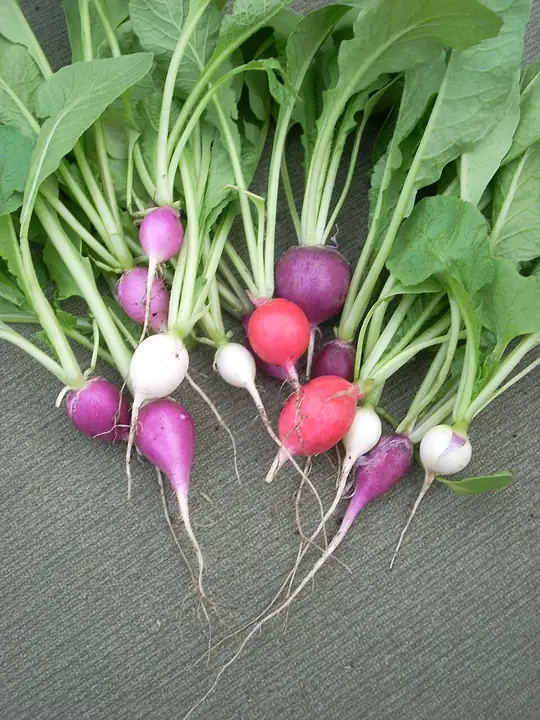
Radish
Raphanus sativus · Cabbage family (Brassicaceae)
When to plant: Sow seeds outdoors 2 to 4 weeks before the last frost and again in fall, 4 to 12 weeks before the first fall frost.
| Hardiness zones | 2 to 11 |
|---|---|
| Sun | full sun |
| Water | moderate |
| Life cycle | annual |
| Frost | Hardy: takes frost |
| Soil pH | 6.0–7.0 |
| Spacing | 1 to 2 inches |
| Days to harvest | 21 to 35 days |
| Soil temperature to plant | at least 40°F |
About Radish
Radishes are the fastest crop in most gardens, ready in about a month from seed. Spring radishes like cool weather; larger winter radishes such as daikon are sown in late summer.
Grown as a cool-season annual in every zone; time it for the cool weather of spring or fall.
When to plant
Timing is counted from your average last spring frost (and first fall frost). Sow & Tell works out the actual dates for your ZIP code.
- Sow seeds outdoors: 2 to 4 weeks before the last frost
- Fall planting: 4 to 12 weeks before the first fall frost
Days count from seeding: 3 to 5 weeks for garden radishes; winter radishes need about 45 to 70 days. Sow small batches every 10 to 14 days in spring.
Soil
Any well-drained soil loosened at least 6 inches deep, or 12 inches for long types.
Have the soil tested and keep pH about 6 to 7; work in well-rotted compost or manure and fertilize before planting.
Feeding
Look for: a little nitrogen, such as 21-0-0, kept light. Root crops are grown for their roots: too much nitrogen makes big leafy tops and small roots. The phosphorus and potassium they need go in before planting, as a soil test says.
Fresh manure or quick-release nitrogen can make roots fork; never use weed-and-feed products.
Harvest
Pull as soon as roots reach eating size, usually under an inch across for round types. Left too long, or grown slowly in dry soil, they turn pithy and hot.
Pull each radish once, about 3 to 5 weeks after sowing, before it turns fibrous and hot. Sow in spring and again in August for a fall crop.
Varieties (28)
| Variety | Type | Season and days | Notes |
|---|---|---|---|
| April Cross | Daikon | Fall | Long white daikon radish. Daikon radishes are milder than garden radishes and can grow very large while staying good to eat. Sources: [2][12][13][14][15] |
| Minowase (Summer Cross) | Daikon | Fall | Carrot-shaped daikon with white skin. Listed as Minowase Summer Cross in Wisconsin and Maryland. Sources: [13][14][16] |
| Miyashige | Daikon | Fall · 65 days | Long white daikon. Listed as a daikon by Texas A&M and Wisconsin. Sources: [13][14][17] |
| Rat's Tail | Pod radish | Grown for its crisp edible seed pods rather than a root; plants can reach several feet tall. Sources: [14][16][18] | |
| Easter Egg | Spring (mixed colors) | Spring or fall · 25 days | Round roots in a mix of red, purple and white. Fun for children's gardens. Sources: [13][17][18] |
| Amethyst | Spring (round purple) | Purple radish recommended in Kansas and North Dakota. Sources: [19][20][21][22] | |
| Bacchus | Spring (round purple) | Purple radish that has done well in several North Dakota trials. Sources: [20][22][23] | |
| Plum Purple | Spring (round purple) | Gardeners in North Dakota trials favored its taste. Purple-skinned radish. Sources: [21][23] | |
| Champion | Spring (round red) | Spring or fall · 20 to 28 days | Scarlet, deep oval root with large tops. All-America Selections winner in 1957. Sources: [13][17][24] |
| Cherriette | Spring (round red) | 24 days | Red radish recommended in Wisconsin and Texas. Sources: [13][25] |
| Cherry Belle | Spring (round red) | Spring or fall · 21 to 22 days | Crisp, solid flesh. Round, cherry-red root about 3/4 inch across with short tops. All-America Selections winner in 1949. A favorite for children's gardens. Sources: [12][13][16][17][18][24] |
| Early Scarlet Globe | Spring (round red) | Spring or fall · 24 days | Crisp, mild white flesh. Bright scarlet globe. Also sold as Scarlet Globe. Sources: [12][13][17][24] |
| Red Silk | Spring (round red) | 28 days | Red radish recommended for Kentucky gardens. Sources: [26] |
| Rover | Spring (round red) | Very early · 21 days | Early, reliable and uniform red radish. Sources: [22][27][28][29] |
| Roxanne | Spring (round red) | Large, round, bright red roots. Sources: [22][23][30] | |
| Sora | Spring (round red) | Red radish recommended after North Dakota trials. Sources: [22][29][31] | |
| Pearl | Spring (round white) | 28 days | Crunchy and moderately spicy. Pure white hybrid radish that was vigorous and high-yielding in North Dakota trials. Sources: [23][27] |
| Snow Belle | Spring (round white) | Spring or fall · 30 days | Crisp and mild. Round, white hybrid radish. Sources: [12][13][24] |
| Red Head | Spring (round, two-tone) | Two-tone radish recommended after North Dakota trials. Sources: [22][29][31] | |
| Sparkler | Spring (round, two-tone) | Spring or fall · 25 days | Round, two-toned red-and-white root about 1 inch across. Suggested for children's gardens. Sources: [17][18] |
| White Icicle | Spring/summer (long white) | Spring through summer · 28 to 30 days | Crisp white flesh. Long, slim white root that tapers to a point. Longer radishes like this one tend to handle heat better than the quick round types. Sources: [2][12][13][16][17][24] |
| D'Avignon | Spring/summer (oblong) | French-type radish with slender roots, red on top and white at the tip. Sources: [21][30][32] | |
| French Breakfast | Spring/summer (oblong) | Spring through summer | Slender, oblong red root with a white tip. Holds up in summer heat better than most early radishes if watered regularly. Sources: [2][12][13][16] |
| China Rose | Winter | Fall · 52 days | Pungent white flesh. Long root with deep rose skin. Sow in late summer for a fall crop, like other winter radishes. Sources: [14][16][24] |
| Long Black Spanish | Winter | Fall | Black radishes have an earthy, pungent flavor. Long, tapered root with black skin. Sources: [16] |
| Round Black Spanish | Winter | Fall · 55 days | Pungent white flesh with an earthy bite. Large globe 3 1/2 to 4 inches across with black skin. A winter type sown in late summer for a fall harvest. Sources: [12][14][16][24] |
| Watermelon (Red Meat) | Winter | Fall · 60 days | Round root with pale green-and-white skin and a bright rosy-red interior. Also sold as Misato Rose Red Meat or Chinese Red Meat; Wisconsin lists Red Meat as an heirloom. Sources: [12][13][14][16][17] |
| White Chinese (Celestial) | Winter (Asian) | Fall · 60 days | Crisp, mild white flesh. White root 6 to 8 inches long and about 3 inches across. Sources: [24] |
Good neighbors
Extension sources suggest radishes as a quick space-filler among carrots or at the base of broccoli, not as pest control.
Pests to watch for
Flea beetles, Wireworms, Harlequin bug, Bagrada bug, Beet armyworm, Cabbage maggot, Seedcorn maggot, Blister beetles
Diseases and problems
Alternaria leaf spot, Black rot, Clubroot, Powdery mildew, Downy mildew, White rust, Common scab, Turnip mosaic
In the kitchen
Eaten raw in salads and on snacks, pickled, or roasted.
Keeping it: Cut off the greens, then keep radishes in a loosely closed bag in the fridge; they stay crisp for weeks, up to about a month. Radishes don't freeze well.
Pets: Not listed as toxic by the ASPCA
Sources
- extension.umn.edu
- extension.illinois.edu
- extension.unh.edu
- monroe.cce.cornell.edu
- extension.colostate.edu
- yardandgarden.extension.iastate.edu
- warren.cce.cornell.edu
- extension.umn.edu
- extension.umd.edu
- extension.oregonstate.edu
- cal-ipc.org
- barron.extension.wisc.edu
- florence.extension.wisc.edu
- extension.umd.edu
- extension.umn.edu
- extension.sdstate.edu
- agrilifeextension.tamu.edu
- plants.ces.ncsu.edu
- bookstore.ksre.ksu.edu
- ndsu.edu
- ndsu.edu
- ndsu.edu
- ndsu.edu
- extension.msstate.edu
- agrilifeextension.tamu.edu
- publications.mgcafe.uky.edu
- extension.msstate.edu
- fieldreport.caes.uga.edu
- ndsu.edu
- ndsu.edu
- ndsu.edu
- ndsu.edu
Photo: Photo: Jengod, Public domain, via Wikimedia Commons. Photo resized for the web.

Planting dates and advice are general guidance; check with your local Cooperative Extension office for your area.