
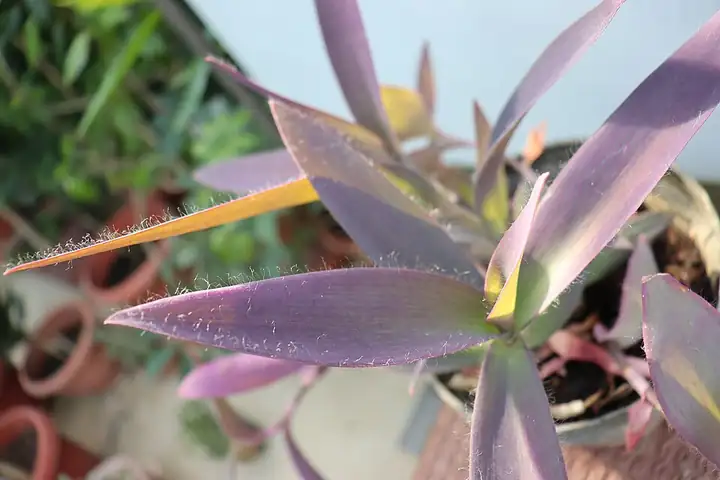
Purple heart
Tradescantia pallida (formerly Setcreasea pallida) · Spiderwort family (Commelinaceae)
When to plant: Any time of year, since it grows indoors. Repot when roots fill the pot; cuttings root easily in water or moist mix.
| Hardiness zones | 10 to 11 |
|---|---|
| Sun | full sun to part shade |
| Water | low |
| Life cycle | perennial |
| Frost | Tender: killed by frost |
Will it grow in your window?
Pick the window it sits in. This is the same check Sow & Tell runs for every plant in your house.
It wants bright, direct light.
Pick a window above and this will tell you whether the spot suits it.
Watering: water when the top inch is dry — about every 7 days, stretching to every 12 from November to February.
Summering outside? Bring it in before nights drop below 50°F.
About Purple heart
Purple heart is a trailing Mexican spiderwort with fleshy purple stems and long, deep-purple leaves, grown as a houseplant, a hanging basket or a summer bedding plant (NC State, Wisconsin Horticulture). It colors best in sun, turns greenish in shade, and roots from any piece of stem, so one plant is easy to keep going for years. It is a cousin of the garden spiderwort and the inch plant.
Hardy outdoors only in zones 10-11 (NC State; Wisconsin Horticulture says zone 10), where it can spread through beds; it is grown indoors everywhere and can summer outdoors once nights stay above 50 F, the coldest it tolerates (NC State).
When to plant
Any time of year, since it grows indoors. Repot when roots fill the pot; cuttings root easily in water or moist mix.
Usually bought as a nursery plant or started from a stem cutting, which roots in water or moist mix (Wisconsin Horticulture, NC State).
Growing it indoors
- Light: Give it a sunny window for the deepest purple; it grows in less light, but the leaves turn greenish and the stems stretch (NC State, Wisconsin Horticulture).
- Water: It is drought tolerant but also takes regular watering, so water when the top of the mix is dry and let the pot drain (Wisconsin Horticulture, NC State). Water less over winter indoors.
- Temperature: It does not tolerate temperatures below 50 F (NC State), so keep it off cold winter glass; MU Extension gives about 55 F nights for its tradescantia cousins.
- Feeding: Feed monthly while it is actively growing; for plants wintered indoors, hold off until growth starts again in spring (Wisconsin Horticulture).
- Repotting: The pages we opened give no schedule; MU Extension's general rule is to repot when roots fill the pot, and old leggy plants are easy to replace from cuttings.
- More plants: Cuttings from any part of the stem root easily: push a node into loose potting mix or stand the cutting in water (Wisconsin Horticulture, NC State). Seed is rarely available.
If something looks wrong
| What you see | Likely cause | What to do |
|---|---|---|
| Leaves more green than purple, stems long and floppy | Too little light | Move it into direct sun and pinch the tips to make it branch (NC State, Wisconsin Horticulture). |
| Stems snapped or broken off | The fleshy stems are fragile and snap when brushed | Keep it out of traffic and root the broken pieces as new plants (Wisconsin Horticulture). |
| Bare, leggy stems after it blooms | Normal aging of the stems | Cut it back after flowering to keep it full (Wisconsin Horticulture). |
| Brown bumps or white cottony tufts on stems | Scale or mealybugs | Wipe them off and check weekly; cut out badly infested stems (Wisconsin Horticulture names both). |
Soil
A well-drained potting mix rich in organic matter (NC State).
Pot in a well-drained potting mix rich in organic matter (NC State).
Feeding
- Spring through fall, during active growth: complete houseplant fertilizer. Monthly (Wisconsin Horticulture).
- Winter indoors: none. Hold off until growth starts again in spring (Wisconsin Horticulture).
Don't feed or water heavily over winter indoors, when growth is slow (Wisconsin Horticulture).
Pests to watch for
In the kitchen
Safety: Low-severity poison (NC State): the sap and leaves can give a red, itchy skin rash, and chewing it irritates the mouth and stomach; Wisconsin Horticulture says the rash is uncommon. Wear gloves when cutting it back if your skin is sensitive.
Pets: Not listed by the ASPCA (no purple heart, purple queen or Setcreasea entry); the ASPCA does list its close relative inch plant (Tradescantia fluminensis) as toxic to dogs and cats, and NC State lists purple heart as a problem for dogs and cats, irritating the mouth and stomach and sometimes the skin.
Sources
- plants.ces.ncsu.edu
- hort.extension.wisc.edu
- extension.missouri.edu
- aspca.org
- aspca.org
- aspca.org
- aspca.org
Photo: Photo: Dandarmkd, CC BY-SA 4.0, via Wikimedia Commons (CC BY-SA 4.0). Photo resized for the web.

Planting dates and advice are general guidance; check with your local Cooperative Extension office for your area.