
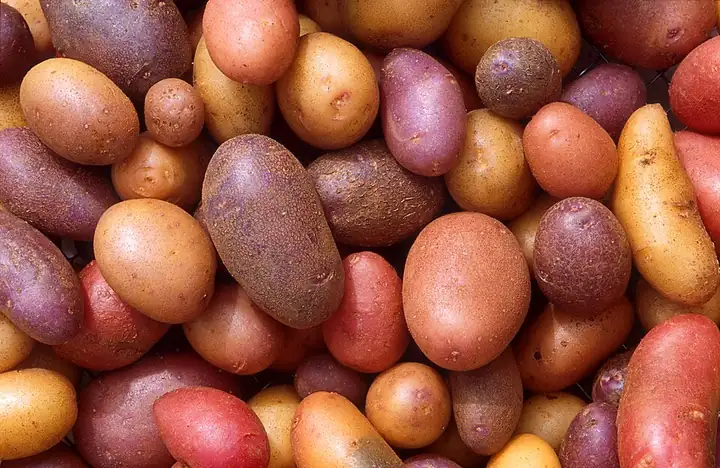
Potato
Solanum tuberosum · Nightshade family (Solanaceae)
When to plant: Sow seeds outdoors up to 3 weeks before the last frost.
| Hardiness zones | 2 to 11 |
|---|---|
| Sun | full sun |
| Water | moderate |
| Life cycle | annual |
| Frost | Half-hardy: takes a light frost |
| Soil pH | 6.0–6.5 |
| Spacing | 10 to 12 inches |
| Days to harvest | 50 to 120 days |
| Soil temperature to plant | at least 45°F |
About Potato
Potatoes are grown from 'seed' pieces of tuber and are among the earliest crops planted in spring. You can dig tender new potatoes in midsummer or wait for full-size storage potatoes after the vines die back.
Grown as a cool-season annual in every zone; plant it in early spring so tubers form before summer heat.
When to plant
Timing is counted from your average last spring frost (and first fall frost). Sow & Tell works out the actual dates for your ZIP code.
- Sow seeds outdoors: up to 3 weeks before the last frost
Days count from planting seed pieces: new potatoes in about 7 to 8 weeks; early varieties mature in up to 110 days and late ones in 120 or more. Plant seed pieces 3 to 5 inches deep and hill soil over the stems as they grow; cold, wet soil can rot them.
Soil
Loose, well-drained, sandy soil rich in organic matter; plant certified disease-free seed potatoes.
Follow a soil test and aim for pH 6.0 to 6.5 (potatoes put up with pH down to 5); work compost or manure and any pre-plant fertilizer into the top 6 inches, using no more than about 1 inch of compost.
Feeding
- about 4 weeks after planting, when plants are about 4 to 6 inches tall and you first hill them: nitrogen fertilizer such as 21-0-0. Mix about 0.15 lb of actual nitrogen per 50 ft of row (about 3/4 lb of 21-0-0) into the soil beside the row as you hill, then water.
Look for: a little nitrogen, such as 21-0-0, kept light. Root crops are grown for their roots: too much nitrogen makes big leafy tops and small roots. The phosphorus and potassium they need go in before planting, as a soil test says. - about 2 weeks later, at the second hilling: nitrogen fertilizer such as 21-0-0. Repeat the same amount as you hill again, and water it in.
Look for: a little nitrogen, such as 21-0-0, kept light. Root crops are grown for their roots: too much nitrogen makes big leafy tops and small roots. The phosphorus and potassium they need go in before planting, as a soil test says.
Heavy feeding gives lots of leaves and delays tuber growth; never use weed-and-feed products.
Harvest
Dig new potatoes when they are 1 to 2 inches across. For storage, wait until the vines have died and the skins are set and do not rub off, then cure them for 10 days or more at 60 to 65F.
The main crop is dug all at once after the vines die back, though you can gently dig a few 'new' potatoes about 7 to 8 weeks after planting.
Varieties (35)
| Variety | Type | Season and days | Notes |
|---|---|---|---|
| Austrian Crescent | Fingerling (heirloom) | 65 to 75 days | Heirloom fingerling potato. Sources: [11] |
| Russian Banana | Fingerling (heirloom) | 65 to 75 days | Heirloom fingerling potato. Sources: [11][12] |
| Adirondack Blue | Purple-flesh specialty | Midseason · 87 days | Purple, slightly netted skin with purple flesh. Highly resistant to foliar late blight; susceptible to Fusarium dry rot. Released by Cornell University in 2003. Short dormancy. Sources: [13] |
| All Blue | Purple-flesh specialty | Late | Best for boiling. Purple skin and purple flesh. Sources: [2][14] |
| Purple Majesty | Purple-flesh specialty | Early | High-yielding, with dark purple skin and evenly dark purple flesh. Bred by Colorado State University. Sources: [15] |
| Caribe | Purple-skinned | Midseason | Good for baking and boiling. Purple (blue) skin. Sources: [2][14] |
| Purple Viking | Purple-skinned, all-purpose | Moderately early · 90 days | High-yielding and highly disease resistant. Sources: [16][17] |
| Adirondack Red | Red-skinned | Early to midseason | Red-skinned potato for early to midseason harvest. Sources: [18] |
| Chieftain | Red-skinned | Oval tubers with bright red skin. Moderately resistant to scab, with moderate field resistance to late blight. Adapted to the north-central and southern U.S. Sources: [12][19] | |
| LaRouge | Red-skinned | Midseason | Round red tubers with good disease tolerance; Kansas State says it yields more than Norland. Bred at Louisiana State University. Sources: [16][19] |
| Viking | Red-skinned, all-purpose | Early | Very white flesh; good for boiling, mashing, roasting and salads. Oval red tubers with high yield potential; few tubers set per plant, so they tend to get large. Resistant to hollow heart. Not the same as 'Purple Viking'. Sources: [2][4] |
| Dark Red Norland | Red-skinned, early | Early | A darker red selection of Norland, one of the main early red-skinned potatoes. Sources: [12][18][19][20] |
| Red Norland | Red-skinned, early | Early · 80 days | Good for boiling, mashing, roasting and salads; only fair for baking. Smooth, round to oblong red tubers with white flesh and shallow eyes. Good disease tolerance. NDSU calls it a typical garden variety. Sources: [4][14][16][17][21][22] |
| Red Pontiac | Red-skinned, late | Mid to late · 100 days | Fair table quality; fine for boiling, mashing and salads. High-yielding, oblong red tubers with white flesh and deep eyes. Stores very well but bruises easily; susceptible to scab and late blight. Released by USDA and Michigan in 1938. Sources: [4][14][21][22][23] |
| Red LaSoda | Red-skinned, midseason | Midseason · 100 days | Red tubers with good disease tolerance and higher yield. Sources: [16][17][22] |
| Mountain Rose | Red-skinned, red-fleshed | Early | Oval tubers with red skin and red flesh. Released by Colorado State University. Sources: [15] |
| Red Gold | Red-skinned, yellow-flesh | Early to midseason · 70 days | Deep yellow flesh for roasting, frying, mashing and baking. Medium-small, oval to round tubers with pink-red skin. Moderately resistant to scab and field-resistant to leafroll and potato virus Y. Short dormancy, so it does not store as long as many others. Sources: [22][24] |
| Goldrush | Russet, baking | Midseason | Very good for baking. Oblong to oval russet tubers with white flesh. Resists hollow heart. Sources: [4][21] |
| Russet Burbank | Russet, baking | Late | Dry, mealy flesh; the classic baker and French fry potato. Large, long russet tubers with white flesh. Resistant to blackleg and fairly resistant to common scab; susceptible to late blight, Verticillium and several viruses. Needs steady moisture and moderate nitrogen to avoid knobby tubers. Released in 1902; UMaine suggests it for higher-pH soils where scab is a problem. Sources: [2][14][25] |
| Russet Norkotah | Russet, baking | Early (Kansas State rates it midseason) | Excellent baking potato. Long, blocky russet tubers with golden eyes. Sensitive to heat and water stress. Kansas State calls it the best russet for Kansas. Sources: [4][16][21] |
| Norgold Russet | Russet, early | Early to midseason | Good for table use. Oblong russet tubers with medium-high yield and short dormancy. Resistant to scab. Was the leading early russet in the U.S. until about 1985. Kentucky lists it as midseason. Sources: [18][19][26][27] |
| Butte | Russet, late | Late | Good for table use and french fries. High yield of long russet tubers. Immune to PVX and resists net necrosis. Described as a common garden variety. Sources: [2][19] |
| Ranger Russet | Russet, late | Late | Good for french fries and table use. High yield of long russet tubers with high solids. Resistant to PVY, Verticillium wilt and Fusarium tuber rot. Sources: [2][19] |
| Kennebec | White, all-purpose | Late (UMaine rates it mid) · 80 to 90 days | Excellent cooking quality for baking, boiling, chips and fries. High-yielding, smooth oblong tubers with thin buff skin and white flesh. Resistant to common late blight races and to potato viruses A and Y. Released by USDA and the Maine Agricultural Experiment Station in 1948. Susceptible to scab, Verticillium and hollow heart. Sources: [4][14][16][17][21][22][28] |
| Atlantic | White, chipping | Midseason | Mainly a chipping potato. High yield of round tubers with lightly netted skin and high solids. Popular across the U.S. and Canada for potato chips. Sources: [19][29] |
| Norchip | White, chipping | Midseason · 85 days | Mealy; good for fries and chips. White tubers. Sources: [16][22] |
| Onaway | White, early | Early | Early white potato bred at Michigan State University. Resistant to scab. Sources: [12][19] |
| Irish Cobbler | White, early (heirloom) | Early | White tubers; poor disease tolerance. Sources: [16] |
| Superior | White, early-midseason | Early to midseason · 90 to 105 days | Good for boiling, baking and mashing. Round to oblong white tubers with medium-deep eyes. Resistant to common scab. Sources: [14][16][17][21][22] |
| Elba | White, late | Late | Good for table use. High yield of round white tubers. Resistant to golden nematode, late blight, early blight and Verticillium wilt. Sources: [19] |
| Katahdin | White, late | Late | Excellent for baking. Smooth, round, shallow-eyed white tubers. Sources: [2][21] |
| Yellow Finn | Yellow-flesh | Late | Best for boiling. White skin with yellow flesh. Sources: [14] |
| Yukon Gold | Yellow-flesh, all-purpose | Early to midseason (sources vary) · 90 days | All-purpose, with a balance of waxy and mealy texture; the yellow flesh holds its color when cooked. Oval, slightly flattened tubers with yellow-white skin and pink eyes. Susceptible to potato virus Y, scab and hollow heart (mainly tubers over 8 oz). Released in 1981 by the University of Guelph (Canada); NDSU calls it the most popular yellow potato in North America. UMaine rates it late in Maine. Sources: [1][4][14][17][21][30] |
| Carola | Yellow-fleshed | Yellow-fleshed potato recommended for Wisconsin gardens. Sources: [12] | |
| German Butterball | Yellow-fleshed (heirloom) | Heirloom potato with yellow flesh. Sources: [12] |
Pests to watch for
Colorado potato beetle, Flea beetles, Aphids, Potato leafhopper, Cutworms, Wireworms, White grubs, Tomato hornworm, Whiteflies, Leafminers, Slugs, Harlequin bug, Tarnished plant bug, Leafhoppers, Eriophyid mites (rust, bud, blister and gall mites), Mole crickets, Mice (house mice and deer mice), Red imported fire ant, Potato psyllid (tomato psyllid), Tomato pinworm, Beet armyworm, European corn borer, Seedcorn maggot, Blister beetles
Diseases and problems
Early blight, Late blight, Common scab, Verticillium wilt, Black scurf, Hollow heart (potato), Magnesium deficiency, Black walnut toxicity, Herbicide injury, Frost and freeze injury, Aster yellows, Blackleg (potato), Tomato spotted wilt, Bacterial wilt, Southern blight, Sooty mold, Tobacco mosaic and tomato mosaic, Curly top, Potato virus Y, Potato leafroll, Tomato and tobacco ringspot, Alfalfa mosaic
In the kitchen
Baked, boiled, mashed, roasted or fried; waxy types hold together in salads and starchy types make fluffy mashed potatoes.
Keeping it: Cure potatoes for about 2 weeks at 50 to 60F, then keep them dark, cool (about 40F) and humid for several months, away from apples. Light turns them green; if fridge-cold storage makes them taste sweet, a few days at room temperature fixes it.
Safety: All green parts contain solanine: the leaves, stems, berries, sprouts and any green skin on the tubers. It can cause nausea, vomiting, stomach pain and diarrhea and can be serious, so never eat tubers that are green below the skin (NC State).
Pets: Not on the ASPCA toxic plant lists, but the ASPCA warns that raw potatoes may be a problem for pets (cooked potatoes are fine in moderation); the green parts contain solanine (NC State).
Sources
- extension.umn.edu
- extension.usu.edu
- extension.illinois.edu
- ndsu.edu
- extension.unh.edu
- extension.colostate.edu
- extension.umn.edu
- plants.ces.ncsu.edu
- aspca.org
- riley.k-state.edu
- agrilifeextension.tamu.edu
- florence.extension.wisc.edu
- ask.ifas.ufl.edu
- extension.umaine.edu
- potatoslvrc.com
- bookstore.ksre.ksu.edu
- agrilifeextension.tamu.edu
- publications.mgcafe.uky.edu
- cucurbit.info
- ndsu.edu
- yardandgarden.extension.iastate.edu
- extension.msstate.edu
- seedpotato.russell.wisc.edu
- seedpotato.russell.wisc.edu
- seedpotato.russell.wisc.edu
- extension.usu.edu
- extension.okstate.edu
- seedpotato.russell.wisc.edu
- fieldreport.caes.uga.edu
- seedpotato.russell.wisc.edu
Photo: Photo: Scott Bauer, USDA ARS, Public domain (USDA ARS), via Wikimedia Commons. Photo resized for the web.

Planting dates and advice are general guidance; check with your local Cooperative Extension office for your area.