
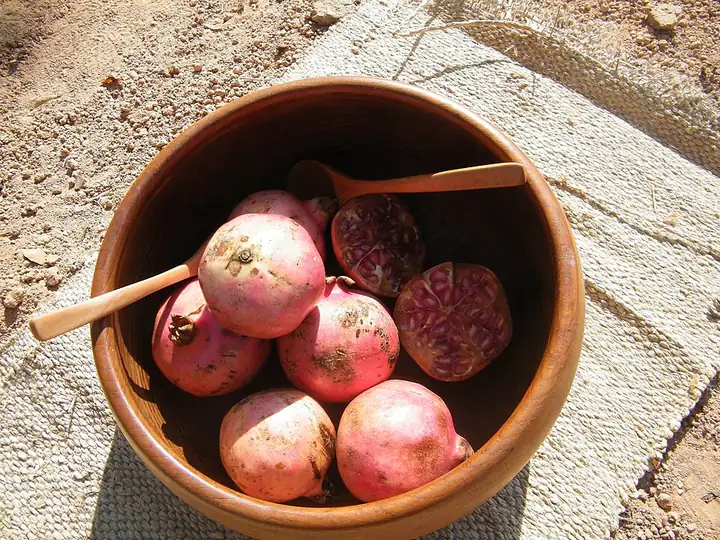
Pomegranate
Punica granatum · Loosestrife family (Lythraceae)
When to plant: In the ground, plant in early spring after the risk of late frost (UF/IFAS), about 10-12 ft apart in home gardens (Utah State).
| Hardiness zones | 8 to 10 |
|---|---|
| Sun | full sun |
| Water | moderate |
| Life cycle | perennial |
| Frost | Half-hardy: takes a light frost |
| Soil pH | 5.5–7.0 |
| Spacing | 120 to 144 inches |
About Pomegranate
Pomegranate is a shrub or small tree with bright orange-red flowers and round, leathery fruit packed with juicy red seeds (arils). It loves long, hot, dry summers and shrugs off drought and alkaline soil once established. In colder areas it grows well in a big pot, and the dwarf form 'Nana' can even bloom and set tiny fruit indoors in a sunny spot.
Clemson and NC State rate it for zones 8-10 (7b with protection); dormant trees can be badly hurt near 10-12 F (UF/IFAS), and Russian types such as 'Salavatski' are rated hardier. USDA PLANTS lists no noxious or invasive status, and we found it on no state invasive list.
When to plant
In the ground, plant in early spring after the risk of late frost (UF/IFAS), about 10-12 ft apart in home gardens (Utah State).
Potted trees go back outside once frost danger has passed (no source gives a set number of weeks, so the window is left blank). Plants may set a fruit or two the first year and bear well about three years after planting (Clemson); seedlings don't come true, so buy a named variety.
Soil
Deep, well-drained loam is best, but it adapts to sand or clay; it grows well in the alkaline soils of south Texas (UF/IFAS; Texas A&M).
Test the soil first; pomegranates grow in most well-drained soils at about pH 5.5-7.0 and mainly need nitrogen (UF/IFAS; NMSU).
Feeding
- In-ground trees, first year: after growth starts, split over February, May and September: nitrogen fertilizer such as ammonium sulfate (21-0-0). Texas A&M uses 1-2 cups per tree the first year, split into 3-4 feedings, doubling it the second year and tripling it the third.
Look for: mostly nitrogen, in spring as growth starts. Spring feeding grows the new shoots and leaves that carry flowers and fruit; feeding after midsummer pushes soft growth that may not harden before winter. - In-ground bearing trees, in March and July: balanced fertilizer such as 10-10-10. Clemson suggests about 1 lb per 3 ft of plant height each time, spread under the canopy and watered in; follow a soil test.
Look for: mostly nitrogen, in spring as growth starts. Spring feeding grows the new shoots and leaves that carry flowers and fruit; feeding after midsummer pushes soft growth that may not harden before winter. - Potted trees, from the start of new growth in spring through summer: complete liquid fertilizer with micronutrients, or a timed-release fertilizer. Feed liquid fertilizer at least monthly, or timed-release about every 12 weeks, because nutrients wash out of pots quickly (UF/IFAS St. Lucie County; NC State). Stop in winter and start again when new growth appears (Maryland Extension).
Look for: mostly nitrogen, in spring as growth starts. Spring feeding grows the new shoots and leaves that carry flowers and fruit; feeding after midsummer pushes soft growth that may not harden before winter.
Don't feed late in the season; late fertilizing delays ripening and hurts fruit color and quality (NMSU). Uneven watering splits the fruit (Utah State).
Harvest
Fruit ripens from late summer into fall (August to November, depending on variety and place). Ripe fruit has full color, a more angular shape and a metallic sound when tapped (NMSU); clip it off instead of pulling, and pick a little early if rain threatens to split it (Utah State).
Pomegranates give one main crop a year, maturing July to November in north Florida, though they may fruit year-round in south Florida. Pick a little early rather than overripe, especially if rain is coming, since late-summer rains cause splitting.
Varieties (21)
| Variety | Type | Season and days | Zones | Notes |
|---|---|---|---|---|
| State Fair | Compact | 8–10typical for pomegranate | About 5 ft tall with small fruit under 2 inches; blooms heavily and is very cold hardy. Sources: [5] | |
| Nana | Dwarf | July to November in north Florida | 7–11 | Dwarf, 2-4 ft tall and wide (about 3 ft), with red-orange flowers and small fruit; very cold hardy for a pomegranate. Can bloom and fruit indoors in a sunny spot. Sources disagree on eating quality: Missouri Botanical Garden calls the tiny fruit edible, while UF/IFAS and UC Marin call it ornamental, not for eating. Sources: [5][7][8][10][20] |
| Azadi | Pale-fruited | 8–10typical for pomegranate | Yellow to light pink peel with light pink arils. From Turkmenistan. The only cultivar rated highly resistant to anthracnose fruit rot in UF/IFAS tests, which makes it a candidate for humid areas. Sources: [2] | |
| Cloud | Pale-fruited | 8–10typical for pomegranate | Sweet; white flesh and white juice. Medium, green-red fruit. A UC Davis selection. Sources: [3][4] | |
| Afganski | Russian (cold hardy) | October | 7–10 | Sweet-tart with dark red arils and soft seeds. Medium fruit. Clemson's Russian series code R26. Susceptible to anthracnose fruit rot (UF/IFAS). 100–200 chill hours Sources: [2][5][6] |
| Kazake | Russian (cold hardy) | 8–10typical for pomegranate | NMSU says it can grow as far north as zone 5. Highly susceptible to anthracnose fruit rot in UF/IFAS tests. Sources: [2][6] | |
| Salavatski | Russian (cold hardy) | Late fall | 7–10 | Large fruit with light red arils; good for juice. Sources call it semi-sweet. Clemson calls the seeds semi-soft, NMSU calls them hard. NMSU calls it the most cold-hardy type it lists, to about 0 F. Clemson's Russian series code R8. Moderately resistant to anthracnose fruit rot (UF/IFAS). Sources: [2][5][6][7] |
| Surh-Anor | Russian (cold hardy) | 8–10typical for pomegranate | Very sweet juice from pale red arils. Semi-dwarf, about 10 ft. Clemson's Russian series code R33. Moderately resistant to anthracnose fruit rot (UF/IFAS). Sources: [2][5] | |
| Red Silk | Semi-dwarf | Mid-September to mid-October | 8–10 | Sweet and berry-like, with deep pink arils and a good sweet-tart balance. Stays 6-8 ft; medium-large fruit and a heavy bearer. Can be grown as a shrub or tree. 150–200 chill hours Sources: [6] |
| Angel Red | Soft-seeded | 8–10 | Juicy with soft seeds. Moderately resistant to anthracnose fruit rot in UF/IFAS tests; Clemson rates it for zone 8 and warmer. Sources: [2][5] | |
| Desertnyi | Soft-seeded | October to November | 8–10 | NMSU compares the flavor to orange juice; soft, edible seeds and dark arils in a light orange rind. Highly susceptible to anthracnose fruit rot in UF/IFAS tests. 200 chill hours Sources: [2][6] |
| Parfianka | Soft-seeded | Late September to late October | 7–10 | Sweet with a hint of tartness; large red fruit with very small, edible seeds. Vigorous, upright plant; one of the cold-hardy types recommended in Arizona. Susceptible to anthracnose fruit rot in UF/IFAS tests. 100–200 chill hours Sources: [2][6][21] |
| Eversweet | Soft-seeded (pale juice) | Early (September to mid-October) | 8–10 | Very sweet, with light red arils and clear juice that doesn't stain. Soft seeds; tree 8-12 ft. Rated resistant to anthracnose fruit rot in UF/IFAS tests. 150 chill hours Sources: [2][5][6] |
| Utah Sweet | Soft-seeded (pale juice) | 7–10 | Very sweet, with light pink arils and clear juice. Soft seeds; pink fruit and pinkish-orange flowers. Clemson rates it for zone 7 with protection. Sources: [4][5] | |
| Sharp Velvet | Standard | Mid-October to early November | 8–10 | Mildly tart and refreshing, with dark red arils. Large, dark red fruit; one of the cold-hardy types recommended in Arizona. 150–200 chill hours Sources: [6][21] |
| Eight Ball | Standard (dark) | 8–10typical for pomegranate | Nearly black fruit on a plant about 8 ft tall. Sources: [5][7] | |
| Sweet | Standard (pale, sweet) | Late summer to early October | 8–10 | Much sweeter than 'Wonderful', with pink juice. Lighter, greenish fruit with a red blush; small, glossy-leaved plant that bears early and suits containers and espalier. Susceptible to anthracnose fruit rot (UF/IFAS). 100 chill hours Sources: [2][4][6] |
| Ambrosia | Standard (pink) | September to early October | 8–10 | Very large, sweet-tart fruit with pale pink skin and purple arils. Highly susceptible to anthracnose fruit rot in UF/IFAS tests, so it's a poor pick for humid Southeast summers. 150 chill hours Sources: [2][5][6] |
| Early Wonderful | Standard (red) | About two weeks before 'Wonderful' | 8–10typical for pomegranate | Large, deep-red, thin-skinned fruit with good flavor. Blooms late but bears heavily. Sources: [4][5] |
| Granada | Standard (red) | About one month before 'Wonderful' | 8–10 | Darker red and less tart than 'Wonderful'. A bud sport of 'Wonderful' found in Lindsay, Calif., in 1966; can be grown as a bush or tree. 150 chill hours Sources: [4][5][6] |
| Wonderful | Standard (red, tart-sweet) | Mid to late season (September to October) | 8–10 | Juicy, tangy and wine-like; big deep purple-red fruit with seeds that are not very hard. Tree 8-12 ft (NMSU gives up to 15 ft); large red flowers. The leading U.S. commercial variety and the one in grocery stores. Originated in Florida and was propagated in California from 1896 (Utah State). 150 chill hours Sources: [1][4][5][6] |
Pests to watch for
Leaffooted bugs, Scale insects, Twospotted spider mite, Whiteflies, Thrips, Mealybugs
Diseases and problems
Anthracnose fruit rot, Alternaria fruit rot (black heart), Leaf spot, Fruit splitting
In the kitchen
Eat the arils fresh or press them for juice, syrup, jelly, wine or grenadine (Texas A&M; NMSU).
Keeping it: Whole pomegranates keep for weeks somewhere cool and airy, and up to 2 months in the fridge. Fresh arils or juice keep about 5 days in the fridge.
Safety: The juice is considered safe, but NCCIH says the root, stem and peel may not be safe in large amounts; some people get stomach upset or allergic reactions, and there is little safety data in pregnancy beyond the juice. Check with a doctor before using pomegranate products alongside medicines (NCCIH).
Pets: Not listed as toxic by the ASPCA
Sources
- ask.ifas.ufl.edu
- ask.ifas.ufl.edu
- aggie-hort.tamu.edu
- extension.usu.edu
- hgic.clemson.edu
- donaanaextension.nmsu.edu
- plants.ces.ncsu.edu
- ucanr.edu
- missouribotanicalgarden.org
- missouribotanicalgarden.org
- plantsservices.sc.egov.usda.gov
- nccih.nih.gov
- content.ces.ncsu.edu
- yardandgarden.extension.iastate.edu
- aspca.org
- aspca.org
- aspca.org
- blogs.ifas.ufl.edu
- extension.umd.edu
- sfyl.ifas.ufl.edu
- cales.arizona.edu
Photo: Photo: Dorieo, CC BY-SA 3.0, via Wikimedia Commons (CC BY-SA 3.0). Photo resized for the web.

Planting dates and advice are general guidance; check with your local Cooperative Extension office for your area.