
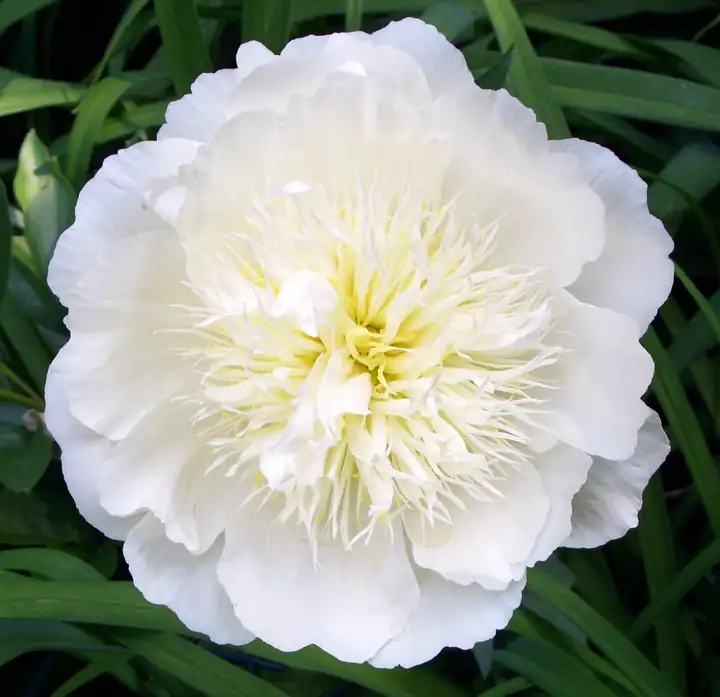
Peony
Paeonia lactiflora and hybrids (herbaceous); P. suffruticosa and hybrids (tree peonies); Itoh (intersectional) hybrids · Peony family (Paeoniaceae)
When to plant: Plant bare-root divisions in early fall (September-October), with 3-5 eyes each.
| Hardiness zones | 3 to 8 |
|---|---|
| Sun | full sun |
| Water | moderate |
| Life cycle | perennial |
| Frost | Hardy: takes frost |
| Soil pH | 6.0–7.0 |
| Spacing | 36 to 60 inches |
About Peony
Peonies are long-lived perennials with huge, often fragrant late-spring flowers; a happy clump can bloom for 50 years or more. There are three kinds: herbaceous peonies die to the ground each winter, tree peonies are woody shrubs that keep their stems, and Itoh (intersectional) peonies are crosses of the two that have tree-peony-style flowers but die back like herbaceous ones. The ants you see on the buds are just sipping nectar from glands on the bud covers; they do no harm and are not needed for the flowers to open.
Hardy in zones 3-8 and best in 5-7; in warm zones 8-9 some cultivars get too little winter chill, so NC State suggests low-chill types there.
When to plant
Plant bare-root divisions in early fall (September-October), with 3-5 eyes each.
Set herbaceous and Itoh peonies so the pinkish eye buds sit only 1-2 inches below the soil (Clemson says no more than 1 inch in the South); buried deeper, they often won't bloom. Grafted tree peonies go deeper, with the graft 4-6 inches down (Penn State; NC State). New plants may skip blooming the first year and fill out by the third or fourth year (Iowa State).
Soil
Deep, fertile, well-drained soil near neutral; peonies will not stand wet ground (Penn State, Clemson).
Follow a soil test; aim for pH 6.5-7.0 and dig a hole 12-18 inches deep, mixing compost or aged manure into heavy clay (Clemson).
Feeding
- spring, when new stems are 2-3 inches tall: low-nitrogen fertilizer such as 5-10-10 or 5-10-5. Scatter about 2-3 lb per 100 sq ft around (not on) the crowns and water it in (Clemson; NC State). Established clumps only need this every few years (Illinois).
Look for: a balanced or all-purpose fertilizer at the label rate. Skip high-phosphorus "bloom boosters" unless a soil test shows low phosphorus: most garden soils already have enough, and the extra can wash into streams.
Too much nitrogen and eyes planted more than 2 inches deep are top reasons peonies don't bloom (Clemson; Illinois).
Harvest
Blooms from late spring into early summer (early May in central Illinois); each plant flowers for about two weeks. For vases, cut buds that show color and feel soft like a marshmallow; swish them in water to rinse off ants. Cut no more than a third to half of the flowers, and leave as much foliage as you can on the plant, or next year's bloom suffers (NC State).
Varieties (27)
| Variety | Type | Season and days | Zones | Notes |
|---|---|---|---|---|
| Belleville | Herbaceous | 3–8typical for peony | Anemone flower form. Sources: [3] | |
| Bowl of Beauty | Herbaceous | 3–8typical for peony | Japanese/anemone form: bright pink petals around a creamy white center. Sources: [12] | |
| Coral Charm | Herbaceous | 3–8typical for peony | Coral pink semi-double. Sources: [12] | |
| Kansas | Herbaceous | 3–8typical for peony | Carmine red double. Sources: [2][12] | |
| Karl Rosenfield | Herbaceous | 3–8typical for peony | Dark red double. Sources: [12] | |
| Miss America | Herbaceous | 3–8typical for peony | White semi-double. Sources: [12] | |
| Pink Hawaiian | Herbaceous | 3–8typical for peony | Peachy pink semi-double. Sources: [12] | |
| Raspberry Sundae | Herbaceous | 3–8typical for peony | Bomb form: lavender-pink with a cream to pink center. Sources: [12] | |
| Shirley Temple | Herbaceous | 3–8typical for peony | White double. Sources: [12] | |
| Baroness Schroeder | Herbaceous (lactiflora) | 3–8typical for peony | White flowers. An older variety NC State recommends. Sources: [10] | |
| Felix Crousse | Herbaceous (lactiflora) | Bright pink to red doubles. Low chill requirement (NC State). Sources: [8][10] | ||
| Festiva Maxima | Herbaceous (lactiflora) | Fragrant double white flowers flecked with crimson. An old favorite; NC State lists it as a low-chill choice for warmer zones, and Clemson names it among doubles that do well in South Carolina. Sources: [8][10][12] | ||
| Monsieur Jules Elie | Herbaceous (lactiflora) | 3–8typical for peony | Medium pink double. An older variety NC State recommends. Sources: [10] | |
| Sarah Bernhardt | Herbaceous (lactiflora) | Fragrant, pastel pink double; a reliable bloomer. Low-chill choice for warmer zones (NC State). Sources: [8][10][12] | ||
| Red Charm | Herbaceous hybrid | Early | 3–8typical for peony | Fragrant red flowers that open early. Sources: [8] |
| Bartzella | Itoh (intersectional) | 3–8typical for peony | Double yellow with a red flare in the center. Sources: [9][12] | |
| Cora Louise | Itoh (intersectional) | 3–8typical for peony | White semi-double with a dark lavender center. Sources: [9][12] | |
| First Arrival | Itoh (intersectional) | 3–8typical for peony | Lavender-pink semi-double. Sources: [12] | |
| Keiko | Itoh (intersectional) | 3–8typical for peony | Lavender-pink double. Sources: [12] | |
| Kopper Kettle | Itoh (intersectional) | 3–8typical for peony | Copper-pink semi-double. Sources: [12] | |
| Scarlet Heaven | Itoh (intersectional) | 3–8typical for peony | Scarlet red semi-double. Sources: [12] | |
| Sequestered Sunshine | Itoh (intersectional) | 3–8typical for peony | Semi-double yellow. Sources: [9] | |
| Black Pirate | Tree peony | 3–8typical for peony | Dark burgundy flowers. Sources: [12] | |
| Gessekai | Tree peony | 3–8typical for peony | Single white flowers. Sources: [12] | |
| Guardian of the Monastery | Tree peony | 3–8typical for peony | Lotus-shaped flowers. Sources: [3] | |
| High Noon | Tree peony | 3–8typical for peony | Yellow flowers on a woody shrub. Sources: [12] | |
| Shima Nishiki | Tree peony | 3–8typical for peony | Purplish-red semi-double streaked with white. Sources: [9] |
Pests to watch for
Diseases and problems
Botrytis blight, Leaf blotch, Powdery mildew, Phytophthora blight, Black walnut toxicity
In the kitchen
Keeping it: Buds cut at the marshmallow stage can be wrapped dry and laid flat in the fridge for a few weeks, then recut and put in water to open. In a vase, cut peonies last about as long as roses.
Safety: NC State flags peonies as a problem for pets; we found no research-based guidance on human safety. Don't eat any part.
Pets: Toxic to dogs, cats and horses (ASPCA): paeonol in the plant can cause vomiting, diarrhea and depression.
Sources
- hort.extension.wisc.edu
- hgic.clemson.edu
- extension.psu.edu
- yardandgarden.extension.iastate.edu
- yardandgarden.extension.iastate.edu
- extension.illinois.edu
- extension.illinois.edu
- plants.ces.ncsu.edu
- plants.ces.ncsu.edu
- content.ces.ncsu.edu
- aspca.org
- yardandgarden.extension.iastate.edu
Photo: Photo: Charvex, Public domain, via Wikimedia Commons. Photo resized for the web.

Planting dates and advice are general guidance; check with your local Cooperative Extension office for your area.