
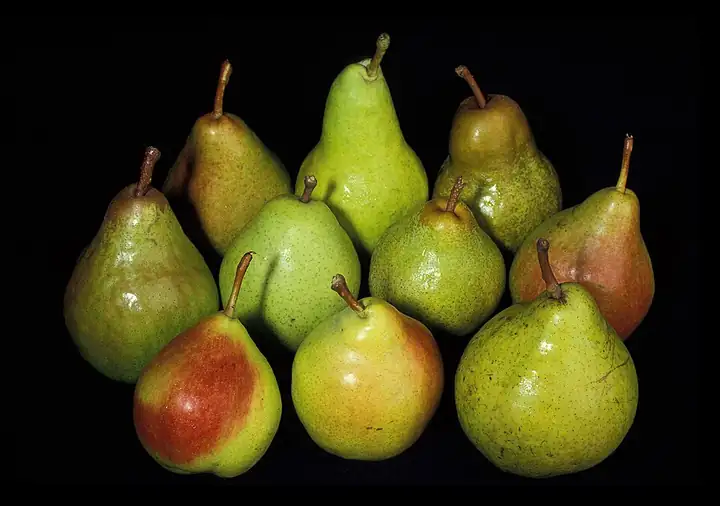
Pear
Pyrus communis (European pear) and Asian pears (Pyrus spp.) · Rose family (Rosaceae)
When to plant: Set out plants from 4 weeks before to 2 weeks after the last frost.
| Hardiness zones | 3 to 9 |
|---|---|
| Sun | full sun |
| Water | moderate |
| Life cycle | perennial |
| Frost | Hardy: takes frost |
| Soil pH | 6.0–6.5 |
| Spacing | 144 to 288 inches |
About Pear
Pears are long-lived fruit trees, usually grafted onto a dwarfing rootstock to keep them a manageable size. They need a second variety nearby for a good crop, and fire blight is the main disease to plan around.
NC State lists European pear for zones 4-8 and University of Minnesota names a couple of varieties for zone 3; low-chill varieties needing only about 150-400 chill hours below 45 F are grown in north and central Florida (UF/IFAS), but none are recommended south of Orlando.
When to plant
Timing is counted from your average last spring frost (and first fall frost). Sow & Tell works out the actual dates for your ZIP code.
- Set out plants: from 4 weeks before to 2 weeks after the last frost
Plant bare-root trees as soon as the soil can be worked and potted trees after frost (University of Minnesota); in the South, late fall to winter planting is best (NC State; UF/IFAS plants bare-root trees late December through January). Trees can take 3 to 10 years to begin bearing (University of Minnesota). Plant at least two varieties that bloom together, since most pears need cross-pollination (NC State).
Soil
Most soils work if they drain well; pears do best slightly acidic.
Plant in well-drained soil with a pH of about 6 to 7, and test the soil before planting.
Feeding
- Early spring from the second year on, only if new shoots grew less than about 12 inches last year: compost, or a balanced fertilizer such as 10-10-10 if a soil test calls for it. Spread it on the soil under and just beyond the branches, keeping it 6 inches from the trunk; follow a soil test for the amount.
Look for: mostly nitrogen, in spring as growth starts. Spring feeding grows the new shoots and leaves that carry flowers and fruit; feeding after midsummer pushes soft growth that may not harden before winter.
Too much nitrogen, even from compost, gives fast soft growth that fire blight attacks easily; trees making 18-24 inches of growth a year need no feeding.
Harvest
Pick European pears when mature but still firm, when the skin lightens from dark to lighter green or the dots on the skin turn brown, then ripen them indoors (University of Minnesota; UGA). Asian pear blossoms are very frost-sensitive and the fruit needs heavy thinning (NC State).
Pears give one crop a year, harvested August to October in Minnesota. Pick when mature but still firm and ripen them indoors; pears left to ripen on the tree turn gritty.
Varieties (42)
| Variety | Type | Season and days | Zones | Notes |
|---|---|---|---|---|
| 20th Century | Asian | Midseason | 5–9 | Good dessert quality. Moderate fire blight resistance. Partly self-fruitful; crops better with Chojuro, Hosui or Shinseiki. Page is for Nijisseiki (Twentieth Century). Sources: [9][10] |
| Chojuro | Asian | Midseason | 5–9 | Crisp, mildly sweet fruit with a distinct aroma. Moderate fire blight resistance. Stores up to about 20 weeks. Tends to overbear, so thin fruit. Pollinize with 20th Century, Shinseiki or Hosui. Nebraska Extension lists zones 4-5 for it. Sources: [9][11][12][13][14] |
| Hosui | Asian | Midseason | 5–9 | Sweet, mild, crisp and juicy with a butterscotch-like note; golden-brown skin. Moderate fire blight resistance. Pollinize with 20th Century, Shinseiki or Chojuro. Nebraska Extension lists zones 4-5 for it. Sources: [9][11][12][15] |
| Shin Li | Asian | 5–9 | Hardy and fire blight-resistant. Sources: [16][17] | |
| Shinko | Asian | Midseason | 5–8typical for Asian pear | Sweet; heavy bearer. One of the more fire blight-resistant Asian pears; hardy. Oklahoma State pairs it with Hosui or Shinseiki. Sources: [9][12][13][16][18] |
| Shinseiki | Asian | Midseason | 5–9 | Smooth yellow skin with crisp, juicy white flesh; a bit less flavor than Hosui or 20th Century. Moderate fire blight resistance. Stores about 12 weeks. Pollinize with Chojuro, 20th Century or Hosui. Nebraska Extension lists zones 4-5 for it. Sources: [9][11][19] |
| Tsu Li | Asian (Chinese) | 5–8typical for Asian pear | Shows some fire blight resistance. Suited to low-chill parts of Texas. Type range is for Pyrus pyrifolia; Tsu Li is a Chinese pear. 300 chill hours Sources: [13][18][20] | |
| Ya Li | Asian (Chinese) | 5–8typical for Asian pear | Shows some fire blight resistance. Suited to low-chill parts of Texas. Type range is for Pyrus pyrifolia; Ya Li is a Chinese pear. 300 chill hours Sources: [13][18][20] | |
| Juicy Jewel | Cold-hardy crisp pear | Mid-August | 4+ | Best eaten fresh; attractive fruit, sometimes with an orange-pink blush. University of Minnesota release (2021). Not recommended for zone 3. Pairs with Summercrisp for pollination. Sources: [4] |
| Summercrisp | Cold-hardy crisp pear | Mid-August | 4+ | Mild, crisp, red-blushed fruit that eats much like an Asian pear. Resistant to fire blight. University of Minnesota release (1985). Juicy Jewel and Summercrisp pollinate each other. Sources: [4] |
| Flemish Beauty | Cold-hardy northern pear | 3–9typical for pear | Very cold-hardy; suggested for colder New Hampshire sites. Sources: [21] | |
| Golden Spice | Cold-hardy northern pear | Late August | 3+ | Small fruit, under 2 inches; good for canning. Very resistant to fire blight. Tree reaches about 20 ft. Rated excellent in zone 4 and very good in zone 3. A recommended pollen source for Ure. Sources: [4] |
| Gourmet | Cold-hardy northern pear | Mid- to late September | 4+ | Juicy, sweet, medium-size fruit with firm, crisp texture. Tolerates fire blight. Cannot pollinate other pears. Sources: [4] |
| Lincoln | Cold-hardy northern pear | 4–8 | Good flavor. Nebraska Extension calls it the hardiest of its listed pears. Sources: [1][11] | |
| Luscious | Cold-hardy northern pear | Mid- to late September | 4–8 | Medium-small fruit with Bartlett-like flavor; firm but melting texture. Tolerates fire blight; very cold-hardy. Its pollen is poor, so it cannot pollinate other pears. Parker is a good partner. Sources: [1][4][11][21] |
| Parker | Cold-hardy northern pear | Mid-August | 4+ | Similar to Bartlett in size, flavor and texture. Prone to fire blight. May not be hardy north of the Twin Cities. A good pollinizer for Luscious. May set some fruit alone. Sources: [4] |
| Patten | Cold-hardy northern pear | Mid- to late September | 4+ | Large fruit, excellent for fresh eating, much like Bartlett. Prone to fire blight. A bit hardier than Parker. May set some fruit alone. Sources: [4] |
| Ure | Cold-hardy northern pear | Mid-August | 3+ | Small Bartlett-type fruit with good flavor. Smaller tree, to about 15 ft. Prone to fire blight. In places too cold for most pears, grow it with Golden Spice for pollen. Sources: [4] |
| Bartlett | European | Early (early September in New Hampshire) | 4–8typical for European pear | The classic sweet, juicy pear that other pears are judged against. Very prone to fire blight. Old favorite for canning. Hardy where winters rarely drop below about -25°F. Needs a pollinizer. Bartlett and Seckel will not pollinate each other; Bosc or Anjou work. 1000+ chill hours Sources: [1][9][13][16][21] |
| Bosc | European | Late (about October 1 in New Hampshire) | 4–8typical for European pear | High-quality, late-ripening dessert pear. Prone to fire blight. Bears regularly and heavily in Connecticut trials. A good pollen source for Bartlett. Oklahoma State calls it partly self-fertile. 1000+ chill hours Sources: [1][9][13][16][21] |
| Clapp's Favorite | European | Late August in New Hampshire | 4–8typical for European pear | Very large fruit with good flavor. Prone to fire blight. Fruit can break down at the core if left too long on the tree. Needs a pollinizer. Sources: [1][21] |
| Comice | European | Late | 4–8typical for European pear | Delicate dessert pear; better fresh than cooked. Oklahoma State pairs it with Moonglow or Maxine. Sources: [1][9] |
| D'Anjou | European | Midseason | 4–8typical for European pear | Sweet pear with the familiar pear shape. Low fire blight resistance. Oklahoma State pairs it with Bartlett for pollination. 1000+ chill hours Sources: [1][9][13] |
| Harrow Delight | European | Midseason | 4–8 | Smooth, high-quality flesh. High fire blight resistance and very cold-hardy. Part of the Harrow series from Ontario, which is notably blight-resistant. Oklahoma State pairs it with Moonglow or Maxine. Sources: [9][20][21][22] |
| Harrow Sweet | European | 4–8 | Selected for cold hardiness, heavy cropping and fire blight resistance. Sources: [11][20][23] | |
| Harvest Queen | European | 4–8 | Early-ripening, cold-hardy pear with fire blight resistance. Sources: [11][20][24] | |
| Honeysweet | European | 4–8typical for European pear | Good to great for fresh eating; also cooks and stores well. Good fire blight resistance. Sources: [1][21][25] | |
| Magness | European | Midseason | 5–8 | Light-colored, sweet, aromatic fruit of excellent dessert quality. Very resistant to fire blight. Makes poor pollen, so it cannot pollinate other pears. Plant two other varieties with it. Sources: [1][9][11][12][21] |
| Maxine | European | Midseason | 4–8typical for European pear | Good for fresh eating, canning or preserves. Moderate fire blight resistance. Oklahoma State pairs it with Harrow Delight or Magness. Sources: [1][9][16][20] |
| Moonglow | European | Early to midseason | 5–8 | Good dessert quality and flavor. Very resistant to fire blight. Texas groups it with the lower-chill European hybrid pears. Oklahoma State lists Maxine or Comice as pollen partners. Sources: [9][11][12][13][21][26] |
| Old Home | European | 4–8typical for European pear | Shows some fire blight resistance; Illinois lists it for fresh eating, cooking and storage. Sources: [1][20][25] | |
| Potomac | European | 5–8 | Excellent fire blight resistance. Sources: [21][27] | |
| Seckel | European | Late | 5–8 | Small, very sweet, firm 'sugar pear' with excellent flavor. Good fire blight resistance for a European pear. Compact tree; easy to grow. May set some fruit alone but crops better with a partner. Will not cross-pollinate with Bartlett. Sources: [9][11][12][16][21][28] |
| Starking Delicious | European | 4–8typical for European pear | Listed with fire blight-resistant pears for Illinois and New England; good for eating, cooking and storage. Sources: [1][20][25] | |
| Warren | European | Midseason | 4–8typical for European pear | Excellent dessert quality. High fire blight resistance and cold-hardy. Oklahoma State lists it as self-fruitful. Sources: [1][9][20] |
| Kieffer | European-Asian hybrid | Mid-September to mid-October | 4–9 | Crisp, coarse, gritty white flesh; better for preserves, canning and baking than fresh eating. Resistant to fire blight. Heavy-bearing tree; about 20 ft on standard roots, 12-15 ft as a dwarf. Plant at least two varieties for good pollination. Sources: [12][13][16][29] |
| Baldwin | Low-chill southern pear | Late August to September in Florida | Good fresh or canned. Moderate resistance to fire blight and leaf spot. Needs a pollinizer. 150 chill hours Sources: [6] | |
| Flordahome | Low-chill southern pear | July to August in Florida | Good fresh or canned. Resistant to fire blight and leaf spot. Partly self-fertile. 150 chill hours Sources: [6] | |
| Hood | Low-chill southern pear | Mid-July in Florida | Good fresh or canned. Moderate resistance to fire blight and leaf spot. Self-fertile. 160–260 chill hours Sources: [6] | |
| LeConte | Low-chill southern pear | July to August in Florida | Used fresh. Fire blight reports differ: Clemson rates it moderately resistant; Florida calls it somewhat susceptible. Needs a pollinizer. 250–300 chill hours Sources: [6][12][25] | |
| Orient | Low-chill southern pear | Late July to early August in Florida | Best used for canning. Very resistant to fire blight and resistant to leaf spot. Self-fertile in Florida. Not recommended south of Orlando. Sources: [6][12][20] | |
| Pineapple | Low-chill southern pear | Early August in Florida | Best used for canning. Very resistant to fire blight; moderate leaf spot resistance. Partly self-fertile. Sources: [6] |
Pests to watch for
Codling moth, Pear psylla, Scale insects, Twospotted spider mite, Aphids, Japanese beetle, Voles, Rabbits, Sawflies (garden sawflies), Eriophyid mites (rust, bud, blister and gall mites), Katydids, Boxelder bugs, Roundheaded appletree borer, Flatheaded appletree borer, Obliquebanded leafroller, Pear sawfly (pearslug, cherry slug), European red mite, Plum curculio, Apple maggot, Cherry fruit fly, Eastern tent caterpillar, Green June beetle (fig-eater)
Diseases and problems
Fire blight, Powdery mildew, Anthracnose, Potassium deficiency, Cedar-quince rust, Sooty blotch and flyspeck, Gray mold (Botrytis)
In the kitchen
Eaten fresh, cooked or dried.
Keeping it: Pick European pears firm and ripen them at 60-70F in a paper bag; once ripe, keep them a few days on the counter or about 5 days in the fridge. Firm, mature pears hold for months in cold storage near 30-32F.
Pets: Not listed as toxic by the ASPCA
Sources
- plants.ces.ncsu.edu
- content.ces.ncsu.edu
- content.ces.ncsu.edu
- extension.umn.edu
- fieldreport.caes.uga.edu
- ask.ifas.ufl.edu
- aspca.org
- aspca.org
- extension.okstate.edu
- plants.ces.ncsu.edu
- extensionpubs.unl.edu
- hgic.clemson.edu
- aggie-horticulture.tamu.edu
- plants.ces.ncsu.edu
- plants.ces.ncsu.edu
- homegarden.cahnr.uconn.edu
- plants.ces.ncsu.edu
- plants.ces.ncsu.edu
- plants.ces.ncsu.edu
- netreefruit.org
- extension.unh.edu
- plants.ces.ncsu.edu
- plants.ces.ncsu.edu
- plants.ces.ncsu.edu
- extension.illinois.edu
- plants.ces.ncsu.edu
- plants.ces.ncsu.edu
- plants.ces.ncsu.edu
- plants.ces.ncsu.edu
Photo: Photo: Keith Weller, USDA ARS, Public domain (USDA ARS), via Wikimedia Commons. Photo resized for the web.

Planting dates and advice are general guidance; check with your local Cooperative Extension office for your area.