
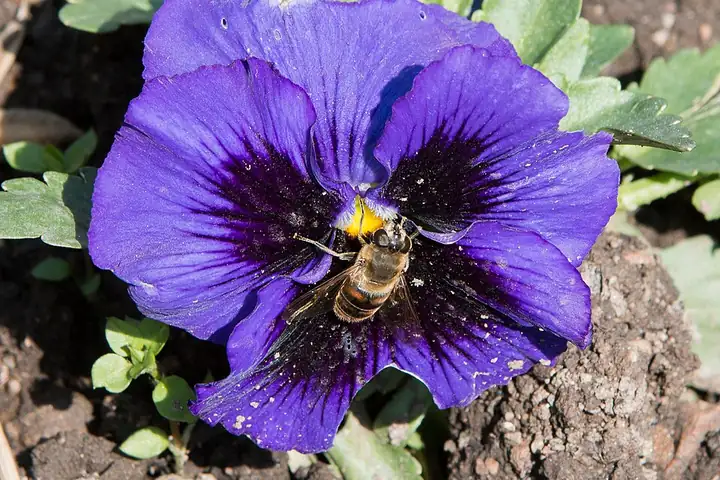
Pansy and viola
Viola x wittrockiana (pansy); Viola cornuta and V. tricolor (violas, Johnny-jump-ups) · Violet family (Violaceae)
When to plant: Plant transplants in fall when soil is 45-65 F: about Sept. 15-Oct. 1 in zones 6b-7a, Oct. 1-15 in zone 7b and Oct. 15-Nov. 1 in zone 8 (UGA); in Iowa, set plants out in early to mid April or early September.
| Hardiness zones | 6 to 10 |
|---|---|
| Sun | full sun to part shade |
| Water | moderate |
| Life cycle | annual |
| Frost | Hardy: takes frost |
| Soil pH | 5.4–6.0 |
| Spacing | 6 to 10 inches |
About Pansy and viola
Pansies and their smaller-flowered cousins, violas and Johnny-jump-ups, are cool-weather flowers with 'faces' that bloom through fall, mild winters and spring. In the South they are planted in fall and can bloom 4-6 months; in the North they brighten early spring and fall and fade in summer heat. The flowers are edible, and pansies are a caterpillar food plant for the variegated fritillary butterfly.
Grown as a cool-season annual (sometimes a biennial). NC State lists zones 6-10, where fall plantings bloom into spring; healthy plants survive single-digit cold (UGA), and violas and Johnny-jump-ups are even hardier. In colder areas plant in early spring and again in early fall (Iowa State).
When to plant
Plant transplants in fall when soil is 45-65 F: about Sept. 15-Oct. 1 in zones 6b-7a, Oct. 1-15 in zone 7b and Oct. 15-Nov. 1 in zone 8 (UGA); in Iowa, set plants out in early to mid April or early September.
Start seed indoors 8-10 weeks before you plan to set plants out (Iowa State). Plants stretch and get leggy in heat.
Soil
Well-drained, moist soil with plenty of organic matter; raised beds help where drainage is poor (Clemson, UGA).
Mix in organic matter (about 3 inches worked into the top foot), raise beds for drainage, and follow a soil test; keep pH around 5.4-5.8 and don't lime unless the test calls for it (UGA).
Feeding
- Fall and winter, while plants are growing: water-soluble fertilizer with mostly nitrate nitrogen (such as calcium or potassium nitrate). Feed every 2-3 weeks through the cool season (UGA, Mississippi State); cut back in warm spells. High ammonium forms make plants stretch and less cold-hardy (UGA).
Look for: a balanced or all-purpose fertilizer at the label rate. Skip high-phosphorus "bloom boosters" unless a soil test shows low phosphorus: most garden soils already have enough, and the extra can wash into streams. - Late winter into spring (after about mid-March in Georgia): balanced fertilizer such as 20-20-20, or slow-release granules. Switch to a balanced feed as soil warms (UGA); Iowa State feeds spring plantings every 1-3 weeks.
Look for: a balanced or all-purpose fertilizer at the label rate. Skip high-phosphorus "bloom boosters" unless a soil test shows low phosphorus: most garden soils already have enough, and the extra can wash into streams.
Soggy soil and high-ammonium fertilizer lead to root rot and stretched, less hardy plants; pH above 5.8 invites black root rot and iron and boron shortages (UGA).
Harvest
Pick or pinch off faded flowers often so plants keep blooming instead of setting seed (Clemson, NC State); some violas such as the Sorbet XP series drop spent flowers on their own. Pull plants when summer heat makes them leggy.
Varieties (19)
| Variety | Type | Season and days | Notes |
|---|---|---|---|
| Jolly Joker | Bicolor pansy | Two-toned flowers. Sources: [3] | |
| Maxim series | Blotched pansy | Sources: [3] | |
| Imperial Antique Shades | Blotched pansy (F1 hybrid) | Soft shades from yellow toward red; UGA lists Imperial among heat-tolerant F1 hybrids. Sources: [3] | |
| Regal series | Blotched pansy (F1 hybrid) | Faced flowers; UGA lists it among heat-tolerant F1 hybrids. Sources: [3] | |
| Crystal Bowl series | Clear-faced pansy | Solid-colored flowers without blotches. Sources: [3] | |
| Crown series | Clear-faced pansy (F1 hybrid) | Solid colors; UGA lists it among heat-tolerant F1 hybrids. Sources: [3] | |
| Majestic Giant (and Super Majestic Giant) | Large-flowered blotched pansy (F1 hybrid) | Blotched ('faced') flowers; UGA lists the series among heat-tolerant F1 hybrids. Sources: [3] | |
| Matrix Lavender Shades | Large-flowered pansy | Fall to spring | Lavender shades in the Matrix series. Sources: [9] |
| Matrix series | Large-flowered pansy | Fall to spring; early to bloom | About 8 in tall and wide and well branched, with big flowers on sturdy stems in blotched or clear colors. Mississippi State calls it one of the toughest cool-season bedding plants. Sources: [9][10] |
| Delta Beaconsfield | Pansy | Sources: [9] | |
| Delta series | Pansy | Fall to spring; blooms early | About 8 in tall and wide, freely branching, with many flowers held on strong stems. Mississippi State says plants can freeze solid and thaw with little damage. Sources: [9] |
| Dynamite Blueberry Thrill | Pansy | Sources: [2] | |
| Delta Wine and Cheese | Pansy (clear-faced) | A blend of primrose, red, violet and pale yellow flowers without dark blotches. Mississippi State notes it can be hard to find. Sources: [9] | |
| Cool Wave series | Spreading/trailing pansy | Fall to spring | Trailing, vigorous plants for beds and hanging baskets; colors include white, yellow, purple, Frost, Violet Wing, Blueberry Swirl and Sunshine N' Wine. Sources: [10] |
| Cool Wave Sunshine N' Wine | Spreading/trailing pansy | Yellow flowers with burgundy markings. Sources: [10] | |
| Sorbet XP Deep Orange | Viola | Bright orange flowers on tidy 4-6 in mounds. Spent flowers drop on their own, so no deadheading. Sources: [5] | |
| Sorbet XP Delft Blue | Viola | White faces edged in blue-purple with a yellow center and dark blotch; compact. Sources: [5] | |
| Sorbet XP Yellow Jump Up | Viola | Yellow and purple flowers held up on slender stems; 4-6 in tall. Sources: [5] | |
| Sorbet series | Viola (Viola cornuta) | Fall to spring | Small flowers in many colors on compact plants about 4-6 in tall and wide that resist stretching as it warms; includes 'Banana Cream' and 'Lavender Pink'. Mississippi State says violas stand cold even better than pansies. Sources: [8] |
Pests to watch for
Aphids, Slugs, Brown garden snail, Twospotted spider mite, Cutworms, Thrips
Diseases and problems
Black root rot, Crown rot, Gray mold (Botrytis), Downy mildew, Cercospora leaf spot, Anthracnose, Powdery mildew, Edema (oedema), Cucumber mosaic
In the kitchen
Pansy and viola flowers are edible, with a mild, grassy taste; use them fresh on salads and cakes or candy them (UMN, NC State).
Safety: Eat only flowers you grew without pesticides; nursery plants may carry systemic insecticides (NC State). Dark flowers can stain the tongue for a while, and some people react to any new food, so try a little first (UMN).
Pets: Non-toxic to pets (ASPCA)
Sources
- plants.ces.ncsu.edu
- hgic.clemson.edu
- fieldreport.caes.uga.edu
- yardandgarden.extension.iastate.edu
- extension.msstate.edu
- extension.umn.edu
- aspca.org
- extension.msstate.edu
- extension.msstate.edu
- oxfordeagle.com
Photo: Photo: Daniel Villafruela, CC BY-SA 4.0, via Wikimedia Commons (CC BY-SA 4.0). Photo resized for the web.

Planting dates and advice are general guidance; check with your local Cooperative Extension office for your area.