
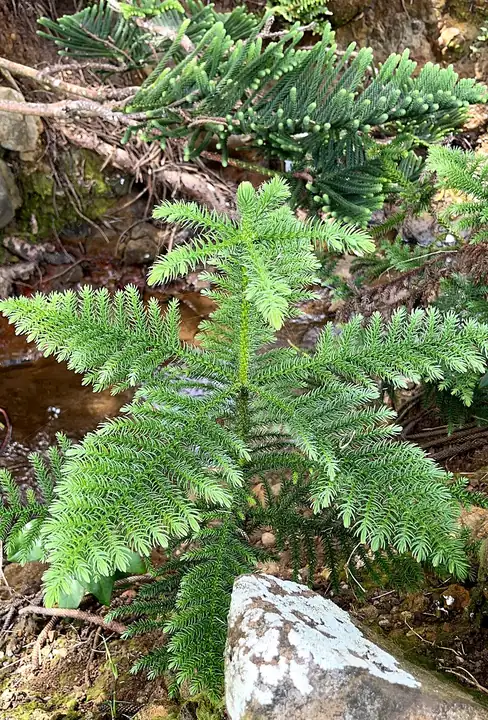
Norfolk Island pine
Araucaria heterophylla (formerly A. excelsa) · Araucaria family (Araucariaceae)
When to plant: Any time of year, since it grows indoors. Repot in spring, one size up, when roots fill the pot.
| Hardiness zones | 9 to 11 |
|---|---|
| Sun | full sun to part shade |
| Water | moderate |
| Life cycle | perennial |
| Frost | Tender: killed by frost |
Will it grow in your window?
Pick the window it sits in. This is the same check Sow & Tell runs for every plant in your house.
It wants bright, indirect light.
Pick a window above and this will tell you whether the spot suits it.
Watering: water when the top inch is dry — about every 7 days, stretching to every 12 from November to February.
Summering outside? Bring it in before nights drop below 55°F.
About Norfolk Island pine
The Norfolk Island pine is not a true pine but a southern-hemisphere conifer found wild only on Norfolk Island in the South Pacific, where it grows to about 200 ft (NC State). Indoors it makes a soft-needled, symmetrical little tree with tiers of branches, sold at the holidays as a living Christmas tree, and it can reach about 9 ft over the years. It wants the brightest, coolest room in the house, and NC State notes the species is vulnerable in the wild.
Hardy outdoors only in zones 9-11, where it becomes a large tree (NC State); it is grown indoors everywhere and can summer outdoors in bright, lightly shaded spots once nights stay above about 55 F.
When to plant
Any time of year, since it grows indoors. Repot in spring, one size up, when roots fill the pot.
Usually bought as a small nursery tree, often at the holidays; it is propagated from seed (NC State).
Growing it indoors
- Light: Give it a bright, cool room, with light afternoon shade so the needles don't bleach yellow; it tolerates very low light for 2-3 years but then drops needles and lower branches (NC State).
- Water: Water regularly from spring to fall without keeping the mix wet, and sparingly in winter (NC State); MU Extension lists it as evenly moist. Use a pot with drainage and empty the saucer after watering (Wisconsin).
- Humidity: It adapts to the warm, dry air of most homes, but NC State suggests misting it in heated rooms in winter.
- Temperature: It prefers a cool room of 55-65 F (NC State), and MU Extension also lists 55 F nights; keep it out of cold drafts from doors and windows (Wisconsin).
- Feeding: A dilute liquid fertilizer every week or two from spring through fall (NC State), none in winter.
- Repotting: The pages we opened give no schedule; repot in spring, one pot size up, when roots fill the pot or come out the drainage holes (Wisconsin's general rule).
- More plants: NC State lists seed as the way to propagate it; the pages we opened don't cover cuttings.
If something looks wrong
| What you see | Likely cause | What to do |
|---|---|---|
| Lower branches and needles dropping after a few years indoors | Too little light over a long time | Move it to the brightest window you have (NC State). |
| Needles bleaching to a yellowish tint | Too much hot afternoon sun | Give it light afternoon shade (NC State). |
| Small bumps on the stems and a black sooty film on the needles | Scale insects and the sooty mold that grows on their honeydew | Scrape or wipe off the scale and wash off the sooty film (NC State lists both). |
Soil
A fertile, porous, slightly acidic, well-drained potting mix with some sand and peat (NC State).
Pot in a fertile, porous, slightly acidic, well-drained mix with some sand and peat (NC State).
Feeding
- Spring through fall: dilute liquid fertilizer. Every week or two (NC State); follow the label.
- Winter: none. Skip feeding while no new growth is showing, and water sparingly (MU Extension, NC State).
Needle drop and lost lower branches come from too little light, which fertilizer can't fix (NC State).
Pests to watch for
Diseases and problems
Sooty mold, Leaf spot
In the kitchen
Safety: NC State tags it non-toxic and gives no poison warning; the needles end in soft but sharp points.
Pets: Non-toxic to dogs, cats and horses (ASPCA, listed as Australian pine, also called Norfolk Island pine).
Sources
Photo: Photo: alexbarnard, CC BY 4.0, via Wikimedia Commons (CC BY 4.0). Photo resized for the web.

Planting dates and advice are general guidance; check with your local Cooperative Extension office for your area.