
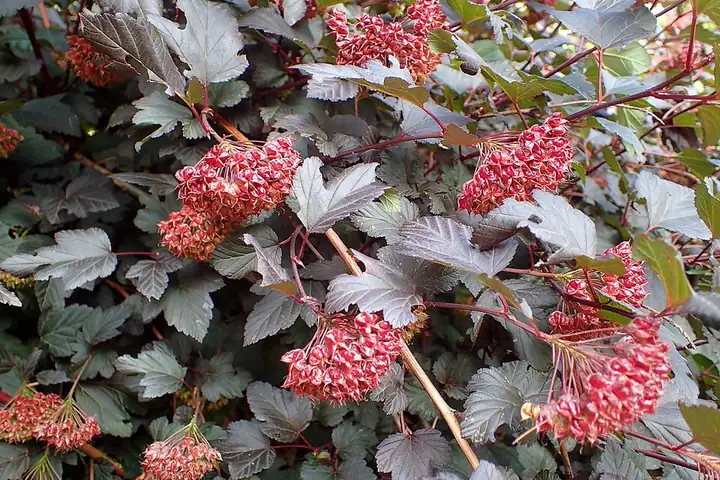
Ninebark
Physocarpus opulifolius · Rose family (Rosaceae)
When to plant: Plant container shrubs in spring or fall and water deeply until established (UMN).
| Hardiness zones | 2 to 8 |
|---|---|
| Sun | full sun to part shade |
| Water | moderate |
| Life cycle | perennial |
| Frost | Hardy: takes frost |
About Ninebark
Ninebark is a tough native shrub of central and eastern North America with arching stems, round clusters of small white to pinkish flowers in late spring, and peeling bark that shows in winter. Purple- and gold-leaved cultivars such as 'Diabolo' and 'Summer Wine' are popular color shrubs, and it handles heat, drought, clay and wet spots (NC State, Morton Arboretum). University of Minnesota Extension suggests a ninebark in place of invasive burning bush.
Very cold hardy, zones 2-8; in the far South it likes some shade (NC State).
When to plant
Plant container shrubs in spring or fall and water deeply until established (UMN).
Easy to transplant (NC State).
Soil
Adapts to most soils, acid or alkaline, clay or sand, and takes occasional drought or flooding (Morton Arboretum, NC State).
Test the soil before planting; mature shrubs in decent soil need little or no fertilizer (Clemson).
Feeding
- Spring to early summer after new growth starts, only if a soil test shows a need: slow-release complete fertilizer in a 3:1:2 ratio, or what the soil test calls for. Spread evenly from the trunk out to the drip line and water it in; a typical soil-test rate for shrubs is about 2 lb of 12-6-6 per 100 sq ft (Clemson). Follow a soil test.
Look for: mostly nitrogen, in spring as growth starts. Spring feeding grows the new shoots and leaves that carry flowers and fruit; feeding after midsummer pushes soft growth that may not harden before winter.
Water is what new shrubs need most: daily for the first 2 weeks, every 2-3 days through week 12, then weekly until the roots spread (at least two growing seasons), using about a quarter to a third of the nursery pot's volume each time (UMN). Too much fertilizer burns roots and pushes leaves at the expense of flowers; don't feed drought-stressed shrubs (Clemson).
Harvest
Blooms late May to early July. Prune right after flowering (no later than mid-August), since next year's flowers form on old wood; overgrown shrubs can be cut to the ground in winter to renew them (NC State, Morton Arboretum).
Varieties (12)
NC State and Morton Arboretum document these.
| Variety | Type | Zones | Notes |
|---|---|---|---|
| Coppertina ('Mindia') | Copper-leaved | 2–8typical for ninebark | 6-8 ft; copper new leaves age to reddish-bronze. Sources: [1][2] |
| Dart's Gold | Gold-leaved | 2–8typical for ninebark | Dwarf with yellow foliage. Sources: [1] |
| Nugget | Gold-leaved | 2–8typical for ninebark | Compact, about 6 ft; golden to lime foliage. Sources: [1][2] |
| Lemon Candy ('Podaras 3') | Gold-leaved dwarf | 2–8typical for ninebark | Chartreuse leaves; 2-2.5 ft tall. Sources: [1] |
| Amber Jubilee ('Jefam') | Gold/orange-leaved | 2–8typical for ninebark | 5-6 ft tall, 3-4 ft wide; yellow-orange new growth turning lime; purple fall color. Sources: [1][2] |
| Snowfall | Green-leaved | 2–8typical for ninebark | Dense, about 7 ft. Sources: [1] |
| Var. intermedius | Native variety | 2–8typical for ninebark | Smaller and denser, about 4 ft. Sources: [1] |
| Center Glow | Purple-leaved | 2–8typical for ninebark | Purple-leaved type. Sources: [1] |
| Diabolo ('Monlo') | Purple-leaved | 2–8typical for ninebark | Upright, 8-10 ft; dark purple leaves; pinkish-white flowers. Sources: [1][2] |
| Summer Wine ('Seward') | Purple-leaved | 2–8typical for ninebark | Compact, 5-6 ft; deeply cut wine-red leaves; good mildew resistance. Sources: [1][2] |
| Little Devil ('Donna May') | Purple-leaved dwarf | 2–8typical for ninebark | Rounded, 3-4 ft; deep burgundy leaves. Sources: [2] |
| Tiny Wine ('SWPOTWG') | Purple-leaved dwarf | 2–8typical for ninebark | Bushy, 3-4 ft; fine purple leaves; white flowers along the stems. Sources: [2] |
Diseases and problems
Powdery mildew, Fire blight, Leaf spots, Canker
In the kitchen
Safety: No toxicity is listed in the extension sources we used.
Pets: Not on the ASPCA toxic plant lists.
Sources
- plants.ces.ncsu.edu
- mortonarb.org
- extension.umn.edu
- extension.umn.edu
- aspca.org
- aspca.org
- hgic.clemson.edu
Photo: Photo: Krzysztof Ziarnek (Kenraiz) / Wikimedia Commons, CC BY-SA 4.0 (CC BY-SA 4.0). Photo resized for the web.

Planting dates and advice are general guidance; check with your local Cooperative Extension office for your area.