
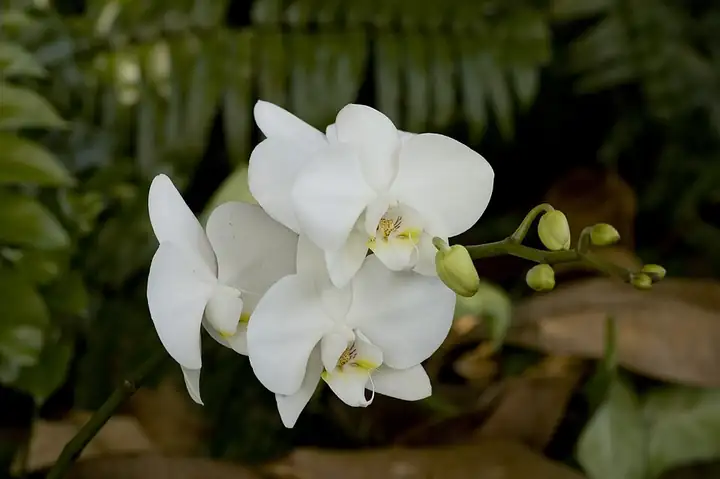
Moth orchid
Phalaenopsis hybrids · Orchid family (Orchidaceae)
When to plant: Any time of year, since it grows indoors. Repot every 1-2 years, when the bark breaks down or new roots start, but never while it is in bloom.
| Hardiness zones | 10 to 12 |
|---|---|
| Sun | shade |
| Water | moderate |
| Life cycle | perennial |
| Frost | Tender: killed by frost |
Will it grow in your window?
Pick the window it sits in. This is the same check Sow & Tell runs for every plant in your house.
It wants medium light.
Pick a window above and this will tell you whether the spot suits it.
Watering: let it dry out between waterings — about every 10 days, stretching to every 18 from November to February.
Summering outside? Bring it in before nights drop below 55°F.
About Moth orchid
Moth orchids are epiphytes from tropical Asia and northern Australia that hold a few thick leaves and send up an arching spike of flat, moth-shaped flowers that last four months or more (NC State). They are the easiest orchid for a windowsill: they take the lowest light of the common orchids, sit happily in bark at room temperature, and with a cool spell in fall most bloom once a year. More than 34,000 hybrids are registered, in white, pink, yellow, peach and spotted patterns; the blue ones are dyed.
Hardy outdoors only in zones 10-12 (NC State); it is grown indoors everywhere and can summer outdoors in shade once nights stay above 55 F, coming back in when evenings drop into the 50s (Clemson, UMD).
When to plant
Any time of year, since it grows indoors. Repot every 1-2 years, when the bark breaks down or new roots start, but never while it is in bloom.
Almost always bought as a blooming nursery plant in bark or moss; home propagation isn't covered by the Extension pages we opened.
Growing it indoors
- Light: An east window is ideal, or a well-shaded west or south window; light-green leaves mean the light is right, dark stiff leaves mean too little, and yellowish leaves with red edges mean too much, since direct sun burns them (NC State, UMD).
- Water: In the morning, run tepid water through the bark for a minute or dunk the pot, then let it drain completely; mature plants need this about once a week, more in summer heat and less in winter, when the bark has dried somewhat and the pot feels light (NC State, Clemson, UMD). Never let it sit in water; soggy roots rot, and ice cubes and misting are no substitute for a proper soak.
- Humidity: Iowa State aims for 40-60 percent humidity; set the pot on a tray of wet pebbles with the pot bottom above the water, or run a humidifier, since wrinkled leaves and dropped buds follow dry winter air.
- Temperature: Keep it above 55 F (Iowa State; Penn State gives 60 F nights as the minimum), at normal 65-80 F room temperatures, off cold winter glass and away from drafts and heat vents; a fall drop to 55-60 F nights for a few weeks triggers the flower spike (NC State, Iowa State, Clemson).
- Feeding: A balanced orchid or houseplant fertilizer at half strength twice a month, or quarter strength weekly, in spring and summer; UMD feeds every third or fourth watering and skips winter (NC State, UMD).
- Repotting: Every 1-2 years, when the bark has broken down or new leaves and roots are starting, into fresh bark in the same size pot or one barely larger; never repot while it is in bloom (UMD, NC State, Clemson).
- More plants: The Extension pages we opened don't describe home propagation of moth orchids; UF/IFAS says most orchids can be divided at repotting, but a single-crown phalaenopsis is usually left as one plant and simply repotted.
If something looks wrong
| What you see | Likely cause | What to do |
|---|---|---|
| Leaves limp and wrinkled | Too little water or dry air, or roots lost to rot in soggy moss | Unpot and check the roots: firm white or green roots mean it just needs a proper weekly soak and more humidity; brown mushy roots mean trim them and repot in fresh bark (NC State, UMD). |
| Healthy leaves but no flower spike for a year or more | Too little light, or no cool spell in fall | Move it to an east window and give it a few weeks of 55-60 F nights in fall; low light is the most common reason moth orchids don't rebloom (UMD, Iowa State). |
| Buds yellowing and dropping before they open | Bud blast from a sudden change in temperature, humidity, water or location | Keep it in one spot with steady watering while in bud, away from drafts and vents (NC State). |
| Leaves yellowish with red edges, or sunken tan patches | Too much direct sun | Move it back from the window or hang a sheer curtain (UMD, Iowa State). |
Soil
A bark-based orchid mix in a pot with excellent drainage; plants sold in pure sphagnum moss are hard to rewet and are best moved into bark at the next repotting (NC State, Iowa State).
Pot in a bark-based orchid mix in a pot with excellent drainage (NC State, Iowa State).
Feeding
- Spring and summer, while leaves and roots are growing: balanced orchid or houseplant fertilizer, diluted. Half strength twice a month or quarter strength weekly (NC State), or every third or fourth watering (UMD); water first, and wait several weeks after repotting before feeding again (UF/IFAS).
- Fall and winter, during bud set and bloom: none, or a light feeding. UMD skips winter feeding; Clemson keeps feeding lightly through the rest period from mid-spring to early fall only.
Overfeeding gives leaves at the expense of flowers, and letting the pot stand in water rots the roots (UMD, Iowa State).
Harvest
Blooms about once a year with good care, usually winter into spring after cool fall nights, and the flowers last four months or more (NC State). When the last flower drops, cut the spike just above the first node below the faded flowers for a chance at a side branch, or cut a yellowed spike back near the base (NC State, UMD).
Varieties (2)
NC State names two wild species but no cultivars; the tens of thousands of registered hybrids are sold by color rather than by name.
| Variety | Type | Zones | Notes |
|---|---|---|---|
| Phalaenopsis schilleriana | Species, large-flowered | 10+typical for moth orchid | Whitish-pink flowers over handsome silver-mottled leaves. Sources: [1] |
| Phalaenopsis equestris | Species, small-flowered | 10+typical for moth orchid | A small-flowered species with purple blooms, a parent of many dwarf hybrids. Sources: [1] |
Pests to watch for
Diseases and problems
Root and crown rot, Gray mold (Botrytis), Bud blast, Orchid viruses
In the kitchen
Safety: Not listed as poisonous to people or pets (NC State, ASPCA).
Pets: Non-toxic to dogs, cats and horses (ASPCA, listed as Phalaenopsis sp.).
Sources
- plants.ces.ncsu.edu
- extension.umd.edu
- hgic.clemson.edu
- extension.iastate.edu
- extension.psu.edu
- hort.extension.wisc.edu
- gardeningsolutions.ifas.ufl.edu
- extension.missouri.edu
- aspca.org
Photo: Photo: Ianaré Sévi, CC BY-SA 3.0, via Wikimedia Commons (CC BY-SA 3.0). Photo resized for the web.

Planting dates and advice are general guidance; check with your local Cooperative Extension office for your area.