
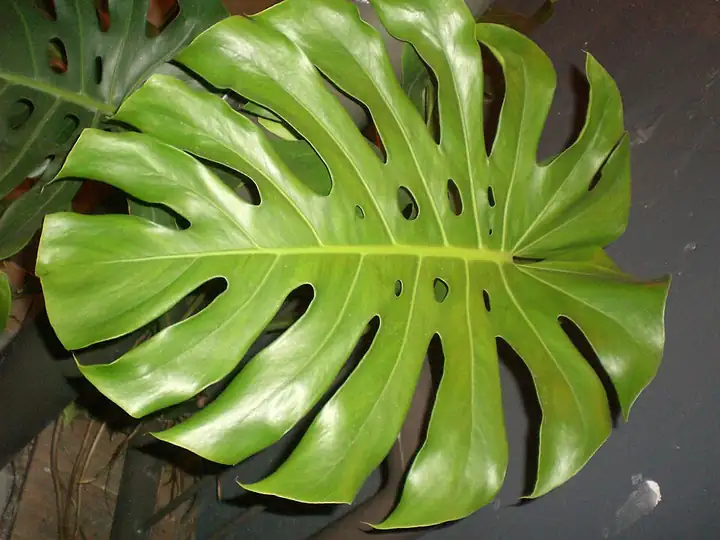
Monstera (Swiss cheese plant)
Monstera deliciosa (sold as split-leaf philodendron, though it is not a philodendron) · Arum family (Araceae)
When to plant: Any time of year, since it grows indoors. Repot in spring when roots fill the pot; stem cuttings root at any time of year.
| Hardiness zones | 10 to 12 |
|---|---|
| Sun | part shade |
| Water | moderate |
| Life cycle | perennial |
| Frost | Tender: killed by frost |
| Soil pH | 6.0–8.0 |
Will it grow in your window?
Pick the window it sits in. This is the same check Sow & Tell runs for every plant in your house.
It wants bright, indirect light.
Pick a window above and this will tell you whether the spot suits it.
Watering: water when the top inch is dry — about every 7 days, stretching to every 12 from November to February.
Summering outside? Bring it in before nights drop below 50°F.
About Monstera (Swiss cheese plant)
Monstera is a big climbing vine from the rainforests of southern Mexico to Panama with glossy, leathery leaves that split and develop holes as they mature (NC State, Wisconsin Horticulture). Indoors it usually stays 6-8 ft tall, clings to a moss pole with its aerial roots and grows fast in good light, which makes it the classic statement plant for a bright corner. In the tropics it bears a cone-shaped fruit that tastes of banana and pineapple, but it almost never flowers or fruits in a house.
Hardy outdoors only in zones 10-12 (NC State); it is grown indoors everywhere and can summer outdoors in shade once nights stay above about 60 F, moved out gradually so the leaves don't sunburn (Wisconsin Horticulture).
When to plant
Any time of year, since it grows indoors. Repot in spring when roots fill the pot; stem cuttings root at any time of year.
Usually bought as a nursery plant or started from a stem cutting taken just below an aerial root, or by air layering (Penn State, Wisconsin Horticulture).
Growing it indoors
- Light: Give it bright light near a sunny window but out of hot direct sun; in low light it gets leggy and the new leaves come out solid, without the splits and holes (Penn State, Wisconsin Horticulture), and variegated kinds need more light than green ones (NC State).
- Water: Water thoroughly, then let the top 1-2 inches of mix dry before watering again (Penn State); NC State says let the top quarter to a third of the pot dry. Overwatering is the main cause of root rot, so use a pot with a drainage hole and water less in winter; leaves that drip water at the edges mean the mix is too wet (Wisconsin Horticulture).
- Humidity: Prefers humidity above 50 percent; a humidifier or pebble tray helps in dry winter air, and brown leaf edges mean the air is too dry (Penn State, NC State, Wisconsin Horticulture).
- Temperature: Happiest at 60-85 F and away from cold drafts (Penn State, NC State); Wisconsin Horticulture says never let it drop below 50 F, and frost kills it.
- Feeding: Feed a balanced houseplant fertilizer every two weeks during the growing season and monthly in winter (Penn State); Wisconsin Horticulture simply says feed regularly spring through fall.
- Repotting: Repot in spring when the roots fill the pot, into a pot a size larger with fresh well-draining mix and a sturdy moss-covered pole; it is a vigorous grower that needs repotting often and ample root room to make big leaves (NC State, Wisconsin Horticulture).
- More plants: Stem cuttings taken just below an aerial root root in moist mix or water at any time of year, and air layering or simple layering also work (Penn State, Wisconsin Horticulture). Seed works but needs warmth and is slow.
If something looks wrong
| What you see | Likely cause | What to do |
|---|---|---|
| New leaves small and solid, with no splits or holes; long bare stretches of stem | Too little light | Move it to bright indirect light near a window; holes only form on leaves grown in good light (Wisconsin Horticulture, Penn State). |
| Yellow leaves, soggy mix, water droplets at the leaf edges | Overwatering or poor drainage, leading to root rot | Let the top couple of inches dry before watering, check the drainage hole, and repot in fresh mix if the roots are brown and mushy (Penn State, Wisconsin Horticulture). |
| Brown, crispy leaf edges | Dry indoor air | Raise the humidity with a humidifier or a pebble tray and keep it away from heat vents (Wisconsin Horticulture, NC State). |
| Bleached or scorched patches after moving it outside | Sunburn from a sudden jump in light | Move it outdoors into full shade first and increase light over a week or two (Wisconsin Horticulture). |
Soil
A well-draining soilless potting mix rich in organic matter, with bark, charcoal or perlite added and a pH anywhere from 6.0 to 8.0 (Penn State, NC State).
Pot in a well-draining soilless mix rich in organic matter, with bark, charcoal or perlite added, in a container with a drainage hole and a moss-covered pole for support (Penn State, NC State).
Feeding
- Spring through fall, while new leaves are coming: balanced water-soluble houseplant fertilizer. Penn State feeds every two weeks at label strength; MU Extension's general rule is about once a month, watering first and never feeding a wilted plant.
- Winter: balanced houseplant fertilizer, or none. Penn State drops to monthly; MU Extension skips feeding whenever no new growth is showing.
Don't feed a plant that is sitting in dim light or soggy mix; small, unsplit leaves there are a light problem, not a nutrient one (Penn State, MU Extension).
Varieties (4)
NC State, Penn State and Wisconsin Horticulture name 4 cultivars and related kinds.
| Variety | Type | Zones | Notes |
|---|---|---|---|
| Thai Constellation | Cream variegated | 10+typical for monstera | Creamy-white speckles and marbling across the green leaves; more compact than the species; rare. Sources: [1][2] |
| Variegata | Cream variegated | 10+typical for monstera | Variegated foliage on somewhat smaller leaves. Sources: [3] |
| Monstera adansonii (Swiss cheese vine) | Small-leaved relative | 10+typical for monstera | A smaller vining species, 3-8 ft tall and 1-3 ft wide indoors, with holes in much smaller leaves; the cultivar 'Archipelago' is variegated. Often confused with M. deliciosa (NC State). Sources: [1][2] |
| Albo Variegata | White variegated | 10+typical for monstera | Leaves splashed with white; somewhat smaller leaves than the green plant, rare and expensive. Needs more light than the green form to hold its variegation (NC State). Sources: [1][2][3] |
Pests to watch for
Scale insects, Mealybugs, Twospotted spider mite, Aphids, Thrips, Fungus gnats
Diseases and problems
In the kitchen
Only the fully ripe fruit is edible, with a banana-pineapple flavor; unripe fruit is full of calcium oxalate crystals that burn the throat, some people are allergic, and fruit is rarely seen indoors (NC State, Wisconsin Horticulture).
Safety: Every part except the ripe fruit contains needle-like calcium oxalate crystals: chewing it causes intense burning of the mouth, tongue and throat, drooling, trouble swallowing, nausea and vomiting, and the sap can cause a skin rash, so wear gloves when pruning (NC State rates it low severity; Penn State). Keep it away from small children.
Pets: Toxic to dogs and cats (ASPCA): insoluble calcium oxalates cause oral irritation, intense burning of the mouth, tongue and lips, heavy drooling, vomiting and trouble swallowing. NC State also lists it as a problem for horses.
Sources
Photo: Photo: Princesleaf, CC BY-SA 3.0, via Wikimedia Commons (CC BY-SA 3.0). Photo resized for the web.

Planting dates and advice are general guidance; check with your local Cooperative Extension office for your area.