
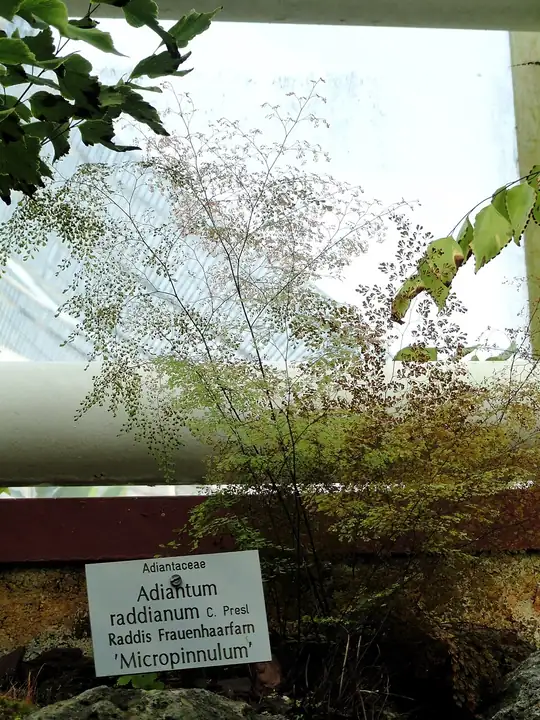
Maidenhair fern
Adiantum raddianum and A. capillus-veneris · Ribbon fern family (Pteridaceae)
When to plant: Any time of year, since it grows indoors. Move it to a larger pot when it outgrows its pot, dividing the clump if you like.
| Hardiness zones | 9 to 10 |
|---|---|
| Sun | shade |
| Water | high |
| Life cycle | perennial |
| Frost | Tender: killed by frost |
Will it grow in your window?
Pick the window it sits in. This is the same check Sow & Tell runs for every plant in your house.
It wants medium light.
Pick a window above and this will tell you whether the spot suits it.
Watering: keep it evenly moist — about every 4 days, stretching to every 7 from November to February.
Summering outside? Bring it in before nights drop below 55°F.
About Maidenhair fern
Maidenhair ferns have airy, arching fronds of small fan-shaped leaflets on wiry, shiny black stems; the name Adiantum means 'unwetted', since water beads off the leaves (NC State). The delta maidenhair (A. raddianum) from tropical America and the West Indies is the usual houseplant, while the southern maidenhair (A. capillus-veneris) grows wild in warm regions around the world, including a few coastal spots in North Carolina, where it is listed as endangered. They are fussy indoors: UMN Extension calls them a real challenge, since they want greenhouse-like humidity and roots that never dry out.
The delta maidenhair is hardy outdoors only in zones 9b-10 and the southern maidenhair in zones 6-9 (NC State); as houseplants they are grown indoors everywhere and can summer outdoors in shade once nights stay above about 55 F.
When to plant
Any time of year, since it grows indoors. Move it to a larger pot when it outgrows its pot, dividing the clump if you like.
Usually bought as a nursery plant or started by dividing the creeping rhizomes; ferns make spores, not flowers or seeds (NC State).
Growing it indoors
- Light: Medium light, such as an east window or a few feet from a south or west one, moved right up to a west or south window from November through February (UMN); full sun scorches it and deep shade weakens it (NC State).
- Water: Never let the roots dry out: keep the mix evenly moist (NC State, UMN), water until it drains and empty the tray after a few minutes. Use room-temperature water, not softened water, which builds up salts (UMN).
- Humidity: It needs high humidity, as in a bathroom or terrarium (NC State); UMN prefers a room humidifier to misting, which does little and can spread leaf spot.
- Temperature: MU Extension lists ferns at about 55 F nights; keep it away from hot, dry air near the ceiling or heat sources (UMN).
- Feeding: Ferns need little: feed only during active new growth with fish emulsion or a houseplant fertilizer at half strength, used sparingly, since overfeeding browns the frond tips (UMN); NC State notes potted southern maidenhair does need some feeding.
- Repotting: Move it to a larger pot of peat-rich mix when it outgrows its pot (UMN), dividing the clump at the same time if you like (NC State).
- More plants: Division of the creeping rhizomes is the recommended way (NC State).
If something looks wrong
| What you see | Likely cause | What to do |
|---|---|---|
| Fronds crisping and shriveling | Roots allowed to dry out, or dry air | Water before the mix dries, run a humidifier, and cut off dead fronds (NC State, UMN). |
| Browning that starts at the frond tips | Too much fertilizer or dry air | Feed less, at half strength, and raise the humidity (UMN). |
| Bleached, scorched patches | Too much sun | Move it into filtered or medium light (NC State). |
| Cottony tufts or soft brown bumps on the stems | Mealybugs or soft scale | Wash the fronds in lukewarm water with a few drops of mild dish soap and wipe off the pests (UMN, NC State). |
Soil
A highly organic, porous, peat-rich potting mix that holds moisture but drains (UMN, NC State); the southern maidenhair tolerates neutral to alkaline soil.
Pot in a highly organic, porous, peat-rich mix that holds moisture but drains (UMN, NC State).
Feeding
- During active new growth, or when the fronds look paler than normal: fish emulsion, or a houseplant fertilizer at half strength. Apply sparingly (UMN); NC State notes potted southern maidenhair does need some feeding.
- When it isn't putting out new fronds, such as in winter: none. Hold off until new growth starts (UMN).
Ferns are easily damaged by over-fertilizing, which browns the frond tips first (UMN).
Varieties (10)
NC State names 7 cultivars of the delta maidenhair and 3 of the southern maidenhair.
| Variety | Type | Zones | Notes |
|---|---|---|---|
| Brilliantelse | Delta maidenhair (A. raddianum) | 9–10typical for maidenhair fern | Dense fronds that open pinkish to violet and turn green. Sources: [1] |
| Fragrantissimum | Delta maidenhair (A. raddianum) | 9–10typical for maidenhair fern | Light green, softly fragrant fronds on black stems; a popular houseplant. Sources: [1] |
| Fritz Luthi | Delta maidenhair (A. raddianum) | 9–10typical for maidenhair fern | Large, deeply lobed leaflets on a big triangular frond. Sources: [1] |
| Kensington Gem | Delta maidenhair (A. raddianum) | 9–10typical for maidenhair fern | Small, delicate green leaflets on black stems. Sources: [1] |
| Microphyllum | Delta maidenhair (A. raddianum) | 9–10typical for maidenhair fern | A compact dwarf up to 12 in tall. Sources: [1] |
| Red Venus | Delta maidenhair (A. raddianum) | 9–10typical for maidenhair fern | New fronds red, maturing to light green. Sources: [1] |
| Variegatum (snowflake fern) | Delta maidenhair (A. raddianum) | 9–10typical for maidenhair fern | Light green leaflets flecked with white. Sources: [1] |
| Alabama Lace | Southern maidenhair (A. capillus-veneris) | 9–10typical for maidenhair fern | Lacy fronds on black stems; denser and faster spreading than the species. Sources: [2] |
| Banksianum | Southern maidenhair (A. capillus-veneris) | 9–10typical for maidenhair fern | Bright green oval leaflets on black stems, up to 18 in tall. Sources: [2] |
| Fimbriata | Southern maidenhair (A. capillus-veneris) | 9–10typical for maidenhair fern | Soft green, fringed leaflets. Sources: [2] |
Pests to watch for
Diseases and problems
Leaf sunburn, Brown frond tips (dry air, overfeeding)
In the kitchen
Safety: Neither NC State page lists it as poisonous or gives it a poison rating. Old herbals used it as a cough remedy (see history), which is not advice.
Pets: Not listed by the ASPCA.
Sources
Photo: Photo: Daderot / Wikimedia Commons, Public domain. Photo resized for the web.

Planting dates and advice are general guidance; check with your local Cooperative Extension office for your area.