
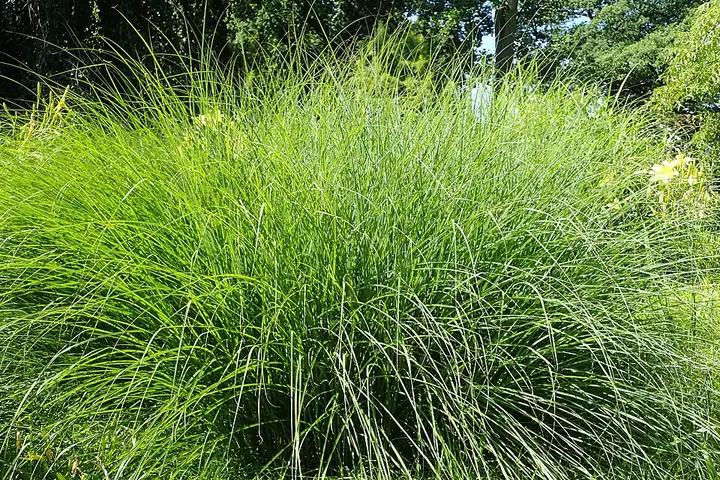
Maiden grass (Miscanthus)
Miscanthus sinensis · Grass family (Poaceae)
When to plant: Not recommended for new plantings because it is invasive (Clemson, NC State).
| Hardiness zones | 5 to 9 |
|---|---|
| Sun | full sun |
| Water | moderate |
| Life cycle | perennial |
| Frost | Hardy: takes frost |
About Maiden grass (Miscanthus)
Maiden grass (Japanese silver grass) is a big Asian grass with silvery or pink plumes in late summer and fall. It is invasive: it reseeds freely, escapes into fields and woods and crowds out native plants. NC State lists it as invasive in North Carolina and Clemson does not recommend planting it. Natives such as switchgrass or little bluestem are better choices; Clemson suggests giant sacaton (Sporobolus wrightii).
Hardy in zones 5-9 (NC State). INVASIVE: listed by the NC Invasive Plant Council and not recommended by Clemson; if you keep one, low-seed or sterile kinds like 'Scout' reduce spread. It is also very flammable.
When to plant
Not recommended for new plantings because it is invasive (Clemson, NC State).
To remove an old clump, NC State suggests cutting it down, letting regrowth reach about 12 inches, then treating it with a 1% glyphosate solution (follow the label) and mulching heavily to stop seedlings.
Soil
Grows in almost any soil, clay to sand, wet to dry (NC State).
Not recommended for new plantings (invasive).
Feeding
Too much nitrogen makes grasses weak, floppy and prone to disease (Clemson). Water thoroughly after planting and watch closely the first few weeks; established clumps want about 1 inch of water a week from rain or irrigation.
Varieties (9)
Listed for people who already have Miscanthus or want lower-seed kinds; the species is invasive and Clemson does not recommend planting it.
| Variety | Zones | Notes |
|---|---|---|
| Gracillimus | 5–9typical for maiden grass | Low seed set (NC State). Low seed set. Sources: [1] |
| Graziella | 5–9typical for maiden grass | Copper-red and orange fall color. Low seed set. Sources: [1] |
| Little Zebra | 5–9typical for maiden grass | Good phytophthora resistance. Sources: [1] |
| NCMS1 (My Fair Maiden) | 5–9typical for maiden grass | NC State release with reduced fertility. Reduced seed. Sources: [1] |
| NCMS2B (Bandwidth) | 5–9typical for maiden grass | NC State release with reduced fertility; rust resistant. Reduced seed. Sources: [1] |
| Rotsilber | 5–9typical for maiden grass | Orange-red fall color. Sources: [1] |
| Scout | 5–9typical for maiden grass | Sterile selection from the University of Georgia. Sterile. Sources: [1] |
| Yaku Jima | 5–9typical for maiden grass | Low seed set (NC State). Low seed set. Sources: [1] |
| Zebrinus | 5–9typical for maiden grass | Low seed set (NC State). Low seed set. Sources: [1] |
Diseases and problems
In the kitchen
Pets: Not listed as toxic by the ASPCA.
Sources
Photo: Photo: Krzysztof Ziarnek (Kenraiz) / Wikimedia Commons, CC BY-SA 4.0 (CC BY-SA 4.0). Photo resized for the web.

Planting dates and advice are general guidance; check with your local Cooperative Extension office for your area.