
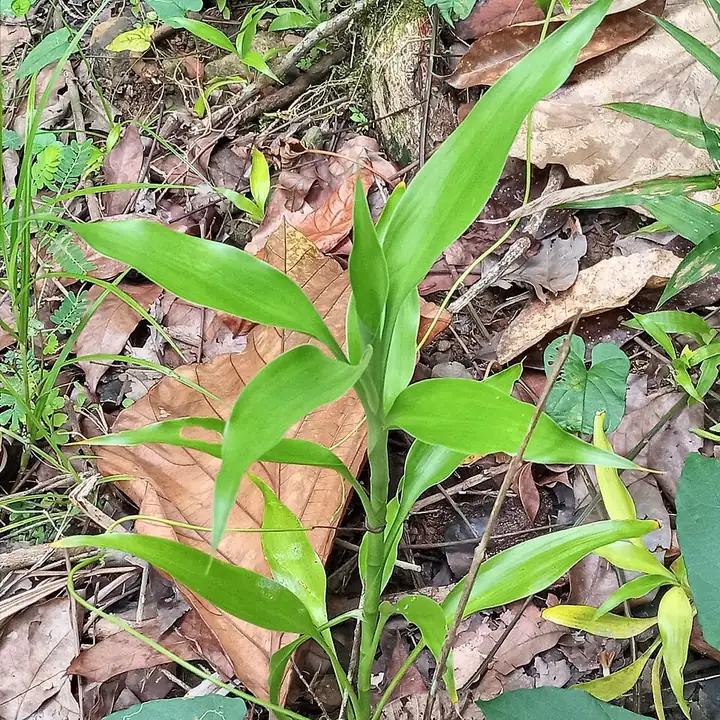
Lucky bamboo
Dracaena sanderiana · Asparagus family (Asparagaceae)
When to plant: Any time of year, since it grows indoors. Move it to a bigger vase or a pot of moist mix when the roots crowd the pebbles; cuttings root in water.
| Hardiness zones | 10 |
|---|---|
| Sun | shade |
| Water | moderate |
| Life cycle | perennial |
| Frost | Tender: killed by frost |
Will it grow in your window?
Pick the window it sits in. This is the same check Sow & Tell runs for every plant in your house.
It wants medium light.
Pick a window above and this will tell you whether the spot suits it.
Watering: keep it evenly moist — about every 4 days, stretching to every 7 from November to February.
Summering outside? Bring it in before nights drop below 65°F.
About Lucky bamboo
Lucky bamboo is not a bamboo at all but a dracaena from the rainforests of Cameroon in West Africa, sold as rooted cane cuttings, often braided or coiled into spirals, standing in a vase of pebbles and water (NC State, Arkansas Extension). It is popular as a feng shui gift and lives for a year or more in plain water, longer with a little fertilizer, and does fine in a dim corner where most plants sulk (Arkansas Extension, Penn State). Fluoride, chlorine and salts in tap water brown the leaf tips, so use filtered or rain water.
Hardy outdoors only in zone 10 (NC State lists 10a-10b); it is grown indoors everywhere and can summer outdoors in part shade in its container once nights stay above about 65 F, the night temperature MU Extension gives for dracaenas.
When to plant
Any time of year, since it grows indoors. Move it to a bigger vase or a pot of moist mix when the roots crowd the pebbles; cuttings root in water.
Bought as a cane cutting, usually already rooted in water, or started from a stem cutting stood in water (NC State, Arkansas Extension).
Growing it indoors
- Light: NC State asks for bright indirect light, but Penn State's plant grew best in low to medium light and stayed vibrant in deep shade, and direct sun scorches the leaves, so keep it out of any window that gets sun (UF/IFAS).
- Water: In a vase, keep the roots covered with filtered or rain water and change it every week; tap water's chlorine, fluoride and salts burn the leaf tips, so if tap water is all you have, let it stand uncovered 1-2 days first (NC State, UF/IFAS, Arkansas Extension). In potting mix keep it moist but never soggy; yellow leaves and rotting stems mean too much water.
- Humidity: Low humidity browns the leaf tips (NC State); a pebble tray or grouping with other plants helps in winter.
- Temperature: MU Extension lists 65 F nights for dracaenas and warns that tropical foliage plants are injured below 40 F; keep it away from cold windows and heat vents.
- Feeding: A few drops of diluted liquid houseplant fertilizer in the vase water every couple of months is all it needs; plain water alone eventually starves it (Arkansas Extension, NC State).
- Repotting: Move it to a bigger vase, or a pot of moist mix, when the roots crowd the pebbles; add pebbles so the roots have room and the vase doesn't tip (NC State).
- More plants: Stem cuttings stood in water root and sprout new shoots; cutting a leggy cane back to its original height tidies it and the cut top can be rooted (NC State, Arkansas Extension).
If something looks wrong
| What you see | Likely cause | What to do |
|---|---|---|
| Brown, burned leaf tips | Fluoride, chlorine or salts in tap water, or dry air | Switch to filtered or rain water, or let tap water sit 1-2 days before using it, and raise the humidity (Arkansas Extension, UF/IFAS, NC State). |
| Yellow leaves, stems going soft and smelly | Stale water or overwatering in mix | Change the water weekly and rinse the pebbles; in a pot, let the mix dry a little and check that it drains (NC State, UF/IFAS). |
| Yellow, bleached leaves on a plant near a window | Too much direct sun | Move it into a bright room out of the window (UF/IFAS, Penn State). |
| Fine webbing and speckled leaves | Spider mites | Wash the leaves under the tap and repeat weekly; mites build up fast in dry rooms (Arkansas Extension). |
Soil
Either a vase of pebbles and chlorine-free water changed weekly, or a moist, well-drained potting mix (NC State).
A vase of pebbles and filtered or rain water, or a pot of moist, well-drained potting mix (NC State, UF/IFAS).
Feeding
- Year-round in water, every couple of months: diluted liquid houseplant fertilizer. Add a few drops of fertilizer diluted well below label strength to fresh water every couple of months; plain water alone eventually starves it (Arkansas Extension, NC State).
- In potting mix, spring and summer: water-soluble houseplant fertilizer. Feed monthly while new leaves are coming and not in winter (MU Extension).
Full-strength fertilizer and salty or fluoridated tap water burn the leaf tips; keep the dose weak and change the water weekly (Arkansas Extension, NC State).
Varieties (2)
NC State names two cultivars; most lucky bamboo is sold unnamed as straight, braided or spiral canes.
| Variety | Type | Zones | Notes |
|---|---|---|---|
| Silver Ribbon | Variegated | 10typical for lucky bamboo | Slightly twisted leaves striped in two shades of green. Sources: [1] |
| White Stripe | Variegated | 10typical for lucky bamboo | Deep green leaves edged in creamy white. Sources: [1] |
Pests to watch for
Diseases and problems
Root and crown rot, Stem rot, Fluoride leaf-tip burn
In the kitchen
Safety: NC State rates it low severity for people: every part contains saponins, so nobody should eat it, and the sap can irritate skin; keep the vase water out of reach of toddlers and change it weekly so mosquitoes can't breed in it.
Pets: Toxic to dogs and cats (ASPCA, listed under ribbon plant, Dracaena spp.): saponins cause vomiting, sometimes with blood, depression, loss of appetite, drooling and, in cats, dilated pupils.
Sources
Photo: Photo: Beah Vega, CC BY 4.0, via Wikimedia Commons (CC BY 4.0). Photo resized for the web.

Planting dates and advice are general guidance; check with your local Cooperative Extension office for your area.