
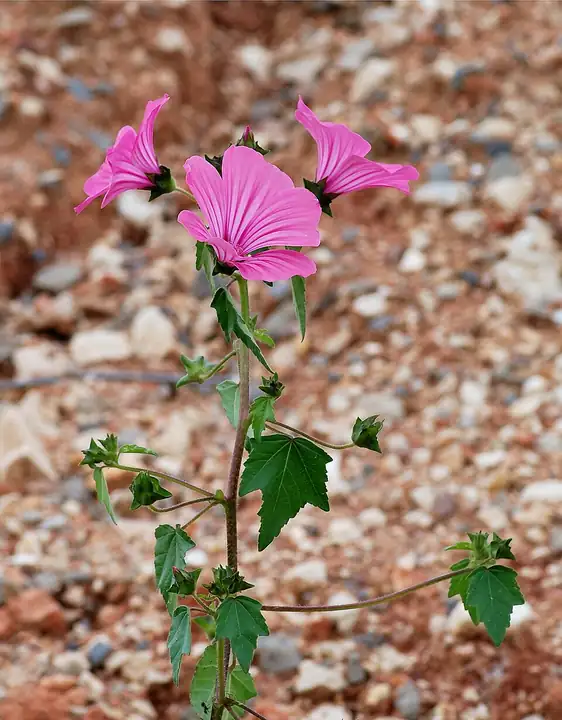
Lavatera (annual mallow)
Malva trimestris (formerly Lavatera trimestris) · Mallow family (Malvaceae)
When to plant: Start seeds indoors 6 to 8 weeks before the last frost and sow seeds outdoors 2 weeks before the last frost.
| Hardiness zones | 2 to 11 |
|---|---|
| Sun | full sun to part shade |
| Water | moderate |
| Life cycle | annual |
| Frost | Half-hardy: takes a light frost |
About Lavatera (annual mallow)
Annual mallow is a fast, bushy hollyhock relative from the Mediterranean that fills a summer bed with satiny, saucer-shaped flowers about 3 inches across in pink or white, often with darker veins (NC State, Montana State). It grows 3-4 ft tall from seed sown right in the garden and makes a good cut flower. It likes summers with cool nights, and afternoon shade helps where summers are hot (NC State).
Grown as a summer annual in every zone (NC State); it tolerates light frost (Montana State).
When to plant
Timing is counted from your average last spring frost (and first fall frost). Sow & Tell works out the actual dates for your ZIP code.
- Start seeds indoors: 6 to 8 weeks before the last frost
- Sow seeds outdoors: 2 weeks before the last frost
Sow seed right in the garden about 2 weeks before the last frost, or start it indoors 6-8 weeks ahead for earlier flowers (NC State). Cover the seed; a University of Alaska chart has it sprouting in about 15-20 days at 70 F. No sourced count from sowing to first bloom.
Soil
Average, well-drained loam or sandy soil; it copes with poor soil, salt and seaside exposure (NC State), and Virginia Tech suggests keeping it on the dry side with good air flow.
No special prep: average, well-drained loam or sandy soil is fine, and it tolerates poor soil (NC State).
Feeding
Look for: a balanced or all-purpose fertilizer at the label rate. Skip high-phosphorus "bloom boosters" unless a soil test shows low phosphorus: most garden soils already have enough, and the extra can wash into streams.
Crowding and damp conditions invite pests and disease; Virginia Tech suggests growing it on the dry side with generous spacing and good air flow.
Harvest
Blooms from July into September. Deadhead spent flowers to stretch the season (NC State). For bouquets, cut when the flowers are just uncurling and starting to open, and enjoy them fresh, since they don't store well (Virginia Tech).
Varieties (1)
NC State names only 'Splendens'; we found no other trustworthy cultivar list.
Pests to watch for
Diseases and problems
Root rot, Leaf spots
In the kitchen
Safety: We found no poisoning information for annual mallow; NC State lists none. Don't eat it unless a trusted source says it's edible.
Pets: Not listed by the ASPCA.
Sources
Photo: Photo: Alvesgaspar, CC BY-SA 3.0, via Wikimedia Commons (CC BY-SA 3.0). Photo resized for the web.

Planting dates and advice are general guidance; check with your local Cooperative Extension office for your area.