
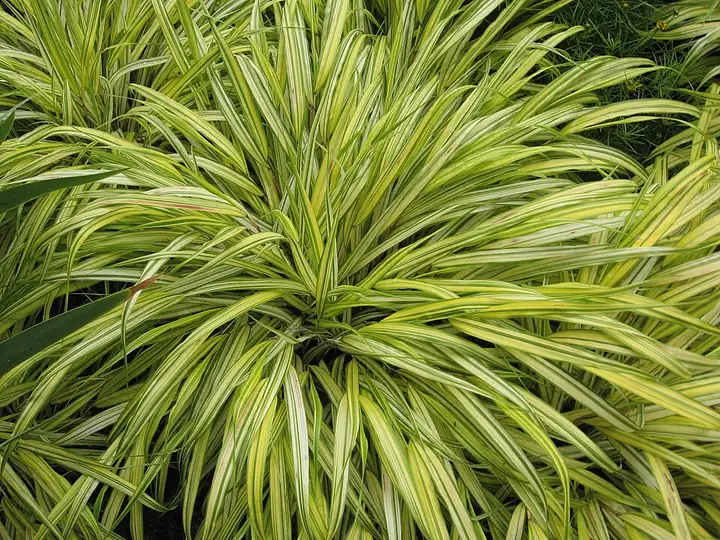
Japanese forest grass (hakone grass)
Hakonechloa macra · Grass family (Poaceae)
When to plant: Plant in spring; divide in spring, though it grows so slowly it may go years without needing it (NC State).
| Hardiness zones | 5 to 9 |
|---|---|
| Sun | part shade |
| Water | moderate |
| Life cycle | perennial |
| Frost | Hardy: takes frost |
About Japanese forest grass (hakone grass)
Japanese forest grass is one of the few ornamental grasses for shade. It makes soft, cascading mounds that look like a waterfall, and gold or striped kinds like 'Aureola' light up dark corners (NC State). It spreads slowly and is not invasive.
Hardy in zones 5-9, but NC State notes it may not like the hot summers of zones 8-9.
When to plant
Plant in spring; divide in spring, though it grows so slowly it may go years without needing it (NC State).
A thick mulch over the crowns before winter helps stop frost heaving.
Soil
Humus-rich, well-drained soil that stays evenly moist; it won't grow in heavy clay, soggy or very dry soil (NC State, Clemson).
Work in humus so the soil stays evenly moist but drains well (NC State, Clemson).
Feeding
- Spring, only if a soil test shows a need: fertilizer only as a soil test recommends. Most ornamental grasses need very little fertilizer; base any feeding on a soil test (Clemson).
It scorches if it dries out in hot weather; keep it watered the first summer and mulch the crowns before winter (NC State). Too much nitrogen makes grasses weak, floppy and prone to disease (Clemson). Water thoroughly after planting and watch closely the first few weeks; established clumps want about 1 inch of water a week from rain or irrigation.
Varieties (10)
NC State and Clemson document these 10 cultivars.
| Variety | Zones | Notes |
|---|---|---|
| Alboaurea | 5–9typical for japanese forest grass | Striped cream, yellow and green. Sources: [1] |
| Albostriata | 5–9typical for japanese forest grass | Green leaves with cream-white stripes; taller than most. Sources: [1] |
| All Gold | 5–9typical for japanese forest grass | Solid gold; more upright, smaller and slow-growing. Sources: [1] |
| Aureola | 5–9 | Gold leaves with thin green stripes; pink-red fall blush; about 15 in. Sources: [1][2] |
| Benikaze | 5–9typical for japanese forest grass | Green in summer, red in cool fall weather. Sources: [1] |
| Fubuki | 5–9typical for japanese forest grass | Green and white striped; about 14 in. Sources: [1][2] |
| Naomi | 5–9typical for japanese forest grass | Yellow and green; purplish-red in fall. Sources: [1] |
| Nicolas | 5–9typical for japanese forest grass | Green leaves that turn red, yellow and orange in fall. Sources: [1] |
| Samurai | 5–9typical for japanese forest grass | Graceful variegated clumps. Sources: [1] |
| Stripe It Rich | 5–9typical for japanese forest grass | Boldly striped leaves. Sources: [1] |
In the kitchen
Pets: Not listed as toxic by the ASPCA.
Sources
Photo: Photo: Cillas / Wikimedia Commons, CC BY-SA 4.0 (CC BY-SA 4.0). Photo resized for the web.

Planting dates and advice are general guidance; check with your local Cooperative Extension office for your area.