
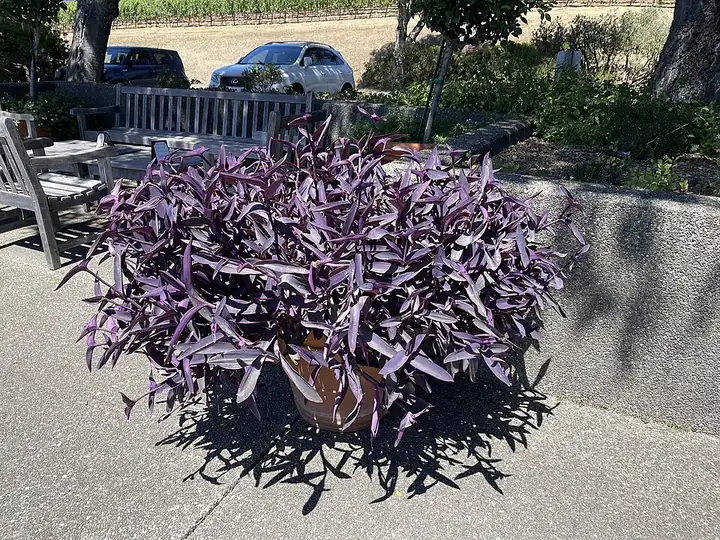
Inch plant (wandering dude)
Tradescantia zebrina (formerly Zebrina pendula) · Spiderwort family (Commelinaceae)
When to plant: Any time of year: cuttings root in days. Prune it hard each spring, and restart an old straggly plant from cuttings.
| Hardiness zones | 9 to 11 |
|---|---|
| Sun | part shade |
| Water | moderate |
| Life cycle | perennial |
| Frost | Tender: killed by frost |
Will it grow in your window?
Pick the window it sits in. This is the same check Sow & Tell runs for every plant in your house.
It wants bright, indirect light.
Pick a window above and this will tell you whether the spot suits it.
Watering: water when the top inch is dry — about every 7 days, stretching to every 12 from November to February.
Summering outside? Bring it in before nights drop below 55°F.
About Inch plant (wandering dude)
The inch plant, long sold as wandering Jew and now called wandering dude or zebra plant, is a fast trailing creeper from Mexico and Central America with silver-striped leaves flushed purple underneath; its name comes from the stem joints spaced about an inch apart, each of which roots on contact (NC State). It fills a hanging basket in a season, roots from any cutting dropped in water, and gets leggy only in dim light. Outdoors in south Florida it escapes into natural areas and UF/IFAS rates it invasive there, so keep it in a pot in the warm South.
Hardy outdoors in zones 9-11 (NC State, UF/IFAS), where it is a groundcover; it is grown indoors or as a summer basket plant everywhere and can summer outdoors in light shade once nights stay above about 55 F (MU Extension), coming back in before frost. In south Florida UF/IFAS rates it invasive and says not to plant it in the ground.
When to plant
Any time of year: cuttings root in days. Prune it hard each spring, and restart an old straggly plant from cuttings.
Bought as a nursery basket or, more often, started from stem cuttings, which root in days in water or moist mix (NC State, Wisconsin Horticulture).
Growing it indoors
- Light: Bright light keeps the stripes and purple vivid and the stems full; in low light the lower leaves drop and the color fades to green, while hot direct sun washes the color out (NC State, Wisconsin Horticulture).
- Water: Water regularly but let the top of the mix dry between waterings, and cut back in winter; soggy mix rots the roots and stems, and wetting the leaves invites leaf spot, so water the mix, not the foliage (NC State). MU Extension keeps it evenly moist and Wisconsin lets it dry between drinks, so aim between the two.
- Humidity: It tolerates average home humidity and high humidity alike (NC State).
- Temperature: Thrives at 65-75 F (NC State); MU Extension lists 55 F as its night temperature, and it can't take frost.
- Feeding: Neither NC State nor Wisconsin gives a schedule; follow MU Extension's general rule and feed a water-soluble houseplant fertilizer monthly while it is growing in spring and summer, and not in winter.
- Repotting: Rather than repotting an old straggly plant, Wisconsin Horticulture says to renew it by rooting fresh tip cuttings in a new pot of mix; prune hard each spring to keep it dense (NC State).
- More plants: Stem cuttings root in days in water or moist potting mix with no rooting hormone, and stems root wherever a node touches moist mix; pinch the tips often and use the trimmings as cuttings (NC State, Wisconsin Horticulture).
If something looks wrong
| What you see | Likely cause | What to do |
|---|---|---|
| Long bare stems with leaves only at the tips, color fading to green | Too little light | Move it to a brighter window, cut the stems back hard, and root the trimmings to fill the pot (NC State, Wisconsin Horticulture). |
| Stems soft and brown at the base, mix soggy | Root and stem rot from overwatering | Let the mix dry, take healthy tip cuttings and restart in fresh mix (NC State). |
| Washed-out, pale leaves on a plant in a hot window | Too much direct sun | Move it to filtered light; full sun suits it only in cool northern summers (NC State, Wisconsin Horticulture). |
| Sticky leaves, cottony tufts or tiny white flies | Aphids, mealybugs or whiteflies | Rinse the plant under the tap, dab mealybugs with rubbing alcohol, and repeat weekly before they get out of hand (NC State). |
Soil
A moist but well-drained potting mix in a pot or basket with a drainage hole (NC State).
Pot in a moist but well-drained potting mix in a pot or basket with a drainage hole (NC State).
Feeding
- Spring and summer, while it is growing fast: water-soluble houseplant fertilizer. Feed monthly at about a quarter of the label rate (UGA, MU Extension); NC State and Wisconsin give no schedule.
- Fall and winter: none. Don't feed while growth has slowed, and water less (NC State, MU Extension).
Feeding won't fix a leggy plant; that is a light problem, so move it to a brighter window and cut it back (NC State, Wisconsin Horticulture).
Varieties (4)
NC State, Wisconsin Horticulture and UF/IFAS name 4 cultivars of T. zebrina.
| Variety | Type | Zones | Notes |
|---|---|---|---|
| Burgundy | Dark-leaved | 9–11typical for inch plant | Dark burgundy-purple leaves with grayish stripes. Sources: [1][2] |
| Purpusii | Dark-leaved | 9–11typical for inch plant | Dark red or red-green unstriped leaves with fine hairs. Sources: [3] |
| Leprechaun | Striped | 9–11typical for inch plant | A newer kind with greenish-gray leaves striped red-brown and purple; the purple fades as leaves age. Sources: [2] |
| Quadricolor | Striped | 9–11typical for inch plant | Leaves striped pink, purple, silver and green; needs bright light to hold the colors. Sources: [1][2][3] |
Pests to watch for
Aphids, Mealybugs, Scale insects, Whiteflies, Twospotted spider mite
Diseases and problems
Root and crown rot, Stem rot, Leaf spot
In the kitchen
Safety: Low severity (NC State): eating the leaves can irritate the mouth and stomach, and the watery sap gives some people a red, itchy rash, so wear gloves if you react and wash your hands after taking cuttings (NC State, Wisconsin Horticulture).
Pets: Toxic to dogs, cats and horses (ASPCA, listed as inch plant, Tradescantia fluminensis, a close all-green relative): the sap causes dermatitis; NC State lists T. zebrina itself as a problem for dogs and cats, causing mouth and stomach irritation if eaten.
Sources
- plants.ces.ncsu.edu
- hort.extension.wisc.edu
- ask.ifas.ufl.edu
- assessment.ifas.ufl.edu
- blogs.ifas.ufl.edu
- extension.missouri.edu
- aspca.org
- fieldreport.caes.uga.edu
Photo: Photo: Missvain, CC BY 4.0, via Wikimedia Commons (CC BY 4.0). Photo resized for the web.

Planting dates and advice are general guidance; check with your local Cooperative Extension office for your area.