
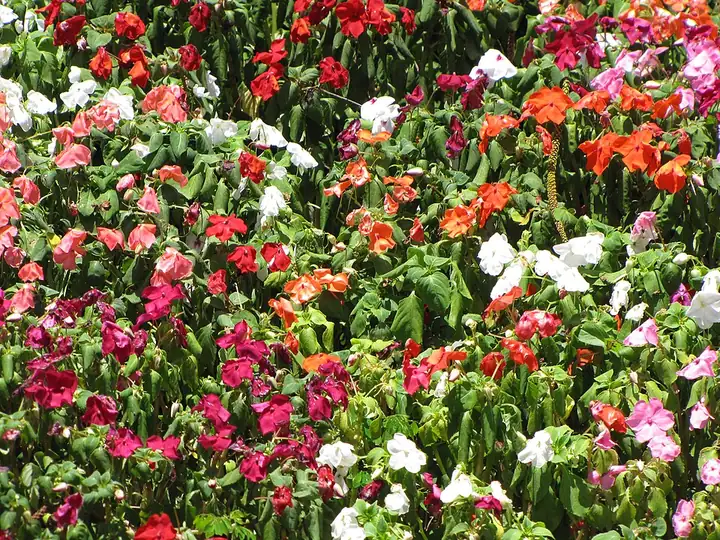
Impatiens
Impatiens walleriana (garden impatiens, busy Lizzie), I. hawkeri (New Guinea impatiens) and interspecific hybrids such as SunPatiens · Balsam family (Balsaminaceae)
When to plant: Start seeds indoors 6 to 10 weeks before the last frost and set out plants up to 2 weeks after the last frost.
| Hardiness zones | 10 to 12 |
|---|---|
| Sun | part shade |
| Water | high |
| Life cycle | tender perennial (grown as an annual) |
| Frost | Tender: killed by frost |
| Spacing | 8 to 18 inches |
About Impatiens
Impatiens are the classic flowers for shady beds, pots and hanging baskets, blooming from late spring to frost. Garden impatiens have small leaves and 1-2 inch flowers; New Guinea impatiens have big bronze, purple or striped leaves and larger flowers, and take a bit more sun. Since impatiens downy mildew arrived, garden impatiens can collapse in late summer, so New Guinea types, interspecific hybrids like SunPatiens, and bred-resistant garden series (Beacon, Imara XDR) are the safer picks (Clemson, Purdue, Wisconsin).
Grown as a summer annual almost everywhere; garden impatiens are perennial only in zones 10-11 and New Guinea impatiens in 10-12 (NC State). UF/IFAS predicts garden impatiens will be invasive in Florida and doesn't recommend it there, and it has naturalized in Hawaii and Florida.
When to plant
Timing is counted from your average last spring frost (and first fall frost). Sow & Tell works out the actual dates for your ZIP code.
- Start seeds indoors: 6 to 10 weeks before the last frost
- Set out plants: up to 2 weeks after the last frost
Start seed indoors 6-10 weeks ahead and set plants out after the last frost once hardened off; buying plants is faster (Clemson). Space compact kinds 8-10 inches apart and tall ones about 18 inches; crowding makes them leggy. NC State notes seed-grown plants can take several months to bloom, so no days-to-bloom count is given. To keep a favorite over winter, take stem cuttings in fall, grow them indoors and replant after the last frost (NC State).
Soil
Rich, moist soil high in organic matter that drains well; mulch to hold moisture, and keep it moist but not soggy (Clemson, NC State).
Work in organic matter so the bed is rich and holds moisture but still drains; use a well-drained soilless mix in pots (Clemson).
Feeding
- About once a month from planting through summer: water-soluble fertilizer. Feed monthly; plants under trees and in containers often need a little more water and fertilizer because of root competition and frequent watering (Clemson).
Look for: a balanced or all-purpose fertilizer at the label rate. Skip high-phosphorus "bloom boosters" unless a soil test shows low phosphorus: most garden soils already have enough, and the extra can wash into streams.
Don't let plants wilt (they drop leaves and flowers), but don't keep them soggy either, which invites rot (Clemson, NC State). Avoid overhead watering and crowding, which favor downy mildew (Wisconsin).
Harvest
Blooms from late spring to frost (May to October). Impatiens are self-cleaning, so there's no need to deadhead (Clemson); if plants look leggy in late summer, trim off the top third to bring on fresh flowers (NC State).
Varieties (20)
| Variety | Type | Notes |
|---|---|---|
| Accent series | Garden impatiens (I. walleriana) | Dwarf plants with large flowers that bloom all summer in shade. Sources: [1][3] |
| Beacon series | Garden impatiens (I. walleriana) | Garden impatiens bred for much better resistance to many races of impatiens downy mildew; NC State calls 'Beacon' highly resistant. Resistant isn't immune; disease can still show up in bad years (Purdue, Wisconsin). Sources: [1][4][5] |
| Blitz | Garden impatiens (I. walleriana) | Big 2 1/2-inch flowers; tolerates more heat and drought than most. Sources: [3] |
| Carousel | Garden impatiens (I. walleriana) | Has the highest share of fully double flowers. Sources: [3] |
| Dazzler series | Garden impatiens (I. walleriana) | 9-11 in tall and 13-15 in wide in shade; good in containers. Sources: [3] |
| DeZire series | Garden impatiens (I. walleriana) | 8-10 in tall and 12-14 in wide in shade; for beds, pots and baskets. Sources: [3] |
| Expo series | Garden impatiens (I. walleriana) | 12-16 in tall and 12-14 in wide in shade. Sources: [3] |
| Fiesta series | Garden impatiens (I. walleriana) | Double, rose-like flowers on plants 10-14 in tall; shade or part sun. Sources: [1][3] |
| Imara XDR series | Garden impatiens (I. walleriana) | Garden impatiens bred for better resistance to many downy mildew races. Still give plants good spacing and air (Purdue). Sources: [4][5] |
| Impreza series | Garden impatiens (I. walleriana) | Compact, 8-10 in tall and 6-8 in wide in shade; stems flop less. Sources: [1][3] |
| Super Elfin series | Garden impatiens (I. walleriana) | 8-10 in tall and 12-14 in wide in shade; heat tolerant. Super Elfin XP is the more uniform version. Susceptible to downy mildew like other garden impatiens (Clemson). Sources: [1][3] |
| Tempo series | Garden impatiens (I. walleriana) | Sources: [1] |
| Bounce and Big Bounce | Interspecific hybrid impatiens | Downy mildew-resistant hybrids for part sun; Bounce 14-20 in tall, Big Bounce 20-30 in tall with bigger flowers. Sources: [3] |
| SunPatiens (Compact, Spreading, Vigorous) | Interspecific hybrid impatiens | Downy mildew-resistant hybrids that take part shade to full sun and flower until frost; 14 in to over 3 ft tall depending on the type. Sources: [3][4][5] |
| Celebration series | New Guinea impatiens (I. hawkeri) | 10-16 in tall and wide for part to full sun; 'Celebration Light Lavender' has lavender flowers over green-and-cream leaves. Sources: [2][3] |
| Celebrette series | New Guinea impatiens (I. hawkeri) | Compact, 8-10 in tall, for part to full shade. Sources: [3] |
| Clockwork series | New Guinea impatiens (I. hawkeri) | 8-10 in tall for shade to part sun. Sources: [3] |
| Devine series | New Guinea impatiens (I. hawkeri) | 10-14 in tall for part sun; green to bronze-green leaves. Sources: [3] |
| Harmony series | New Guinea impatiens (I. hawkeri) | 10-18 in tall and wide; blooms early and steadily until fall and has good leaf spot resistance. Sources: [2][3] |
| Tango | New Guinea impatiens (I. hawkeri) | Extra-large orange flowers on 15-inch plants; one of the few New Guineas grown from seed. Sources: [3] |
Pests to watch for
Aphids, Twospotted spider mite, Thrips, Mealybugs, Slugs, Brown garden snail
Diseases and problems
Impatiens downy mildew, Powdery mildew, Verticillium wilt, Damping off, Southern blight, Impatiens necrotic spot
In the kitchen
Pets: Non-toxic to dogs and cats (ASPCA, listed as Impatience Plant / Patient Lucy, Impatiens spp.); the ASPCA entry doesn't rate horses.
Sources
- plants.ces.ncsu.edu
- plants.ces.ncsu.edu
- hgic.clemson.edu
- purduelandscapereport.org
- hort.extension.wisc.edu
- assessment.ifas.ufl.edu
- plantpono.org
- aspca.org
- aspca.org
- rutgersgardens.rutgers.edu
- plantpono.org
Photo: Photo: Forest and Kim Starr / Wikimedia Commons, CC BY 3.0 US (CC BY 3.0 US). Photo resized for the web.

Planting dates and advice are general guidance; check with your local Cooperative Extension office for your area.