
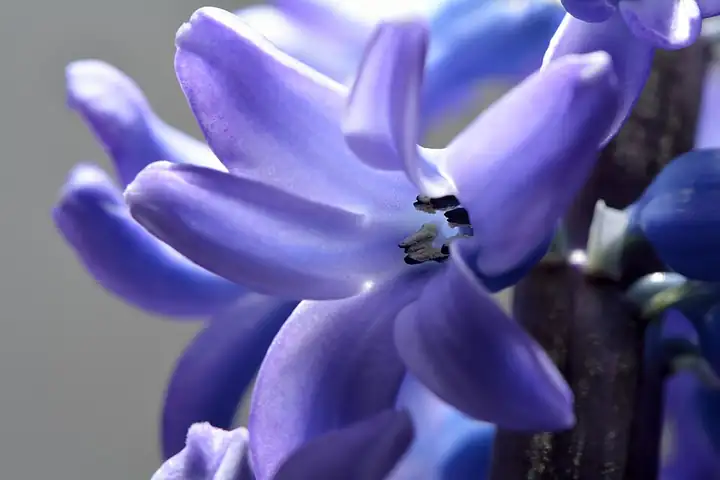
Hyacinth
Hyacinthus orientalis (Dutch or garden hyacinth), including Roman hyacinth (H. orientalis var. albulus) · Hyacinth family (Hyacinthaceae)
When to plant: Plant bulbs in fall: mid-September to mid-October in Minnesota (UMN), and in South Carolina once the soil at planting depth stays below 60 F (late October-November in the upper Piedmont, late December-early January on the coast).
| Hardiness zones | 4 to 8 |
|---|---|
| Sun | full sun to part shade |
| Water | moderate |
| Life cycle | perennial |
| Frost | Hardy: takes frost |
| Soil pH | 6.0–7.0 |
| Spacing | 3 to 6 inches |
About Hyacinth
Hyacinths are spring bulbs with one thick spike of very fragrant, starry flowers per bulb. They are grown in beds and pots and are a favorite bulb for forcing indoors in winter (NC State, Missouri). The bulbs can make skin itch, so wear gloves when planting, and every part is poisonous if eaten (NC State, Oklahoma State).
NC State lists zones 4-8 and suggests winter mulch in zone 4. In coastal South Carolina, chill the bulbs in the refrigerator 6-8 weeks before planting (Clemson).
When to plant
Plant bulbs in fall: mid-September to mid-October in Minnesota (UMN), and in South Carolina once the soil at planting depth stays below 60 F (late October-November in the upper Piedmont, late December-early January on the coast).
Set them 4-6 inches deep and 3-6 inches apart, and wear gloves (Clemson, Oklahoma State).
Soil
Well-drained soil rich in organic matter; bulbs rot in soggy ground. Keep the soil moist after planting, then water less after bloom as the bulbs go dormant (NC State, Clemson).
Plant in well-drained soil; for long-term beds without a soil test, mix a slow-release complete fertilizer or bone meal into the rooting area, and keep the pH about 6-7 (Clemson).
Feeding
- Fall, at planting (permanent beds): bone meal plus balanced fertilizer such as 10-10-10, or slow-release complete fertilizer. Mix into the root zone: bone meal plus 1-2 lb of 10-10-10 per 100 sq ft, or slow-release fertilizer at the label rate (Clemson). Follow a soil test.
Look for: a balanced or all-purpose fertilizer at the label rate. Skip high-phosphorus "bloom boosters" unless a soil test shows low phosphorus: most garden soils already have enough, and the extra can wash into streams. - Late winter or early spring, as shoots come up: balanced fertilizer such as 10-10-10. Scatter 1-2 lb per 100 sq ft and water it in (Clemson).
Look for: a balanced or all-purpose fertilizer at the label rate. Skip high-phosphorus "bloom boosters" unless a soil test shows low phosphorus: most garden soils already have enough, and the extra can wash into streams.
Avoid high-nitrogen fertilizer and fresh manure, which can lead to bulb rot (UMN). Don't cut the leaves until they brown, at least six weeks after bloom (Clemson).
Harvest
Hyacinths bloom in early to mid-spring (April-May) for 2-3 weeks (NC State). Cut off the flower spike as soon as it fades so the bulb saves its energy, but leave the leaves at least six weeks or until they brown (Oklahoma State, Clemson).
Varieties (14)
Extension sources we could open document 14 hyacinth cultivars and forms; the Missouri list groups them by how early they force indoors.
| Variety | Type | Season and days | Zones | Notes |
|---|---|---|---|---|
| Anne Marie | Dutch hyacinth | Early (for forcing) | 4–8typical for hyacinth | Bright pink. Sources: [5] |
| Blue Jacket | Dutch hyacinth | 4–8typical for hyacinth | Navy blue. Sources: [1] | |
| Carnegie | Dutch hyacinth | Midseason (for forcing) | 4–8typical for hyacinth | White. Sources: [5] |
| City of Harlem | Dutch hyacinth | Late (for forcing) | 4–8typical for hyacinth | Yellow. Sources: [5] |
| Delft Blue | Dutch hyacinth | Early (for forcing) | 4–8typical for hyacinth | Porcelain blue. Sources: [5] |
| Jan Bos | Dutch hyacinth | Early (for forcing) | 4–8typical for hyacinth | Red. Sources: [5] |
| King of the Blues | Dutch hyacinth | Late (for forcing) | 4–8typical for hyacinth | Deep blue. Sources: [5] |
| L'Innocence | Dutch hyacinth | Early (for forcing) | 4–8typical for hyacinth | White. Sources: [5] |
| Lady Derby | Dutch hyacinth | Late (for forcing) | 4–8typical for hyacinth | Rose pink. Sources: [5] |
| Myosotis | Dutch hyacinth | Midseason (for forcing) | 4–8typical for hyacinth | Pale blue. Sources: [5] |
| Ostara | Dutch hyacinth | Midseason (for forcing) | 4–8typical for hyacinth | Dark blue. Sources: [5] |
| Pink Pearl | Dutch hyacinth | Midseason (for forcing) | 4–8typical for hyacinth | Pink. Sources: [5] |
| Woodstock | Dutch hyacinth | 4–8typical for hyacinth | Deep burgundy-purple. Sources: [1] | |
| Roman hyacinth | H. orientalis var. albulus | 4–8typical for hyacinth | Smaller flowers than Dutch hyacinths, but comes back more reliably in the South. Sources: [2] |
Pests to watch for
Diseases and problems
Bulb rot
In the kitchen
Safety: Poisonous if eaten, the bulbs most of all; it can cause stomach cramps, drooling, vomiting and diarrhea (NC State: medium severity). Handling bulbs can irritate skin, so wear gloves or wash hands after planting (NC State, Oklahoma State).
Pets: Toxic to dogs, cats and horses (ASPCA): can cause severe vomiting and diarrhea, sometimes with blood, plus depression and tremors. Bulbs are the most toxic part (NC State).
Sources
- plants.ces.ncsu.edu
- hgic.clemson.edu
- extension.okstate.edu
- extension.umn.edu
- extension.missouri.edu
- aspca.org
Photo: Photo: Uoaei1 / Wikimedia Commons, CC BY-SA 3.0 (CC BY-SA 3.0). Photo resized for the web.

Planting dates and advice are general guidance; check with your local Cooperative Extension office for your area.