
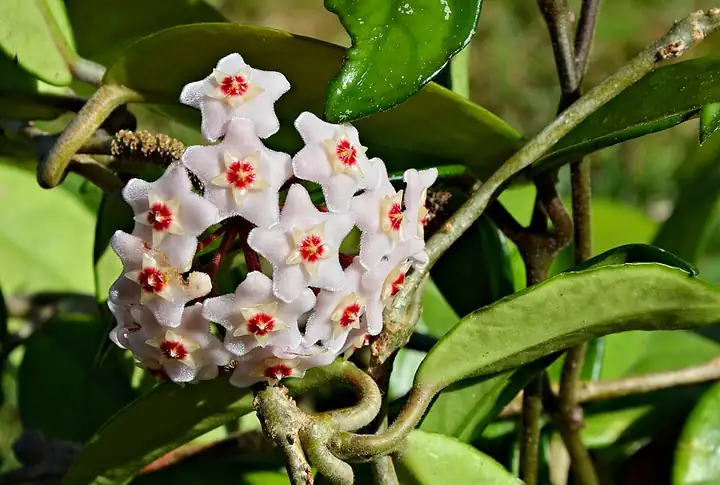
Hoya (wax plant)
Hoya carnosa · Dogbane family (Apocynaceae, formerly Asclepiadaceae)
When to plant: Any time of year, since it grows indoors. Repot only when it has clearly outgrown its pot, and never while it is budding or flowering.
| Hardiness zones | 10 to 13 |
|---|---|
| Sun | part shade |
| Water | low |
| Life cycle | perennial |
| Frost | Tender: killed by frost |
Will it grow in your window?
Pick the window it sits in. This is the same check Sow & Tell runs for every plant in your house.
It wants bright, indirect light.
Pick a window above and this will tell you whether the spot suits it.
Watering: let it dry out between waterings — about every 10 days, stretching to every 18 from November to February.
Summering outside? Bring it in before nights drop below 55°F.
About Hoya (wax plant)
The wax plant is a climbing, tree-perching vine from Southeast Asia, Japan and Taiwan with thick, waxy leaves and, on plants a few years old, hanging clusters of up to 30 fragrant, porcelain-like star flowers (NC State). It was the hanging-basket plant of the 1970s and is back in fashion, with hundreds of species and cultivars collected like orchids (Penn State, Clemson). It is forgiving of neglect as long as it is never left wet, and it blooms from the same woody spurs year after year, so those spurs are never cut.
None of the Extension pages we opened give a hardiness range. It is a frost-tender tropical vine grown indoors everywhere, and it can summer outdoors in shade once temperatures stay above 60 F, coming in when nights fall below 50 F (Clemson, NC State).
When to plant
Any time of year, since it grows indoors. Repot only when it has clearly outgrown its pot, and never while it is budding or flowering.
Usually bought as a nursery plant or started from a stem cutting with one or two nodes rooted in water or moist mix (Iowa State, NC State).
Growing it indoors
- Light: Bright indirect light near an east, west or south window; low light gives thin growth, few flowers and lost variegation, while a sunny south window needs a slow acclimation so the leaves don't burn or redden (Clemson, Iowa State, NC State).
- Water: Water thoroughly with room-temperature water, then let the mix dry almost completely, judging by the weight of the pot or slightly puckered leaves; water less in winter and in low light (Clemson, Iowa State, Penn State). Overwatering is its biggest killer, so keep the pot small and chunky, and cold water shocks it (NC State).
- Humidity: It does best at 40-60 percent but tolerates ordinary rooms; very dry winter air invites spider mites, so a pebble tray or humidifier helps (Iowa State, Clemson, NC State).
- Temperature: Iowa State says 65-80 F with slightly cooler nights and nothing below 55 F; NC State brings outdoor plants in once nights fall below 50 F. Keep it off cold glass and away from vents.
- Feeding: Iowa State feeds an all-purpose fertilizer at a quarter to half strength every second or third watering in spring and summer and none in winter; Clemson prefers a liquid fertilizer with a 2:1:2 or 3:1:2 ratio to encourage bloom.
- Repotting: Only when it has clearly outgrown its pot or the mix has broken down, and never while it is budding or flowering; move up one pot size (no more than 2 in) since it blooms better slightly pot-bound (NC State, Iowa State, Penn State).
- More plants: Cut a stem piece with at least one or two nodes, remove the lowest leaves, and set the node in water, moist sphagnum or light mix in a warm bright spot; roots form within weeks (Iowa State, NC State). A single leaf without a node roots but never makes a vine.
If something looks wrong
| What you see | Likely cause | What to do |
|---|---|---|
| Years of leaves but no flowers | Too little light, a plant that is still young, or spurs that were pruned off | Give it bright indirect light, feed lightly in summer, let it stay a bit pot-bound, don't move it once buds form, and never cut the old flower spurs (NC State, Iowa State, Penn State). |
| Yellow leaves and leaves dropping, mix stays wet | Overwatering and root rot | Let the mix dry almost fully between waterings and repot into a smaller pot of chunky bark mix if the roots are brown (Clemson, Iowa State, NC State). |
| White cottony tufts in the leaf axils and along stems | Mealybugs | Dab them with a cotton swab dipped in rubbing alcohol or spray insecticidal soap per the label, and repeat weekly (Clemson, NC State). |
| Fine webbing and stippled, dull leaves in winter | Spider mites in dry heated air | Rinse the leaves, raise the humidity, and treat with insecticidal soap or neem oil per the label (Clemson, Iowa State). |
Soil
A chunky, fast-draining mix of equal parts potting soil, orchid bark and perlite in a pot no bigger than the roots need (Clemson, Iowa State).
Pot in a chunky, fast-draining mix of equal parts potting soil, orchid bark and perlite in a pot no bigger than the roots need (Clemson, Iowa State).
Feeding
- Spring and summer, while vines and buds are growing: all-purpose liquid fertilizer at a quarter to half strength, or a 2:1:2 or 3:1:2 ratio liquid fertilizer. Every second or third watering (Iowa State); Clemson prefers liquid feed over slow-release because the plant is watered so seldom. Water first.
- Fall and winter: none. Don't fertilize in winter (Iowa State).
A pot much larger than the root ball holds water too long and rots the roots, and cutting the flower spurs removes next year's blooms (Clemson, NC State).
Harvest
Blooms spring through fall, mostly in summer, once the plant is 2-3 years old, and each cluster lasts weeks (NC State, Clemson); let the spent flowers fall and never cut the short woody spurs they grew from, since they bloom again every year.
Varieties (10)
NC State, Clemson, Iowa State and Penn State name these cultivars and related species among hundreds.
| Variety | Type | Zones | Notes |
|---|---|---|---|
| Rubra | Colored-leaf | 10+typical for hoya | A red-tinted selection named by Penn State. Sources: [4] |
| Compacta (Hindu rope, Krinkle Kurl) | Curled-leaf | 10+typical for hoya | Leaves folded and twisted into a rope-like strand; the form the ASPCA lists as non-toxic wax plant. Sources: [1][3][6] |
| Crispa and Regalis | Curled-leaf | 10+typical for hoya | Older rope-plant selections named by Penn State. Sources: [4] |
| Hoya australis (wax vine) | Related species | 10+typical for hoya | A vigorous Australian climber with rounded leaves and white flowers (Iowa State). Sources: [2] |
| Hoya kerrii (sweetheart hoya) | Related species | 10+typical for hoya | Thick heart-shaped leaves; slow-growing, and the single potted 'sweetheart' leaf sold for Valentine's never grows into a vine (Penn State, Clemson). Sources: [3][4] |
| Hoya obovata | Related species | 10+typical for hoya | Round, thick leaves; 'Splash' and 'Variegata' forms are speckled or edged in cream (Iowa State). Sources: [2] |
| Hoya pubicalyx (silver pink vine) | Related species | 10+typical for hoya | Long dark leaves speckled silver and dark pink-purple flower clusters (Iowa State). Sources: [2] |
| Krimson Princess | Variegated | 10+typical for hoya | Green margins with pink and white centers, the reverse of 'Krimson Queen'. Sources: [1] |
| Krimson Queen (Tricolor) | Variegated | 10+typical for hoya | Green centers with creamy-white to pink margins; the common big-box variegated hoya (NC State, Clemson). Sources: [1][3] |
| Variegata | Variegated | 10+typical for hoya | Creamy-white leaf margins, sometimes pink-tinged (NC State, Penn State). Sources: [1][4] |
Pests to watch for
Mealybugs, Twospotted spider mite, Scale insects, Fungus gnats
Diseases and problems
Root and crown rot, Leaf spot
In the kitchen
Safety: Not listed as poisonous to people or pets (NC State, ASPCA); cut stems ooze a sticky milky sap that is messy rather than harmful (NC State).
Pets: Non-toxic to dogs and cats (ASPCA, listed as wax plant, Hoya carnosa 'Krinkle Kurl'); NC State also tags it non-toxic for horses.
Sources
- plants.ces.ncsu.edu
- yardandgarden.extension.iastate.edu
- hgic.clemson.edu
- extension.psu.edu
- extension.missouri.edu
- aspca.org
Photo: Photo: JLPC, CC BY-SA 3.0, via Wikimedia Commons (CC BY-SA 3.0). Photo resized for the web.

Planting dates and advice are general guidance; check with your local Cooperative Extension office for your area.