
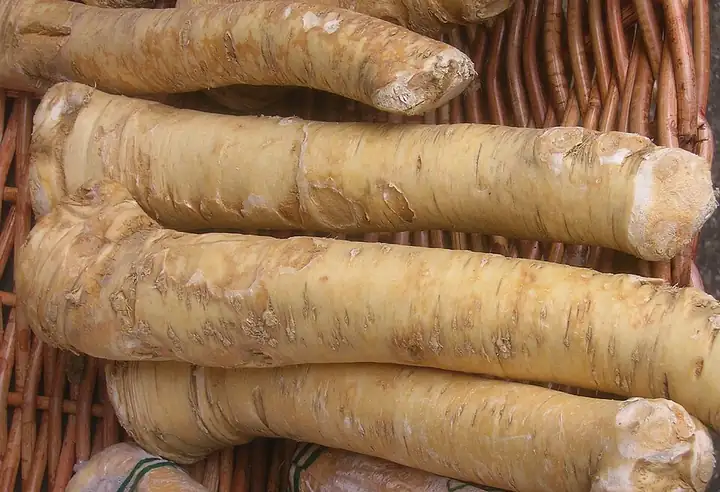
Horseradish
Armoracia rusticana · Cabbage family (Brassicaceae)
When to plant: Plant root cuttings at a slant in early spring as soon as the soil can be worked.
| Hardiness zones | 4 to 9 |
|---|---|
| Sun | full sun to part shade |
| Water | moderate |
| Life cycle | perennial |
| Frost | Hardy: takes frost |
| Soil pH | 6.0–7.5 |
| Spacing | 12 to 24 inches |
About Horseradish
Horseradish is a hardy perennial grown for its thick, fiery root, grated into sauces and condiments. It is almost too easy to grow: small bits of root left in the soil sprout again, so give it a spot where it can't take over.
A hardy perennial (NC State lists zones 4-9) that prefers cool summers; roots are dug after frost.
When to plant
Plant root cuttings at a slant in early spring as soon as the soil can be worked.
To keep it from spreading, dig the roots every year or grow it in a large buried pot or pipe.
Soil
Deep, rich, moist but well-drained loam; hard, shallow or stony soil gives poor roots.
Loosen soil 8 to 10 inches deep, mix in plenty of well-decayed compost, keep pH about 6.0 to 7.0, and follow a soil test; without one, about 1 lb of balanced fertilizer such as 10-10-10 per 100 sq ft.
Feeding
- 4 weeks after planting root cuttings: nitrogen fertilizer such as 21-0-0. Use about 1 tsp per plant beside it and water it in.
Look for: a little nitrogen, such as 21-0-0, kept light. Root crops are grown for their roots: too much nitrogen makes big leafy tops and small roots. The phosphorus and potassium they need go in before planting, as a soil test says. - 8 weeks after planting: nitrogen fertilizer such as 21-0-0. Repeat about 1 tsp per plant and water it in.
Look for: a little nitrogen, such as 21-0-0, kept light. Root crops are grown for their roots: too much nitrogen makes big leafy tops and small roots. The phosphorus and potassium they need go in before planting, as a soil test says.
Fresh manure, too much nitrogen or late-season nitrogen gives lots of leaves and forked, branched roots.
Harvest
Dig roots from late fall, after a hard frost, until new growth starts in spring. Trim off the tops and side roots and scrub the main root clean.
Dig roots once a year in late October or November, before the ground freezes, and save pieces 8 inches or longer to replant in spring. Roots left in the ground two seasons turn stringy and woody.
Varieties (10)
Wisconsin Extension notes that named varieties are rarely available to home gardeners other than the ornamental Variegata. Commercial types fall into two groups: Common (broad, crinkled leaves; top root quality) and Bohemian (narrow, smooth leaves; somewhat lower quality but better disease resistance). Numbered Illinois breeding clones are grown commercially and are left out.
| Variety | Type | Season and days | Zones | Notes |
|---|---|---|---|---|
| Maliner Kren | Bohemian or Common (sources differ) | 180 days | 4–9typical for Horseradish | Large white roots. Utah State calls it a German variety with the most vigorous growth and largest roots. Arkansas and Oregon State call it a Bohemian type; Nebraska Extension and a 2021 Illinois review group it with the Common type, which is prone to white rust and turnip mosaic virus. Species-level range for Armoracia rusticana. Sources: [2][3][4][8][9][10][11] |
| Bohemian | Bohemian type | 4–9typical for Horseradish | Narrow, smooth leaves and smaller roots. Quality is somewhat lower, but disease resistance is better. Species-level range for Armoracia rusticana. Sources: [4][8][9][10][12] | |
| Bohemian Giant | Bohemian type | 4–9typical for Horseradish | A Bohemian type listed by Nebraska Extension. Species-level range for Armoracia rusticana. Sources: [4][9] | |
| Improved Bohemian | Bohemian type | 4–9typical for Horseradish | Oregon State says Improved Bohemian and Bohemian form the basis of the U.S. industry. Species-level range for Armoracia rusticana. Sources: [4][8][11] | |
| New Bohemian | Bohemian type | 4–9typical for Horseradish | Roots may be lower in quality and yield than other types, but it resists white rust and mosaic. Species-level range for Armoracia rusticana. Sources: [2][4][9] | |
| Sass | Bohemian type | 4–9typical for Horseradish | A high-yielding type grown in small amounts in Illinois. Species-level range for Armoracia rusticana. Sources: [4][9][10] | |
| Swiss | Bohemian type | 4–9typical for Horseradish | A Bohemian type listed by Nebraska Extension. Species-level range for Armoracia rusticana. Sources: [4][9][10] | |
| Common | Common type | 4–9typical for Horseradish | Broad, crinkled leaves and top root quality, but susceptible to white rust and turnip mosaic virus. Species-level range for Armoracia rusticana. Sources: [4][8][9][10][12] | |
| Variegata | Ornamental | 4–9typical for Horseradish | Large, wavy, dark green leaves splashed with cream. Less invasive than plain types and tolerates partial shade, but a bit less vigorous. The markings may fade for a while after transplanting, and plants take 2 to 3 years to settle in. Species-level range for Armoracia rusticana. 'Variegata' is listed on the same page. Sources: [2][4][9][12] | |
| Big Top Western | 180 days | 4–9typical for Horseradish | Large, high-quality roots that can be rough on the outside, with wide, smooth leaves. Known for resistance to turnip mosaic virus. Arkansas lists it as Big Top and notes wide adaptability. Species-level range for Armoracia rusticana. Sources: [3][4][9][10] |
Pests to watch for
Diseases and problems
In the kitchen
Freshly grated root is mixed with vinegar for prepared horseradish, or into cocktail sauce, dressings and sauces for meat.
Keeping it: Store whole roots in a plastic bag with moist sand in the fridge, or in moist sand in a dark root cellar, for up to about 3 months. Keep them dark so they don't turn green.
Safety: The heat comes from mustard oils released when the root is cut or grated; grinding releases them into the air, so fresh-grated horseradish gives off very pungent fumes (Arkansas and NC State Extension).
Pets: Not listed as toxic by the ASPCA, but USU Extension warns not to feed horseradish to animals, because its volatile oils cause acute inflammation of the stomach that can be fatal.
Sources
- extension.umn.edu
- extension.usu.edu
- uaex.uada.edu
- plants.ces.ncsu.edu
- extension.illinois.edu
- aspca.org
- aspca.org
- horticulture.oregonstate.edu
- lancaster.unl.edu
- mdpi.com
- ir.library.oregonstate.edu
- hort.extension.wisc.edu
Photo: Photo: Anna reg, CC BY-SA 3.0, via Wikimedia Commons (CC BY-SA 3.0). Photo resized for the web.

Planting dates and advice are general guidance; check with your local Cooperative Extension office for your area.