
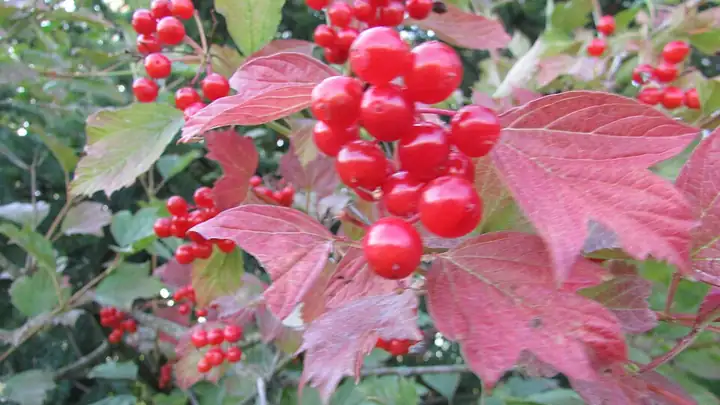
Holly
Ilex opaca (American holly), I. crenata (Japanese holly), I. glabra (inkberry), plus I. cornuta (Chinese holly), I. vomitoria (yaupon) and hybrids such as 'Nellie R. Stevens' · Holly family (Aquifoliaceae)
When to plant: Container hollies can go in at any time, but early fall is best (Clemson).
| Hardiness zones | 4 to 11 |
|---|---|
| Sun | full sun to part shade |
| Water | moderate |
| Life cycle | perennial |
| Frost | Hardy: takes frost |
About Holly
Evergreen hollies are tough shrubs and trees for hedges, screens and foundation plantings. American holly is the native Christmas holly with spiny leaves and red berries; Japanese holly and native inkberry have small, spineless leaves and black berries and are often used in place of boxwood. Most hollies come as male and female plants, so berries form only on females with a male nearby (Clemson, NC State). Deciduous winterberry has its own page.
American holly grows in zones 5-9, Japanese holly in 5-8 (it may struggle in hot, humid Southern summers) and inkberry in 4-11 (NC State).
When to plant
Container hollies can go in at any time, but early fall is best (Clemson).
For berries, plant a male of the same kind near the females; Chinese holly is one of the few that berries without a male.
Soil
Well-drained, slightly acid soil rich in organic matter; American and Japanese hollies turn yellow in alkaline soil, while inkberry tolerates wet spots (Clemson, NC State).
Work organic matter into well-drained, slightly acid soil and test the soil first (Clemson).
Feeding
- Spring to early summer after new growth starts, only if a soil test shows a need: slow-release complete fertilizer in a 3:1:2 ratio, or what the soil test calls for. Spread evenly from the trunk out to the drip line and water it in; a typical soil-test rate for shrubs is about 2 lb of 12-6-6 per 100 sq ft (Clemson). Follow a soil test.
Look for: mostly nitrogen, in spring as growth starts. Spring feeding grows the new shoots and leaves that carry flowers and fruit; feeding after midsummer pushes soft growth that may not harden before winter.
Water is what new shrubs need most: daily for the first 2 weeks, every 2-3 days through week 12, then weekly until the roots spread (at least two growing seasons), using about a quarter to a third of the nursery pot's volume each time (UMN). Extra nitrogen can cut berry set on hollies (Clemson); hollies may flush new growth after late-season feeding, so give only part of the year's amount then (Clemson).
Harvest
Small greenish-white flowers open April to June; berries ripen in fall and last into winter on female plants. Japanese hollies take hard pruning, and inkberry 'Compacta' can be sheared to a 2-foot hedge (Clemson, NC State).
Varieties (17)
| Variety | Type | Zones | Notes |
|---|---|---|---|
| Canary | American holly (I. opaca) | 4–11typical for holly | Female with yellow fruit; needs a male nearby. Sources: [2] |
| Greenleaf | American holly (I. opaca) | 4–11typical for holly | Female with heavy crops of red berries; 20-30 ft tall and 10-15 ft wide. Sources: [2] |
| Jersey Knight | American holly (I. opaca) | 4–11typical for holly | Male pollinator for female American hollies. Sources: [1] |
| Stewart's Silver Crown | American holly (I. opaca) | 4–11typical for holly | Female; leaves edged in cream. Sources: [1][2] |
| Burfordii (Burford holly) | Chinese holly (I. cornuta) | 4–11typical for holly | Large, about 20 ft tall and wide; heavy berry crops without a male. Sources: [1] |
| Rotunda (dwarf Chinese holly) | Chinese holly (I. cornuta) | 4–11typical for holly | Spiny mound 3-4 ft tall and 6-8 ft wide; usually no berries. Sources: [1] |
| Nellie R. Stevens | Hybrid holly (English x Chinese) | 4–11typical for holly | Fast-growing, dark green, large red berries; a popular specimen and screen. Sources: [1] |
| Gem Box | Inkberry (I. glabra) | 4–11typical for holly | Dwarf, dense, ball-shaped female sold as a boxwood alternative. Sources: [4] |
| Shamrock | Inkberry (I. glabra) | 4–11typical for holly | Compact native inkberry, 3-5 ft tall. Sources: [4] |
| Strongbox | Inkberry (I. glabra) | 4–11typical for holly | Mounded, dense female, resistant to pests and disease; a boxwood alternative. Sources: [4] |
| Compacta | Japanese holly (I. crenata) | 4–11typical for holly | Dwarf, mounding male. Sources: [3] |
| Convexa | Japanese holly (I. crenata) | 4–11typical for holly | Cupped dark green leaves and heavy crops of black fruit; female. Sources: [1][3] |
| Helleri | Japanese holly (I. crenata) | 4–11typical for holly | Compact, small-leaved mound about 4 ft tall and 5 ft wide; female but seldom fruits. Sources: [1][3] |
| Hetzii | Japanese holly (I. crenata) | 4–11typical for holly | Rounded mound 2-3 ft tall; female. Sources: [1][3] |
| Sky Pencil | Japanese holly (I. crenata) | 4–11typical for holly | Narrow column without pruning; female. Sources: [3] |
| Soft Touch | Japanese holly (I. crenata) | 4–11typical for holly | Soft-textured leaves without sharp tips. Sources: [3] |
| Nana (dwarf yaupon) | Yaupon holly (I. vomitoria) | 4–11typical for holly | Native; mounding, 3-5 ft tall and very broad. Sources: [1] |
Pests to watch for
Scale insects, Twospotted spider mite, Whiteflies, Aphids, Deer
Diseases and problems
Root rot, Leaf scorch, Holly leaf blight, Winter injury, Girdling roots
In the kitchen
Safety: NC State rates hollies low in toxicity: eating the berries can cause vomiting and diarrhea, so keep children from snacking on them. NC State also rates American holly and inkberry as highly flammable, so keep them away from the house in wildfire areas.
Pets: Toxic to dogs, cats and horses (ASPCA): saponins cause vomiting, diarrhea and depression; the leaves and berries are of low toxicity.
Sources
- hgic.clemson.edu
- plants.ces.ncsu.edu
- plants.ces.ncsu.edu
- plants.ces.ncsu.edu
- aspca.org
- extension.rutgers.edu
- extension.rutgers.edu
- extension.rutgers.edu
- extension.rutgers.edu
- extension.rutgers.edu
- hgic.clemson.edu
- extension.umn.edu
Photo: Photo: Chris Light / Wikimedia Commons, CC BY-SA 4.0 (CC BY-SA 4.0). Photo resized for the web.

Planting dates and advice are general guidance; check with your local Cooperative Extension office for your area.