
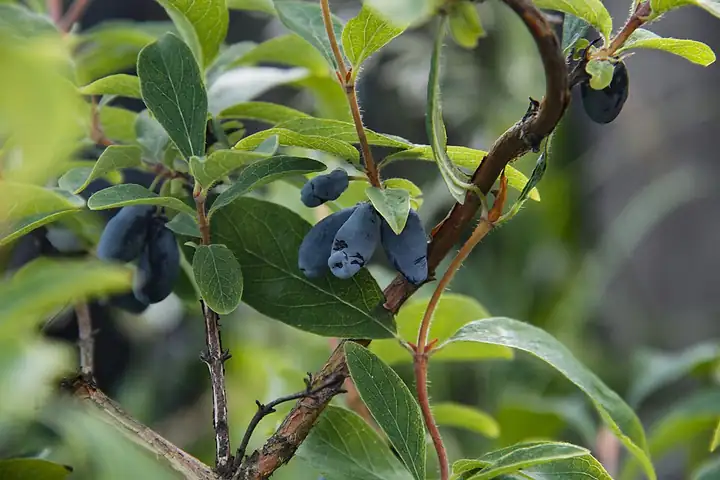
Haskap (honeyberry)
Lonicera caerulea · Honeysuckle family (Caprifoliaceae)
When to plant: Fall is the best time to plant, though dormant plants set out in spring can succeed (Utah State).
| Hardiness zones | 1 to 8 |
|---|---|
| Sun | full sun |
| Water | moderate |
| Life cycle | perennial |
| Frost | Hardy: takes frost |
| Soil pH | 5.5–8.0 |
| Spacing | 36 to 48 inches |
About Haskap (honeyberry)
Haskap, also called honeyberry or blue honeysuckle, is an extremely cold-hardy shrub whose blue berries ripen in early summer, before strawberries. It needs a second, unrelated variety that blooms at the same time.
Can be grown in zones 1-8 (University of Wisconsin), but performs best in zones colder than 6; Japanese types suit warmer areas and Russian types colder ones (Utah State). Blossoms tolerate frost to about 19-20 F.
When to plant
Fall is the best time to plant, though dormant plants set out in spring can succeed (Utah State).
Expect only a few berries the first years, with larger crops by year 3 or 4 (Utah State; University of Wisconsin).
Soil
Well-drained soil; tolerates a wide pH range. Plants are not drought-tolerant, so water deeply every 5-7 days (Utah State).
Haskaps tolerate a wide pH range (about 5.5-8); test the soil, clear weeds, and work in organic matter before planting.
Feeding
- Spring only: balanced fertilizer such as 16-16-16. About 1/2 cup per plant, spread around the base and watered in; follow a soil test.
Look for: mostly nitrogen, in spring as growth starts. Spring feeding grows the new shoots and leaves that carry flowers and fruit; feeding after midsummer pushes soft growth that may not harden before winter.
Do not feed nitrogen after spring, since late feeding makes plants more prone to winter injury; plant a compatible second variety for pollination.
Harvest
Berries start changing color in late May to early June and are usually ready a few weeks later (Utah State); the earliest varieties ripen about two weeks before strawberries (University of Wisconsin). Net plants, because birds such as cedar waxwings take the crop.
Haskap gives one early crop a year: berries color in late May to early June and are ready a few weeks later. Net plants by late May to keep birds off.
Varieties (11)
Only University of Saskatchewan cultivars were found in acceptable sources. Haskaps need a different, compatible variety that blooms at the same time. No zone ranges were found per variety. North Dakota State found the Boreal series produced smaller, harder-to-pick fruit there than in Saskatchewan.
| Variety | Type | Season and days | Zones | Notes |
|---|---|---|---|---|
| Aurora | University of Saskatchewan | Early | 1–8typical for Haskap | Very productive. Widely available since 2014. Early bloomer; pairs well with Tundra, Borealis, Indigo Gem and Honey Bee. Also pollen-compatible with Boreal Beast. Utah State notes haskaps can scorch and drop leaves early above zone 6. Sources: [2][5][6] |
| Boreal Beast | University of Saskatchewan | Mid- to late July in Saskatoon | 1–8typical for Haskap | Top-rated flavor and aroma with a nice aftertaste; berries about 2 g in Saskatchewan. Strongly upright and sturdy. Excellent mildew resistance. Berries cling tightly, so North Dakota suggests it for home gardens rather than commercial picking. Blooms mid-to-late and bridges Boreal Blizzard and Boreal Beauty; bred to pollinate Boreal Beauty. Also compatible with Aurora. Utah State notes haskaps can scorch and drop leaves early above zone 6. Sources: [2][5][6][7] |
| Boreal Beauty | University of Saskatchewan | Late | 1–8typical for Haskap | Heavy, firm, mostly oval berries; North Dakota tasters found them mild and rich. Strong, upright bush. Suits machine picking and fresh sales. Ripens unevenly in North Dakota, so plan on several pickings. Blooms very late; pollinize with Boreal Beast, not the early types. Utah State notes haskaps can scorch and drop leaves early above zone 6. Sources: [2][5][7] |
| Boreal Bliss | University of Saskatchewan | 1–8typical for Haskap | Large, soft berries with a distinctive aromatic flavor. Aimed at home gardens, U-pick and flavoring products. Newest release; plant breeder's rights pending. Utah State notes haskaps can scorch and drop leaves early above zone 6. Sources: [2][5] | |
| Boreal Blizzard | University of Saskatchewan | Early | 1–8typical for Haskap | Very large berries with a pleasant, very mild flavor. Fruit more than twice as heavy as comparable types in Saskatchewan. Tight-clinging fruit and dense leaves made picking hard in North Dakota. Pollinize with Boreal Beast. Utah State notes haskaps can scorch and drop leaves early above zone 6. Sources: [2][5][7] |
| Borealis | University of Saskatchewan | Early | 1–8typical for Haskap | Large, soft berries, about twice the size of older Russian types. Best for home gardens and U-pick, not machine harvest. Early bloomer. Pair with another early bloomer; USask rates Aurora and Honey Bee excellent partners. Utah State notes haskaps can scorch and drop leaves early above zone 6. Sources: [2][5][7] |
| Honey Bee | University of Saskatchewan | Late (holds fruit into mid-August) | 1–8typical for Haskap | Cylindrical berries, mainly for juice. Fast-growing, productive and fruits young. Bred as a pollinizer for the early bloomers Tundra, Borealis and the Indigo series. Utah State notes haskaps can scorch and drop leaves early above zone 6. Sources: [2][5] |
| Indigo Gem | University of Saskatchewan | Early | 1–8typical for Haskap | More upright growth. North Dakota found it the best producer of the early releases, helped by partial self-fertility. Early bloomer. Pair with another early bloomer; USask rates Aurora and Honey Bee excellent partners. Utah State notes haskaps can scorch and drop leaves early above zone 6. Sources: [2][5][7] |
| Indigo Treat | University of Saskatchewan | Early | 1–8typical for Haskap | Most like Tundra of the Indigo series. Early bloomer. Pair with another early bloomer; USask rates Aurora and Honey Bee excellent partners. Utah State notes haskaps can scorch and drop leaves early above zone 6. Sources: [2][5] |
| Indigo Yum | University of Saskatchewan | Early | 1–8typical for Haskap | Early bloomer. Pair with another early bloomer; USask rates Aurora and Honey Bee excellent partners. Utah State notes haskaps can scorch and drop leaves early above zone 6. Sources: [2][5] |
| Tundra | University of Saskatchewan | Early | 1–8typical for Haskap | Firm berries near the top of the program for flavor and size. Firm fruit suited to commercial picking and freezing. Early bloomer. Best partners: Aurora or Honey Bee; Russian types are a fair backup. Utah State notes haskaps can scorch and drop leaves early above zone 6. Sources: [2][5][7] |
Pests to watch for
Diseases and problems
In the kitchen
Used in pies, jams, jellies, juice and ice cream; berries can be frozen or dried (Utah State).
Keeping it: Refrigerate berries and use within a few days; varieties that bleed at the stem end keep the shortest time.
Pets: Not listed as toxic by the ASPCA
Sources
- extension.usu.edu
- cropsandsoils.extension.wisc.edu
- aspca.org
- aspca.org
- research-groups.usask.ca
- research-groups.usask.ca
- ndsu.edu
Photo: Photo: Max071086, CC BY-SA 4.0, via Wikimedia Commons (CC BY-SA 4.0). Photo resized for the web.

Planting dates and advice are general guidance; check with your local Cooperative Extension office for your area.