
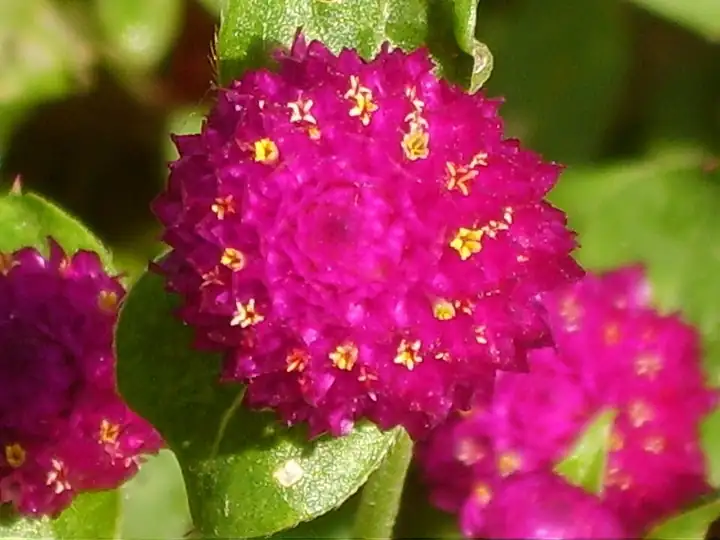
Gomphrena (globe amaranth)
Gomphrena globosa · Amaranth family (Amaranthaceae)
When to plant: Start seeds indoors 6 to 8 weeks before the last frost and set out plants up to 2 weeks after the last frost.
| Hardiness zones | 9 to 11 |
|---|---|
| Sun | full sun |
| Water | low |
| Life cycle | annual |
| Frost | Tender: killed by frost |
| Spacing | 12 to 18 inches |
| Days to harvest | 84 to 112 days |
About Gomphrena (globe amaranth)
Gomphrena makes round, clover-like 1- to 2-inch heads of papery bracts in purple, pink, lavender and white (red and orange in its cousin G. haageana) from June until frost. It shrugs off heat and drought, draws butterflies, bees and other beneficial insects, and is a favorite for cutting and drying because it keeps its color.
Grown as a summer annual in every zone; it can live over only in zones 9-11 (NC State, Clemson).
When to plant
Timing is counted from your average last spring frost (and first fall frost). Sow & Tell works out the actual dates for your ZIP code.
- Start seeds indoors: 6 to 8 weeks before the last frost
- Set out plants: up to 2 weeks after the last frost
Start seed indoors 6-8 weeks before the last frost at 70-75 F; it can take 2-3 weeks to sprout, and soaking seed overnight speeds it up (Wisconsin, Clemson). Seedlings bloom about 12-16 weeks after sowing (Clemson). Set out after frost 12-18 inches apart.
Soil
Average, well-drained soil; drought tolerant once established.
Average, well-drained soil is fine; follow a soil test before adding fertilizer.
Feeding
Look for: a balanced or all-purpose fertilizer at the label rate. Skip high-phosphorus "bloom boosters" unless a soil test shows low phosphorus: most garden soils already have enough, and the extra can wash into streams.
Drought stress can bring on mildew; water during long dry spells.
Harvest
Blooms from June until frost. For drying, cut stems when the heads are fully open and bright, then hang them upside down (Wisconsin, Clemson).
Varieties (15)
| Variety | Type | Notes |
|---|---|---|
| Audray series | Cut flower | 20-24 in tall; bicolor rose, pink, red and white. In NC State cut-flower trials 'Audray Pink' averaged 17-in stems and about 10 days of vase life. Sources: [3][5] |
| Buddy series | Dwarf G. globosa | 6-12 in tall; Rose, Purple and White. Sources: [1][2] |
| Gnome series | Dwarf G. globosa | 6-10 in tall; Pink, Purple and White. Sources: [1][2] |
| Bicolor Rose | G. globosa | Pink and white heads. Sources: [1][2] |
| Pinball series | G. globosa | 10-14 in tall. Sources: [1] |
| Ping Pong series | G. globosa | 16-20 in tall; lavender, purple and white. Sources: [1][3] |
| Cosmic Flare | Gomphrena | Listed by NC State. Sources: [1] |
| Fireworks | Gomphrena | Listed by NC State. Sources: [1] |
| Pinata | Gomphrena | Pink; 23 in tall and 41 in wide in Penn State trials. Rated 4.79 of 5 at Penn State in 2023. Sources: [6] |
| Truffula Pink | Gomphrena | Pink; 25 in tall and 33 in wide in Penn State trials. Rated 4.94 of 5 at Penn State in 2018 ('one of the best'). Sources: [7] |
| QIS series | Gomphrena haageana | 24-26 in tall; eight colors. Sources: [2] |
| Strawberry Fields | Gomphrena haageana | Bright red heads; 18-28 in tall. Sources: [2][3] |
| Las Vegas series | Tall G. globosa | 16-20 in tall; bright colors. Sources: [2][5] |
| Fireball Pink | Vegetative hybrid | Dark pink; 12-18 in tall. Rated 4.88 of 5 at Penn State in 2025. Sources: [2][8] |
| Spitfire Pink | Vegetative hybrid | Pink. Scored a perfect 5.00 at Penn State in 2026. Sources: [9] |
Diseases and problems
In the kitchen
Pets: We found no ASPCA entry for globe amaranth, so we can't say it is pet-safe; discourage pets from chewing it.
Sources
- plants.ces.ncsu.edu
- hort.extension.wisc.edu
- hgic.clemson.edu
- aspca.org
- cutflowers.ces.ncsu.edu
- agsci.psu.edu
- agsci.psu.edu
- agsci.psu.edu
- agsci.psu.edu
Photo: Photo: Dalgial, CC BY-SA 3.0, via Wikimedia Commons (CC BY-SA 3.0). Photo resized for the web.

Planting dates and advice are general guidance; check with your local Cooperative Extension office for your area.