
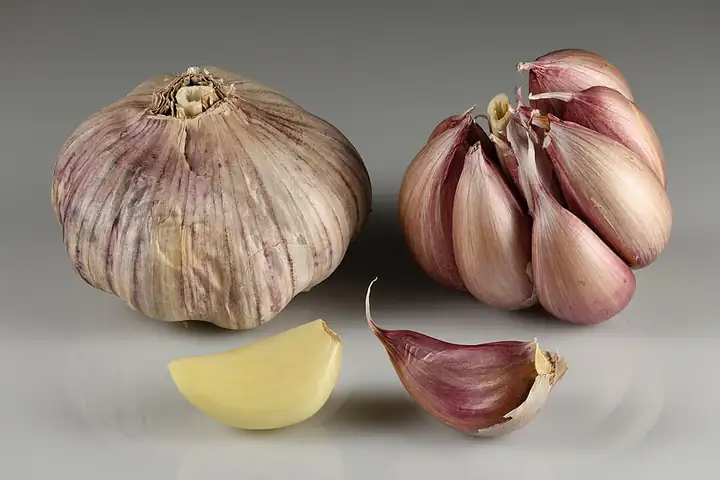
Garlic
Allium sativum · Amaryllis family (Amaryllidaceae)
When to plant: Plant in fall, 1 to 2 weeks after the first fall frost.
| Hardiness zones | 3 to 9 |
|---|---|
| Sun | full sun |
| Water | moderate |
| Life cycle | perennial |
| Frost | Hardy: takes frost |
| Soil pH | 6.0–7.0 |
| Spacing | 6 inches |
| Days to harvest | 240 to 270 days |
About Garlic
Garlic is planted as single cloves in fall, rests through winter, and is dug the next summer. Hardneck types send up edible curly scapes and like cold winters, while softneck types store longer and suit the South.
A perennial grown as a fall-planted annual crop; NC State lists it for zones 4-9 and UMN grows it in Minnesota. It needs weeks of winter cold to bulb well, so softneck types are more reliable where winters are mild.
When to plant
Timing is counted from your average last spring frost (and first fall frost). Sow & Tell works out the actual dates for your ZIP code.
- Fall planting: 1 to 2 weeks after the first fall frost
Plant cloves pointed end up, 2 to 3 inches deep, 1 to 2 weeks AFTER the first killing frost (so the fall value is negative). Days to harvest count from fall planting, about eight months.
Soil
Loose, well-drained soil that holds moisture; mulch 3 to 4 inches deep after planting.
Loosen the soil, keep pH 6 to 7, and work in well-rotted manure or compost; follow a soil test, and without one use about 3 lb of balanced fertilizer such as 10-10-10 per 100 sq ft before fall planting.
Feeding
- spring, as soon as shoots come up (by about mid-April): nitrogen fertilizer such as 21-0-0. Spread about 1/2 lb per 100 sq ft beside the rows and water it in.
Look for: nitrogen, such as 21-0-0. Strong green tops feed the bulb, so these crops get nitrogen while the leaves grow; follow the timing in each step, since feeding too late makes bulbs form late. - 2 to 3 weeks after the first spring feeding, no later than early May: nitrogen fertilizer such as 21-0-0. Use a smaller amount, about 1/4 lb per 100 sq ft, beside the rows and water it in.
Look for: nitrogen, such as 21-0-0. Strong green tops feed the bulb, so these crops get nitrogen while the leaves grow; follow the timing in each step, since feeding too late makes bulbs form late.
Stop adding nitrogen by early May (early April in the South), or bulbs form late; if soil tests high in phosphorus, use a low- or no-phosphorus fertilizer.
Harvest
Dig when the lower leaves have browned but about half the upper leaves are still green, usually late June to late July. Cure 3 to 4 weeks in a warm, dry, airy place. Stop watering 2 weeks before harvest.
Bulbs are dug once, between late June and late July, and you replant the biggest cloves in fall for next year's crop. Curly scapes can be snapped off and eaten in early summer.
Varieties (29)
| Variety | Type | Season and days | Zones | Notes |
|---|---|---|---|---|
| Asian Tempest | Hardneck - Asiatic | Summer (from fall planting) | 4–9typical for Garlic (hardneck and softneck) | Usually 4 to 8 large cloves per bulb; the flower stalk does not curl and makes large bulbils. Genetically closer to softnecks but behaves like a hardneck. A bit less productive than German Red in Minnesota. Species range for Allium sativum; the source covers both hardneck and softneck garlic and gives no separate ranges. Sources: [3][8] |
| Purple Glazer | Hardneck - Glazed Purple Stripe | Summer (from fall planting) | 4–9typical for Garlic (hardneck and softneck) | Glazed purple stripe type. Hardneck types like cold winters and long, cool springs; they are less reliable in the mild-winter South. Included in Oklahoma State's garlic variety trial. Species range for Allium sativum; the source covers both hardneck and softneck garlic and gives no separate ranges. Sources: [3][9][10] |
| Siberian | Hardneck - Marbled Purple Stripe | Summer (from fall planting) | 4–9typical for Garlic (hardneck and softneck) | Marbled purple stripe type. Hardneck types like cold winters and long, cool springs; they are less reliable in the mild-winter South. Recommended in Wisconsin. Species range for Allium sativum; the source covers both hardneck and softneck garlic and gives no separate ranges. Sources: [3][9][11] |
| Georgian Crystal | Hardneck - Porcelain | Summer (from fall planting) | 4–9typical for Garlic (hardneck and softneck) | Porcelain type with white wrappers and a few large cloves. Hardneck types like cold winters and long, cool springs; they are less reliable in the mild-winter South. Species range for Allium sativum; the source covers both hardneck and softneck garlic and gives no separate ranges. Sources: [3][9] |
| German Extra Hardy | Hardneck - Porcelain | Summer (from fall planting) | 4–9typical for Garlic (hardneck and softneck) | Large-cloved porcelain garlic (Washington State lists it as Extra Hardy). Hardneck types like cold winters and long, cool springs; they are less reliable in the mild-winter South. It was the top producer in an Oklahoma State garlic trial and did well even with heavy weed pressure. Species range for Allium sativum; the source covers both hardneck and softneck garlic and gives no separate ranges. Sources: [3][9][10][11][12][13] |
| German White (German White Stiffneck) | Hardneck - Porcelain | Summer (from fall planting) | 4–9typical for Garlic (hardneck and softneck) | Porcelain type; large, even cloves that peel easily. Hardneck types like cold winters and long, cool springs; they are less reliable in the mild-winter South. Rutgers says it grows well in New Jersey. Species range for Allium sativum; the source covers both hardneck and softneck garlic and gives no separate ranges. Sources: [3][10][14] |
| Music | Hardneck - Porcelain | Summer (from fall planting) | 4–9typical for Garlic (hardneck and softneck) | Hardneck garlics generally have a stronger flavor than softnecks (Oklahoma State; not a variety-specific note). Satiny white bulb wrappers with a few large, plump cloves (about 4 to 6) around a stiff stalk; peels easily. Hardneck garlic is the most cold-hardy type and does better in cooler climates; softnecks suit warm climates better. Recommended in Maine, New Jersey, Washington and Wisconsin. Species range for Allium sativum; the source covers both hardneck and softneck garlic and gives no separate ranges. Sources: [3][9][10][11][12][13][14][15] |
| Romanian Red | Hardneck - Porcelain | Summer (from fall planting) | 4–9typical for Garlic (hardneck and softneck) | Porcelain type with a few large cloves. Hardneck types like cold winters and long, cool springs; they are less reliable in the mild-winter South. Included in Oklahoma State's garlic variety trial. Species range for Allium sativum; the source covers both hardneck and softneck garlic and gives no separate ranges. Sources: [3][9][10] |
| Chesnok Red | Hardneck - Purple Stripe | Summer (from fall planting) | 4–9typical for Garlic (hardneck and softneck) | Purple stripe garlics are strong in flavor. Bulb wrappers and clove skins streaked with purple; cloves are even in size and peel easily. Hardneck types like cold winters and long, cool springs; they are less reliable in the mild-winter South. Recommended in Maine, New Jersey, Washington and Wisconsin. Species range for Allium sativum; the source covers both hardneck and softneck garlic and gives no separate ranges. Sources: [3][9][10][11][12][13][14][15] |
| Metechi | Hardneck - Purple Stripe | Summer (from fall planting) | 4–9typical for Garlic (hardneck and softneck) | Purple-striped hardneck. Hardneck types like cold winters and long, cool springs; they are less reliable in the mild-winter South. Rutgers says it grows well in New Jersey. Species range for Allium sativum; the source covers both hardneck and softneck garlic and gives no separate ranges. Sources: [3][14] |
| Persian Star | Hardneck - Purple Stripe | Summer (from fall planting) | 4–9typical for Garlic (hardneck and softneck) | Standard purple stripe type with purple-streaked wrappers. Hardneck types like cold winters and long, cool springs; they are less reliable in the mild-winter South. Species range for Allium sativum; the source covers both hardneck and softneck garlic and gives no separate ranges. Sources: [3][9] |
| German Red | Hardneck - Rocambole | Summer (from fall planting) | 4–9typical for Garlic (hardneck and softneck) | Large cloves, usually 10 to 15 per bulb, and sometimes doubled. The scape first curls tightly, then straightens. Hardneck types like cold winters and long, cool springs; they are less reliable in the mild-winter South. One of the most popular hardnecks for cold climates. Hardnecks keep only a few months. Species range for Allium sativum; the source covers both hardneck and softneck garlic and gives no separate ranges. Sources: [3][8][9][13][16][17][18][19] |
| Killarney Red | Hardneck - Rocambole | Summer (from fall planting) | 4–9typical for Garlic (hardneck and softneck) | Rocamboles have a milder flavor than other hardnecks. Rocambole type with even cloves that peel easily. Hardneck types like cold winters and long, cool springs; they are less reliable in the mild-winter South. Recommended in New Jersey, Washington and Wisconsin. Species range for Allium sativum; the source covers both hardneck and softneck garlic and gives no separate ranges. Sources: [3][9][11][13][14] |
| Merrifield Rocambole | Hardneck - Rocambole | Summer (from fall planting) | 4–9typical for Garlic (hardneck and softneck) | Much like German Red but with slightly larger bulbs; can form double cloves. Hardneck types like cold winters and long, cool springs; they are less reliable in the mild-winter South. A New York selection that did well in Minnesota. Species range for Allium sativum; the source covers both hardneck and softneck garlic and gives no separate ranges. Sources: [3][8][18] |
| Spanish Roja | Hardneck - Rocambole | Summer (from fall planting) | 4–9typical for Garlic (hardneck and softneck) | Good garlic flavor; rocamboles are a bit milder than other hardnecks. Rocambole type with large tan-to-brown cloves and a scape that curls into a loop. Hardneck types like cold winters and long, cool springs; they are less reliable in the mild-winter South. A Northwest selection; recommended in Minnesota, New Jersey, Washington and Wisconsin. Species range for Allium sativum; the source covers both hardneck and softneck garlic and gives no separate ranges. Sources: [3][8][9][11][13][14][19] |
| Elephant garlic | Not true garlic (leek relative) | Summer (from fall planting) | 5–10typical for Allium ampeloprasum (elephant garlic) | Much milder than true garlic; can turn sharp or a little bitter, especially in cold climates. Very large bulbs with only about 3 to 6 huge cloves. A kind of leek (Allium ampeloprasum), not true garlic, and less cold hardy. Species range for Allium ampeloprasum, the species elephant garlic belongs to. Sources: [8][9][15][17][20][21][22] |
| California Late | Softneck | Summer | 4–9typical for Garlic (hardneck and softneck) | Non-bolting softneck grown for fresh market and drying. Softneck types do well in mild-winter areas such as the South and store longer than hardnecks. Species range for Allium sativum; the source covers both hardneck and softneck garlic and gives no separate ranges. Sources: [3][16][17] |
| New York White | Softneck | Summer (from fall planting) | 4–9typical for Garlic (hardneck and softneck) | White bulbs often streaked with purple. It may partly or fully bolt, and bulbs are smaller when it does. Grown in cold states such as Minnesota, South Dakota and Wisconsin. Species range for Allium sativum; the source covers both hardneck and softneck garlic and gives no separate ranges. Sources: [3][8][11][18] |
| California Early | Softneck - Artichoke | Summer (from fall planting) | 4–9typical for Garlic (hardneck and softneck) | Softneck that rarely bolts; many strains were selected for fresh market and drying. Softneck types do well in mild-winter areas such as the South and store longer than hardnecks. Georgia Extension recommends it for the South. Species range for Allium sativum; the source covers both hardneck and softneck garlic and gives no separate ranges. Sources: [2][3][16][17][19][21] |
| Chet's Italian | Softneck - Artichoke | Summer (from fall planting) | 4–9typical for Garlic (hardneck and softneck) | Many artichoke garlics are mild. Vigorous, large-bulbed artichoke type. Softneck types do well in mild-winter areas such as the South and store longer than hardnecks. Georgia Extension recommends it. Species range for Allium sativum; the source covers both hardneck and softneck garlic and gives no separate ranges. Sources: [2][3][19] |
| Inchelium Red | Softneck - Artichoke | Summer (from fall planting) | 4–9typical for Garlic (hardneck and softneck) | Mild garlic flavor. Large, vigorous bulbs with many cloves in layers; the cloves can be hard to peel. Braids well. Softneck types do well in mild-winter areas such as the South and store longer than hardnecks. Recommended from Georgia to Minnesota; softnecks keep about 6 to 8 months. Species range for Allium sativum; the source covers both hardneck and softneck garlic and gives no separate ranges. Sources: [2][3][8][9][11][13][14][18][19] |
| Lorz Italian | Softneck - Artichoke | Summer (from fall planting) | 4–9typical for Garlic (hardneck and softneck) | Artichoke type with many cloves per bulb. Softneck types do well in mild-winter areas such as the South and store longer than hardnecks. Rutgers says it grows well in New Jersey. Species range for Allium sativum; the source covers both hardneck and softneck garlic and gives no separate ranges. Sources: [3][14] |
| Susanville | Softneck - Artichoke | Summer (from fall planting) | 4–9typical for Garlic (hardneck and softneck) | Artichoke type that stores well; large in mild climates but smaller than New York White in Minnesota. Softneck types do well in mild-winter areas such as the South and store longer than hardnecks. Species range for Allium sativum; the source covers both hardneck and softneck garlic and gives no separate ranges. Sources: [3][8][9] |
| Ajo Rojo | Softneck - Creole | Summer (from fall planting) | 4–9typical for Garlic (hardneck and softneck) | Creole type with about 8 to 12 cloves per bulb; can keep 7 to 8 months. Softneck types do well in mild-winter areas such as the South and store longer than hardnecks. Recommended in South Carolina. Species range for Allium sativum; the source covers both hardneck and softneck garlic and gives no separate ranges. Sources: [3][15] |
| Burgundy | Softneck - Creole | Summer (from fall planting) | 4–9typical for Garlic (hardneck and softneck) | Creole type with about 8 to 12 cloves per bulb; can keep 7 to 8 months. Softneck types do well in mild-winter areas such as the South and store longer than hardnecks. Recommended in South Carolina. Species range for Allium sativum; the source covers both hardneck and softneck garlic and gives no separate ranges. Sources: [3][15] |
| Mild French | Softneck - Silverskin | Summer (from fall planting) | 4–9typical for Garlic (hardneck and softneck) | Silverskin type. Softneck types do well in mild-winter areas such as the South and store longer than hardnecks. Georgia Extension recommends it. Species range for Allium sativum; the source covers both hardneck and softneck garlic and gives no separate ranges. Sources: [2][3][19] |
| Nootka Rose | Softneck - Silverskin | Summer (from fall planting) | 4–9typical for Garlic (hardneck and softneck) | Silverskin type; long storage and easy to braid. Softneck types do well in mild-winter areas such as the South and store longer than hardnecks. Species range for Allium sativum; the source covers both hardneck and softneck garlic and gives no separate ranges. Sources: [3][9][14] |
| Rose du Var | Softneck - Silverskin | Summer (from fall planting) | 4–9typical for Garlic (hardneck and softneck) | Silverskin type; long storage and good for braiding. Softneck types do well in mild-winter areas such as the South and store longer than hardnecks. Rutgers says it grows well in New Jersey. Species range for Allium sativum; the source covers both hardneck and softneck garlic and gives no separate ranges. Sources: [3][14] |
| Silver White | Softneck - Silverskin | Summer (from fall planting) | 4–9typical for Garlic (hardneck and softneck) | Silverskins start mild but can be hot. Silverskin type with 12 to 20 cloves in several layers; the longest-keeping kind of garlic and the favorite for braids. Softneck types do well in mild-winter areas such as the South and store longer than hardnecks. Species range for Allium sativum; the source covers both hardneck and softneck garlic and gives no separate ranges. Sources: [2][3][9][15] |
Pests to watch for
Onion maggot, Thrips, Cutworms, Wireworms, Eriophyid mites (rust, bud, blister and gall mites), Allium leafminer
Diseases and problems
Botrytis, Pink root, Purple blotch, Aster yellows, Neck rot
In the kitchen
Used raw or cooked to flavor nearly every cuisine; hardneck scapes are good sauteed or in pesto.
Keeping it: Keep cured bulbs whole and dry in a cool, airy spot, not the fridge; whole heads keep for months (softnecks longest), but once you break a head, use the cloves within about 10 days.
Safety: Garlic supplements may raise bleeding risk, so tell your doctor if you take blood thinners or aspirin or are having surgery. Fresh raw garlic on the skin can cause severe irritation and chemical burns, and amounts above normal food use may not be safe in pregnancy or breastfeeding (NCCIH).
Pets: Toxic to dogs, cats and horses (ASPCA): contains N-propyl disulfide, which damages red blood cells and can cause vomiting, anemia, weakness and a fast heart rate.
Sources
- extension.umn.edu
- fieldreport.caes.uga.edu
- plants.ces.ncsu.edu
- warren.cce.cornell.edu
- nccih.nih.gov
- aspca.org
- extension.usu.edu
- conservancy.umn.edu
- pubs.extension.wsu.edu
- extension.okstate.edu
- hort.extension.wisc.edu
- extension.umaine.edu
- florence.extension.wisc.edu
- njaes.rutgers.edu
- hgic.clemson.edu
- horticulture.oregonstate.edu
- extension.psu.edu
- extension.sdstate.edu
- extension.arizona.edu
- extension.umn.edu
- agrilifeextension.tamu.edu
- plants.ces.ncsu.edu
Photo: Photo: Ivar Leidus, CC BY-SA 4.0, via Wikimedia Commons (CC BY-SA 4.0). Photo resized for the web.

Planting dates and advice are general guidance; check with your local Cooperative Extension office for your area.