
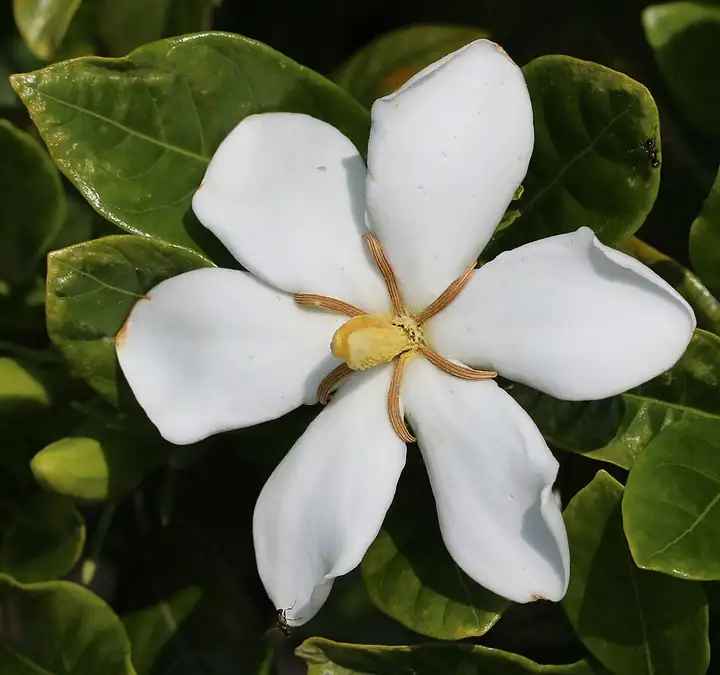
Gardenia (cape jasmine)
Gardenia jasminoides · Coffee family (Rubiaceae)
When to plant: Fall is the best time to plant; gardenias resent root disturbance, so place them once (Clemson).
| Hardiness zones | 7 to 11 |
|---|---|
| Sun | part shade |
| Water | moderate |
| Life cycle | perennial |
| Frost | Half-hardy: takes a light frost |
| Soil pH | 5.0–6.5 |
About Gardenia (cape jasmine)
Gardenia is an evergreen shrub from southern China and Japan grown for waxy white flowers with a heavy, sweet scent in late spring and summer. It needs acid soil and steady care, and whiteflies are a common problem. Hardier cultivars like 'Kleim's Hardy' and 'Jubilation' extend it into zone 7.
Older cultivars are reliable in zone 8; newer ones survive zone 7 (Clemson); NC State lists 7b-11b.
When to plant
Fall is the best time to plant; gardenias resent root disturbance, so place them once (Clemson).
Mulch 2-3 inches and water weekly in summer droughts, ideally by drip. In central and south Florida, grafted plants resist root-knot nematodes but are less cold-hardy (UF/IFAS).
Soil
Moist, well-drained, acid soil rich in organic matter (pH below 6.0, Clemson; 5.0-6.5, UF/IFAS); grow it in a pot where your soil is alkaline.
Amend with compost or peat moss for a rich, well-drained soil with pH 5.0-6.5; use a container if your soil is alkaline (UF/IFAS).
Feeding
- Spring, once frost danger has passed: acid-forming, slow-release azalea fertilizer with about a 2-1-1 ratio. Follow the label and a soil test; water in (Clemson).
Look for: an acid-forming fertilizer: ammonium sulfate (21-0-0) or an azalea fertilizer. These plants need acid soil and use nitrogen as ammonium; nitrate fertilizers and manure composts raise the pH. - About 6 weeks later: the same fertilizer. A second light feeding (Clemson). In Florida, UF/IFAS adds a September-October feeding.
Look for: an acid-forming fertilizer: ammonium sulfate (21-0-0) or an azalea fertilizer. These plants need acid soil and use nitrogen as ammonium; nitrate fertilizers and manure composts raise the pH.
Don't fertilize in fall in the Carolinas (Clemson). Yellow leaves often mean iron deficiency from high pH. Whiteflies and sooty mold are common on stressed plants.
Harvest
Main bloom is May-June with scattered flowers through summer (Clemson). Prune after flowering ends, removing straggly branches and faded flowers; in Florida finish before October to keep next year's buds (UF/IFAS). Bud drop comes from dry air, too much or too little water, or low light.
Varieties (9)
Extension sources document 9 gardenia cultivars.
| Variety | Type | Season and days | Zones | Notes |
|---|---|---|---|---|
| August Beauty | Gardenia (G. jasminoides) | Mid-spring to fall | 7–11typical for gardenia | 4-6 ft; double 3-inch flowers over a long season. Sources: [1] |
| Crown Jewel | Gardenia (G. jasminoides) | Spring and summer | 7–11typical for gardenia | Spreading, about 2 ft tall and 4 ft wide; very cold hardy double. Sources: [1][2] |
| Jubilation | Gardenia (G. jasminoides) | Repeats spring through fall | 7–10 | Compact, rounded shrub with very fragrant 2-4 inch double flowers; drought tolerant once settled. Hardy to zone 7a but leaves may burn in hard winters (NC State). Sources: [2][6] |
| Kleim's Hardy | Gardenia (G. jasminoides) | Spring and summer | 7–11 | About 2-3 ft; single, star-shaped ivory flowers about 2 inches across with gold stamens. One of the most cold-hardy; Clemson says to -10 F, NC State says to 10 F. Sources: [1][2][7] |
| Lynn Lowrey | Gardenia (G. jasminoides) | Spring and summer | 7–11typical for gardenia | Fragrant flowers with yellow centers. Sources: [2] |
| Mystery | Gardenia (G. jasminoides) | Late spring to summer | 7–11typical for gardenia | 4-6 ft, sometimes 8; very large double flowers. Sources: [1] |
| Scentsation | Gardenia (G. jasminoides) | Spring and summer | 7–11typical for gardenia | Very fragrant. Sources: [2] |
| White Gem | Gardenia (G. jasminoides) | Spring and summer | 7–11typical for gardenia | Dwarf, about 2 ft; good in containers. Clemson notes dwarf gardenias are often less cold hardy. Sources: [1] |
| Radicans | Gardenia (G. jasminoides), dwarf groundcover | Late spring, then off and on in summer | 7–8 | Low and spreading, 2-3 ft tall; very fragrant 1-2 inch double flowers. Sources: [2][3] |
Pests to watch for
Whiteflies, Aphids, Scale insects, Mealybugs, Thrips, Root-knot nematodes, Tobacco budworm (geranium or petunia budworm)
Diseases and problems
Sooty mold, Root rot, Iron chlorosis
In the kitchen
NC State notes the orange fruit is used for a yellow food and fabric dye.
Safety: NC State rates it low severity: eating it can cause mild vomiting, diarrhea or hives.
Pets: Toxic to dogs, cats and horses (ASPCA): geniposide and gardenoside can cause mild vomiting, diarrhea and hives.
Sources
- hgic.clemson.edu
- plants.ces.ncsu.edu
- plants.ces.ncsu.edu
- gardeningsolutions.ifas.ufl.edu
- aspca.org
- plants.ces.ncsu.edu
- plants.ces.ncsu.edu
Photo: Photo: Alpsdake, CC BY-SA 3.0, via Wikimedia Commons (CC BY-SA 3.0). Photo resized for the web.

Planting dates and advice are general guidance; check with your local Cooperative Extension office for your area.